uPVC window handles · 13 min read
Window handle loose: tighten, replace or something else?

By The Sparrow team · Updated 30 November 2026
Sizes checked against the Sparrow parts catalogue · How we write guides
The handle wobbles every time you open the window, and you are not sure whether to reach for a screwdriver or a new part. The answer depends on which bit is moving, and that takes about ten seconds to find out.
Why is my window handle loose?
A uPVC window handle is held on by two screws, and the lever drives a gearbox through a square spindle. Movement can come from the fixing, the handle or the mechanism, and each has a different cure.
The most common cause is simple: the screws back out. The frame expands and contracts with temperature, and every turn of the lever puts a bending load on the top screw. Over a few years, that is enough to loosen the grip.
The second most common is a stripped hole. The screw turns, but it never tightens, because the thread it cut in the plastic has worn away. This happens faster if the handle was over-tightened when it was fitted.
The third is wear inside the handle. The return spring weakens, or the spindle rounds off at the corners. The fourth is wear in the gearbox socket. Both feel like a loose handle, but neither is fixed by a screwdriver.
What is actually moving? The two-hand test
Before you undo anything, find out which part has play. Hold the backplate firmly against the window with one hand and move the lever with the other. Then do the opposite: hold the lever still and try to rock the backplate.
If the backplate moves, the fault is in the fixing. If the backplate is solid and only the lever moves, the fault is in the handle, the spindle or the gearbox. That single test saves you from replacing a handle that only needed tightening, or tightening a handle that only needed replacing.
| What you feel | Most likely cause | First thing to check |
|---|---|---|
| Lever flops down on its own | Return spring failed | Whether the backplate is solid |
| Lever rocks with a small click | Worn spindle or gearbox socket | The square end of the spindle |
| Backplate rocks, screws tight | Base not seated or bent | The frame face under the plate |
| Whole handle moves, screws spin | Stripped screw holes | The thread in the frame |
| Handle turns but window will not lock | Gearbox, cams or keeps | The locking cams with the window open |
One more check: open the window and repeat the test. If the looseness disappears when the window is open, the locking points are loading the handle and the fault may be alignment rather than the fixing.
How to tighten a loose window handle
If the backplate is the part that moves, tightening is the first fix. Work with the window open so the locking points are not loading the handle.
- Open the window and set the lever to the open position.
- Turn the cover plate aside, or flick off the cap, to expose the fixings.
- Check the screwdriver fits the head fully. Most handles use a PZ2 tip, and a worn one will round the screw.
- Tighten one screw a little, then the other, alternating between them. Pulling one side down hard tilts the backplate.
- Stop as soon as the backplate stops moving.
- Give each screw no more than a final quarter turn, then test the lever and close the window.
If a screw keeps turning without ever feeling tight, stop. The hole is stripped, and more turning only makes it worse. Move to the repair below.
The screw holes are stripped: what now?
A stripped hole is a hole whose thread has gone. The screw has nothing to bite on, so it spins. Because the spindle fixes the handle's position, you cannot simply move the handle along the frame. You have to restore grip in the same place.
- Take the handle off and look at both screws. Check they are the same length and gauge as each other.
- Try a screw of the same gauge but slightly longer, so it reaches undisturbed material deeper in the frame. Add 5 to 10 mm at a time, no more.
- Before you tighten it, check what is behind the hole. A screw that is too long can foul the locking mechanism or break through the inside face of the frame.
- If a longer screw will not grip, clean the hole out with a small brush or a cocktail stick and blow out the dust.
- Fill the hole with a two-part epoxy putty made for rigid plastic, press it fully in and smooth it flush with the frame.
- Let it cure for the full time on the packet, then drill a pilot hole smaller than the screw.
- Refit the handle and tighten gently. The repair holds the screw, not the whole window, so do not overdo it.
Do not use wood filler or superglue. Wood filler crumbles under the screw load, and superglue is brittle and gives no thread to grip. If the frame has a steel reinforcement behind the plastic, the thread may have gone in the steel rather than the uPVC. That needs a larger screw or a threaded insert, which is a job for a window specialist.
Not sure which one you have?Snap it next to a £1 coin and Sparrow names the exact replacement for upvc window handles, with the measurements to check. Your first scan is free.
Get the appWhat screws does a window handle use?
Most uPVC window handles are fixed with two countersunk cross-head screws that cut their own thread as they go in. On some frames they bite into the plastic alone; on others they pass through it into a steel or aluminium reinforcement behind.
The length matters more than people expect. Too short, and the screw only engages a thread or two, which is why it works loose. Too long, and it can reach the locking mechanism or come through the inside face of the frame. Match the length of the old screw unless you are deliberately going slightly longer to reach fresh material in a stripped hole.
The gauge matters too. A thicker screw needs a wider hole in the handle's backplate, and forcing one through can crack the plate or split the plastic around the hole. A wood screw is not a substitute: its thread is designed to pull into timber and it will chew the uPVC rather than cut a clean thread.
Keep the old screws with the old handle until the new one is fitted. If the new handle comes without screws, the old ones are the best pattern to match at a hardware shop.
Can you take a handle from another window in the house?
Sometimes, and it is a reasonable temporary fix if you have a matching window. Check the spindle length, screw centres, base shape and locking type first. Windows fitted by the same installer often share a handle, but not always.
Bathroom and small top-opening windows sometimes use a non-locking handle where the larger windows use a locking one. A long window may need a longer spindle than a small one, even when the handles look the same from the front.
Remember that you are leaving the donor window without a handle. Only do the swap if that window can be left closed and secure, and treat it as a short-term measure rather than a fix. A borrowed handle with the wrong spindle can damage the gearbox socket, which turns a cheap problem into an expensive one.
Why do the screws work loose in the first place?
uPVC moves. A window frame in direct sun can expand by a small but real amount, and it contracts again overnight. The handle is fixed to that frame, so the joint is constantly working.
The lever adds a second load. Every time you turn it, you push the top of the handle sideways, and the top screw takes most of that force. A handle that is slightly loose moves further with each turn, which enlarges the hole and lets it loosen faster.
Fitting makes a difference too. A handle screwed down with a powered driver is easy to over-tighten, and the plastic around the screw compresses. It feels tight on the day and works loose within a season. Hand-tight, with the screws alternated, holds better. A handle that is tightened properly once usually stays put for years, so it is worth doing slowly the first time.
Is it the handle or the locking mechanism?
Once the backplate is solid, the remaining suspects are the handle, the spindle and the gearbox. The lever's behaviour tells them apart.
| Symptom at the lever | Where the wear is | What that means |
|---|---|---|
| Flops down with no spring | Handle return spring | Replace the handle |
| Rocks before it starts turning | Spindle or gearbox socket | Inspect the spindle first |
| Turns freely but does nothing | Gearbox or cam bar | Mechanism fault, not the handle |
| Stiff only when the window is closed | Sash alignment or keeps | Check the hinges and gaps |
| Will not turn at all | Locked handle or jammed gearbox | Check the lock before forcing |
A handle that has lost its spring is not dangerous, but it is annoying and it lets the lever hang away from the frame. A handle with a worn spindle is worse, because the play can stop the cams engaging fully.
What does a worn spindle feel like?
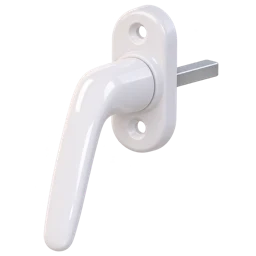
The spindle is the 7 mm square bar that runs from the handle into the gearbox. It wears at the corners, and those corners are what transmit the turning force. Once they round off, the handle turns a few degrees before anything happens, and it rocks in the socket.
Take the handle off and look at the last 10 mm of the spindle. A healthy one has sharp corners and flat sides. A worn one looks polished, rounded or slightly twisted. Compare it with a photograph of a new handle if you are unsure.
Most window handles have the spindle fixed into the handle, so a worn spindle means a new handle. A few have a removable spindle that can be swapped, but those are the exception. Do not wrap the spindle in tape or shim it with card as a long-term fix. It changes the alignment, and the handle can slip when you turn it.
When the gearbox socket is worn
The gearbox is the mechanism inside the sash that the spindle drives. Its square socket can wear just like the spindle, and the two usually wear together.
The tell is a new handle that still rocks, or a lever with a dead zone before the locking cams move. If you have fitted a new handle with a new spindle and the play is still there, the socket is the likely cause.
Gearbox replacement is not a like-for-like handle swap. On most uPVC windows the sash has to come out, and the mechanism is often riveted rather than screwed. That is a specialist job, and it is worth getting a quote before you buy more handles.
Base plate rocking: bent, cracked or badly seated
If the screws are tight and the backplate still rocks, look at the surface it sits on. Paint runs, old silicone, a raised bead or a lump of plaster can hold one end of the plate off the frame, so the handle pivots on that high point.
Take the handle off and run a steel rule or a straight edge across the frame face where it sits. Any rock in the rule is a high spot. Clean it back carefully with a scraper, without gouging the plastic.
Check the backplate itself on a flat surface. A slight bend can sometimes be eased straight, but a cracked plate cannot. Cracks usually start at a screw hole, and a cracked plate will never hold its shape, so replace it.
A gap at one end only, with the other end tight, often means the spindle is not sitting square in the gearbox. Take the handle off, check the socket for debris and refit it straight.
When the sash has dropped
A handle can feel loose because the window has moved, not because the handle has worn. If the sash drops on worn friction stays, the locking cams no longer line up with the keeps, and the lever may feel loose or stiff at the end of its travel.
Open the window and look at the gap around the sash. It should be even on both sides and at the top and bottom. A widening gap at one corner, or a sash that catches on the frame, points to the hinges rather than the handle.
The hinge or handle check walks through that diagnosis, and the friction stay sizes guide covers the replacement parts if the stays are worn.
Repair or replace: which is worth it?
Most loose handles are a fixing problem, and a fixing problem is cheap and quick to solve. The decision changes once the handle itself is worn.
| Situation | Repair possible? | Best next step |
|---|---|---|
| Screws loose, holes sound | Yes | Tighten evenly |
| One stripped hole | Usually | Longer screw, then epoxy repair |
| Both holes stripped or enlarged | Rarely | New handle, or specialist repair |
| Backplate cracked | No | New handle |
| Return spring failed | No | New handle |
| Spindle worn but removable | Yes | New spindle |
| Gearbox socket worn | Not at home | Window specialist |
| Sash dropped | Yes | Adjust or replace the stays |
Window handles are simple parts. If you are spending more than a short while trying to make a worn one hold, a replacement is usually the better use of your time.
How to measure a replacement handle
Order the wrong handle and you will be back where you started, with a loose one and a spare that does not fit. Take five measurements from the old handle before you shop.
- Spindle size. Measure across the square. Espag handles are usually 7 mm.
- Spindle length. Measure from the seating face out to the tip. Spindle lengths are usually 30 mm, 35 mm or 40 mm.
- Screw centres. Run the rule from the centre of one hole to the centre of the other. This is often 43 mm.
- Base shape. A flat base means inline, a stepped one means cranked. If it is cranked, measure the step height as well.
- Locking. Check whether the old handle has a key lock, a push button or no lock at all.
Also check the screw layout, meaning whether the two screws sit one above and one below the spindle or both to one side. Two handles with the same centres can still differ there, and the new one will not cover the old holes. The window handle types guide has the full list if your handle is not an espag.
How to fit a new handle
With the measurements right, fitting takes a few minutes. The dry fit is the part worth slowing down for.
- Open the sash and move the lever to the open position.
- Swivel the cover plate or prise off the cap, and undo the two screws.
- Pull the old handle straight out and check the gearbox socket is clean.
- Slide the new spindle into the socket with the lever set where the old one was.
- Ease the plate down onto the frame. It should meet it evenly, with no rocking.
- Turn the lever through its full travel before fitting the screws. It should clear the frame and stop firmly.
- Tighten the two screws alternately until the plate is firm, then stop.
- Close the cover, close the window and test the lock.
If the plate refuses to sit flat, take the handle off again. Forcing it down with the screws will crack the plate or strip the holes, and you will be repairing the frame as well.
Common mistakes with a loose window handle
- Tightening before diagnosing. If the lever is worn, tightening the base does nothing except add strain.
- Over-tightening. A quarter turn too far crushes the uPVC and strips the thread.
- Using the wrong screwdriver. A loose cross-head tip rounds the screw and makes the next repair harder.
- Fitting a longer screw without checking. A screw that is too long can reach the gearing behind the frame.
- Packing the hole with filler. Wood filler and superglue do not take a screw thread.
- Replacing the handle when the gearbox is worn. The new part will feel just as loose.
- Leaving it loose. A handle that does not drive the cams fully can leave the window unsecured.
When to stop and call a window specialist
Call a specialist if the frame or sash is cracked around the handle, if the screw holes are stripped in a steel reinforcement, or if the gearbox socket is worn. Those repairs need the right insert or a new mechanism, and a failed attempt can damage the frame.
Also stop if the window will not lock after you have fitted a tight handle, if the sash has dropped and the gaps are uneven, or if the window is upstairs and you would be working at an open edge. A window that will not lock is a security risk, so do not leave it while you wait for a part.
How Sparrow helps you replace the right part
Sparrow is an iPhone app made by ThinkingAI Limited that identifies worn household parts from a photo taken next to a pound coin. Photograph the old handle side-on with the coin beside it, so the spindle and the base profile are both visible.
Upload the photo and it estimates the spindle length and screw centres, then lists the espag handles that would fit, along with what to check before ordering. One tap takes you to Screwfix, Toolstation and Amazon UK to compare the exact size. That is useful when the handle is worn but you are not sure whether the fault is the handle, as covered in the handle fault guide.
Frequently asked questions
Why is my window handle loose?
The usual cause is the two fixing screws working loose, or the screw holes in the frame stripping so the screws no longer grip. Less often the handle's return spring, its spindle or the gearbox socket is worn.
Can I just tighten a loose window handle?
Yes, if the screws still grip. Tighten them evenly until the backplate stops moving, then stop. Over-tightening crushes the plastic and strips the hole, which turns a two-minute fix into a repair.
How do I fix a stripped screw hole in a uPVC window?
Try a screw of the same gauge but slightly longer so it bites fresh material. If that fails, fill the hole with a two-part epoxy putty made for rigid plastic, let it cure, drill a pilot hole and refit the screw.
Why does my handle flop but the base is tight?
The return spring inside the handle has failed. Window handles are sealed units with no replaceable cassette, so the fix is a new handle of the same spindle length and screw centres.
Is a loose window handle a security problem?
It can be. A handle that moves may not drive the locking cams fully into the keeps, so the window may not be securely closed. Fix it before you rely on the window being locked.
Will a new handle fix a loose lever?
Only if the wear is in the handle or its spindle. If the square socket in the gearbox is worn, a new handle will still rock, and the gearbox needs attention.
Not sure which one you have?Snap it next to a £1 coin and Sparrow names the exact replacement for upvc window handles, with the measurements to check. Your first scan is free.
Get the appParts guides, Sparrow
We build Sparrow, the iPhone app that identifies worn household parts from a photo taken next to a £1 coin. Our guides cover the six parts Sparrow matches: tap cartridges, euro cylinder locks, uPVC window handles, door handles, shower door seals and window hinges. Every size in a guide is checked against the same parts catalogue the app uses.

