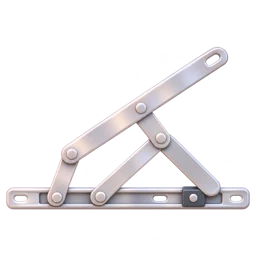
Window hinges · 7 min read
uPVC window won't close properly? Hinge or handle, and what size to buy

By The Sparrow team · Updated 30 November 2026
Sizes checked against the Sparrow parts catalogue · How we write guides
A window that will not shut cleanly is more than a draught. It can rattle, let rain in, or refuse to lock. The good news is that the cause is usually one of two parts: the friction stays that hold the sash, or the handle and locking points that pull it tight. Working out which one comes first, because a new handle will not help a sagging sash, and new hinges will not fix a broken handle.
Why won't your uPVC window close properly?
Most uPVC casement windows hang on two friction stays. These are metal hinges that slide in a track and hold the window open by friction. Over time the rivets and sliding parts wear, the arms loosen and the sash starts to drop or twist. A dropped sash meets the frame at the wrong height, so it rubs, catches, or will not seat against the seals.
Run through these checks before you buy anything:
- Open the window halfway and let go. Does it stay put, drift open or swing shut on its own?
- Close it slowly and watch the opening edge. Does it rub or catch on the frame before it is fully shut?
- Look at the gaps around the closed sash. Are they even all the way round?
- With the window shut, turn the handle. Does it lock easily, or only if you lift or push the sash?
- Open it fully and look at the stays. Are the arms loose, bent, rusty or stiff to move?
Symptom to likely part
| What the window does | Likely cause | Part to look at |
|---|---|---|
| Drops when opened, needs lifting to close | Worn friction stays | Friction stays |
| Catches or rubs on the frame as it closes | Sash dropped or twisted on worn stays | Friction stays |
| Will not stay open, or swings shut | Stays have lost their friction | Friction stays |
| Stiff to open, arms grinding or bent | Damaged or seized stays | Friction stays |
| Shuts flush, but handle will not lock | Broken handle, gearbox, or locking points missing the keeps | Handle, gearbox or keeps |
| Handle spins or is cracked | Broken handle | Window handle |
Is your window side-hung or top-hung?
Friction stays come in two families, and they are not interchangeable. A side-hung window opens like a door, from one side, and its stays sit in the top and bottom of the frame. A top-hung window opens outward from the bottom, and its stays sit in the left and right of the frame. Top-hung stays carry the weight of the sash differently, so always buy the type that matches how your window opens.
Some windows have a tilt and turn action instead, tipping inward from the top as well as opening like a door. These use a different hinge system from standard friction stays, so this guide does not cover them.
Not sure which one you have?Snap it next to a £1 coin and Sparrow names the exact replacement for window hinges, with the measurements to check. Your first scan is free.
Get the appHow do you measure friction stays?
Friction stays are sold by the length of the track, in inches, plus the stack height in millimetres.
- Open the window so you can see the track the stay slides in.
- Measure the track length from end to end. It is most accurate with the window closed or the stay removed, because an open stay can make it hard to see the ends.
- Measure the stack height: how far the stay stands up from the frame. It is usually 13 mm or 17 mm.
- Check for markings on the old stay and any special features (see the next section).
| Measurement | Common sizes |
|---|---|
| Side-hung track length | 10" · 12" · 16" · 20" |
| Top-hung track length | 12" · 16" · 20" · 24" |
| Stack height | 13 mm or 17 mm |
The wrong stack height stops the sash sitting at the right depth in the frame, so it will not seal or lock properly even with brand new stays. For more detail, see the window friction stay size guide. You can also photograph the stay on its track next to a £1 coin in Sparrow, which estimates the length against the coin and shows the matching size.
Egress and easy-clean stays: do you have one?
Two special types look much like standard stays but behave differently:
- Egress stays open wider to give a clear escape route in a fire. They are often fitted on bedroom windows and other windows that could be used to get out. If your old stay is an egress type, replace it with an egress stay of the same size.
- Easy-clean stays let the sash move across as it opens, leaving a gap at the hinge side so you can reach the outside of the glass from indoors.
Open the window fully and compare how it moves with the description above. If the sash slides across to leave a gap at the hinge side, it is likely easy-clean. If you are unsure whether a window is meant to be an escape route, keep the same type as the old stays.
When is it the handle or keeps, not the hinge?
If the window swings shut cleanly and sits flush against the frame, the stays are probably fine. The problem is more likely in the locking side. The handle turns a gearbox inside the sash, which slides the locking points along. These locking points hook into metal keeps screwed to the frame. A loose or moved keep, a broken handle, or a failed gearbox can all stop a window locking even though it closes.
A handle that spins freely or is cracked needs replacing; a handle that turns but leaves the locking points still points to the gearbox. Our guide to a uPVC window handle that won't turn or lock walks through those tests, and the window handle size guide covers spindle length and screw centres.
Replacing friction stays safely
- Replace them in pairs. Both stays on a window wear together, and a new one paired with a worn one leaves the sash uneven.
- Support the sash. Once the screws are out, the sash is free and can fall. Have a helper hold it the whole time it is off its stays.
- Use the old holes. Where the new stay lines up with the existing screw holes, use them, with stainless steel screws.
- Test before you finish. The window should shut evenly and the handle should lock without lifting or pushing.
If the window is upstairs, large or heavy, or the glass is damaged, a window specialist is the safer choice. The same applies if a window you rely on as an escape route will not open or close properly.
Frequently asked questions
Why won't my uPVC window close properly?
The most common cause is worn friction stays, which let the sash drop so it catches on the frame. If the window shuts flush but will not lock, the handle, locking points or keeps are more likely.
How do I know if my window hinges are worn?
Signs include a window that drops when opened, will not stay open in a breeze, swings shut on its own, rubs on the frame, or needs lifting to close. Stiff or loose arms and visible rust on the stay are also clues.
What size friction stay do I need?
Measure the track length end to end in inches. Side-hung stays are commonly 10, 12, 16 or 20 inch, and top-hung stays 12, 16, 20 or 24 inch. Also match the stack height, usually 13 mm or 17 mm.
Should I replace both window hinges?
Yes. Each window has two stays and they wear together. Replacing both keeps the sash level and closing evenly.
What are egress and easy-clean friction stays?
Egress stays open wider to give a clear escape route, often on bedroom windows. Easy-clean stays let the sash move across so you can reach the outside of the glass from inside. If your old stay is one of these, replace it with the same type.
Can I replace friction stays myself?
Many people do, with a helper to hold the sash. If the window is large, heavy or upstairs, or you are unsure, a window specialist is the safer choice.
Not sure which one you have?Snap it next to a £1 coin and Sparrow names the exact replacement for window hinges, with the measurements to check. Your first scan is free.
Get the appParts guides, Sparrow
We build Sparrow, the iPhone app that identifies worn household parts from a photo taken next to a £1 coin. Our guides cover the six parts Sparrow matches: tap cartridges, euro cylinder locks, uPVC window handles, door handles, shower door seals and window hinges. Every size in a guide is checked against the same parts catalogue the app uses.

