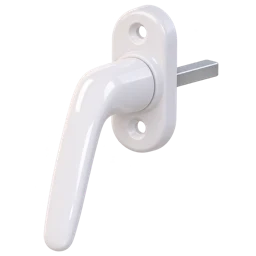
uPVC window handles · 14 min read
Inline vs cranked window handle: the difference

By The Sparrow team · Updated 30 November 2026
Sizes checked against the Sparrow parts catalogue · How we write guides
You have the old handle in your hand and two listings that look the same apart from one word. The base is the difference, and it decides whether the new handle turns freely or scrapes the frame every time you open the window.
What is the difference between an inline and a cranked window handle?
Both are espag handles. An espag handle has a square spindle that slots into a gearbox in the window sash, and turning the lever drives the locking cams along the opening edge. The base decides which of the two you need, not the shape of the lever.
An inline handle has a flat backplate. The lever pivots close to that plate, so the handle sits low against the window face and the lever runs almost parallel to the frame.
A cranked handle has a step built into the base. The pivot is raised and set out, so the lever runs above the window face with a gap beneath it. That gap is the step height, measured in millimetres.
Everything else can be identical: the same 7 mm square spindle, the same spindle length, the same screw centres and the same finish. Some sellers call a cranked handle an offset handle. It is the same part, so read the base shape rather than the label.
Why does a cranked window handle exist?
A lever needs room to swing. To lock an espag window you turn the handle through about 90 degrees, and the lever sweeps an arc as it goes. On a flat, clear window face an inline handle has all the room it needs.
If something sits in that arc, the lever hits it before the turn is finished. A deep frame, a projecting bead or a raised trim can all cause it. So can a reveal that comes forward of the sash, or a handle fitted close to the corner of the frame. When the lever stops early, the locking cams stop short too, so the window may not pull in tight or lock at all.
A cranked base lifts the lever over the obstruction. The step is not decoration and it is not an upgrade. It is a clearance dimension chosen for the window it was fitted to. That is why you match it rather than pick the handle that looks better.
When do you need a cranked window handle?
Ask one question: does the lever have a clear arc through its full travel? The answer decides the handle.
- The old handle is cranked. Replace like for like. The window was made with that clearance.
- The old handle is inline and the lever sweeps nothing. An inline handle will fit, and it keeps the window looking as it did.
- The lever passes over a raised bead, trim or sill upstand. You need the crank, even if the old inline handle was forced over it.
- The sash is set back in a deep reveal. A cranked handle brings the lever out where your hand can reach it.
- The handle sits near a frame return. The lever needs to clear the corner as it turns.
If the window has been altered, for example new beading or a trim panel added, check the arc again. A handle that worked before the change may no longer clear.
| Window situation | Base needed | Why |
|---|---|---|
| Flat sash face, lever clear all round | Inline | Lowest profile and the simplest match |
| Sash set back in a deep reveal | Cranked | Brings the lever out to a usable position |
| Projecting bead or trim in the lever arc | Cranked | Lifts the lever over the obstruction |
| Handle close to a frame return | Cranked | Lets the lever finish its turn |
| Window that also tips inward | Neither | A tilt and turn handle is a different part |
A tilt and turn handle looks similar but has a different action and often a longer spindle, so do not use this guide to choose one. Measure it as a tilt and turn part.
How to tell if your handle is inline or cranked
Look at the handle from the side, with your eye level with the window edge. The difference is obvious from that angle and almost invisible from the front.
- Run a thumb under the lever at the pivot end. If the lever sits close to the frame with no gap, it is inline. If there is a clear gap you can put a finger into, it is cranked.
- Look at the backplate. A flat plate with two screw holes is inline. A plate with a raised bridge or a step between the screws is cranked.
- Look for a dirt line. An old cranked handle often leaves a shadow line on the frame where the base stepped away.
- Look at the lever height. A cranked lever stands noticeably taller than an inline one on the same window.
Do not judge by the lever. Long levers, short levers, curved levers and straight levers all come in both bases. The base is the only reliable clue.
Not sure which one you have?Snap it next to a £1 coin and Sparrow names the exact replacement for upvc window handles, with the measurements to check. Your first scan is free.
Get the appInline, cranked or cockspur: which type do you have?
Inline and cranked only describe espag handles. If the handle has no square spindle, it is a different type and the measurements above do not all apply.
A cockspur handle has a hooked tip that pulls the window against a wedge fixed to the frame. There is no spindle, so spindle length is not a measurement you need. Cockspurs are left- or right-handed, judged from inside with the window closed, and the screw centres are the main figure to match.
A tilt and turn handle looks like an espag from the front, but the window also tips inward from the top. The handle has a different action and often a longer spindle, so measure it as its own type rather than forcing an espag measurement onto it.
| Type | What you see | What to measure |
|---|---|---|
| Espag, inline | Square spindle, flat base | Spindle, length, screw centres |
| Espag, cranked | Square spindle, stepped base | The same, plus step height |
| Cockspur | Hooked tip, no spindle | Hand and screw centres |
| Tilt and turn | Square spindle, deeper body | Spindle length and screw centres |
The guide to uPVC window handle types covers the cockspur and tilt and turn fittings in more detail if the old handle does not match either espag pattern.
How to measure the step height on a cranked handle
The step height is the distance between the face that sits on the window and the underside of the lever. Measure it with the handle off the window, where you can get a straight edge against it.
- Open the window and turn the handle to the open position.
- Swivel the cover plate at the base, or prise off the screw cap, and undo the two screws.
- Pull the handle straight out of the frame and wipe the base clean.
- Stand the handle on its backplate on a flat worktop, with the lever pointing away from you.
- Lay a straight edge across the flat face of the backplate.
- Measure from the straight edge up to the underside of the lever, close to the pivot. That figure is the step height in millimetres.
If the handle is still on the window, you can get a close enough figure by sliding a steel rule into the gap between the window face and the underside of the lever at the pivot end. Measure at the pivot, not at the tip, because many levers taper or curve.
Write the number down and keep the old handle until the new one is fitted. A photograph of the handle side-on, with a coin beside it for scale, also helps you compare listings.
How to measure spindle length and screw centres
Three measurements decide whether the handle fits: the spindle, the spindle length and the screw centres. Take all three from the old handle, even if the listing only asks for one.
- Spindle size. Measure across the square. Most espag handles use a 7 mm square spindle.
- Spindle length. Measure from the flat face that sits on the window to the tip of the spindle. Common lengths are 30, 35 and 40 mm.
- Screw centres. Measure from the centre of one screw hole to the centre of the other. On espag handles this is often 43 mm.
- Screw layout. Note whether the screws sit one above and one below the spindle, or both to one side. A handle with the same centres but a different layout will not cover the old holes.
- Locking. Note whether the old handle has a key lock or a push button. A locking handle has a small keyhole or button on the lever.
- Finish. White, chrome, satin, gold or anthracite, so the new one matches the rest of the house.
| Measurement | Where to measure | Typical figure |
|---|---|---|
| Spindle | Across the square section | 7 mm |
| Spindle length | Seating face to spindle tip | 30 / 35 / 40 mm |
| Screw centres | Centre of one hole to the centre of the other | Often 43 mm |
| Step height | Seating face to underside of lever | Measure your own |
| Base | Flat or stepped | Inline or cranked |
Does a cranked handle need a longer spindle?
Usually not. On a cranked handle the step raises the lever, not the spindle. The spindle still comes out of the face that sits on the window, so its length is measured from that same face.
This is a common measuring mistake on cranked handles. If you measure from the top of the step instead of the seating face, you add the step height to the spindle length. The handle then arrives with a spindle that is too long, will not sit flat, and cannot be screwed down.
Check it this way: hold the old handle with the spindle pointing down at the window. The flat face of the backplate should touch the frame, and the spindle should enter the gearbox socket by roughly the same amount as the old one did. If the backplate stands off before the spindle is fully home, the spindle is too long.
How closely does the step height need to match?
Match it as closely as the listings allow. The step decides how much room the lever has, so a step that is too small can still let the lever catch the frame.
A step that is a little larger than the old one usually works, because the lever simply sits further out. Check that it still clears the frame at both ends of the turn and that it does not foul a blind, a curtain or the window next to it.
A step that is smaller than the old one is the risk. The lever sits closer to the frame, and any bead, trim or deep reveal that the old crank cleared may now be in the way. If you cannot find the exact figure, choose the larger step rather than the smaller one, then test the lever arc before you screw the handle down.
If the listing gives no step figure at all, compare the overall height of the handle from the backplate to the top of the lever. That is not the step, but it is a fair guide when two handles are otherwise the same.
Inline vs cranked: side by side
The two handles share the same fitting and the same spindle. Only the base changes, and that changes where the lever sits.
| Feature | Inline | Cranked |
|---|---|---|
| Base | Flat backplate | Stepped or raised backplate |
| Lever position | Close to the window face | Held out on a step |
| Clearance under the lever | Little or none | Equal to the step height |
| Typical use | Flat sash faces with a clear arc | Deep frames, beads and tight corners |
| What to measure | Spindle, length, screw centres | The same, plus step height |
| If fitted wrongly | Lever fouls the frame and the turn stops short | Lever stands proud and may catch blinds or trim |
On a flat window, an inline handle looks neater and sits closer to the frame. On a window that needs a crank, that neatness is exactly the problem, because there is nowhere for the lever to go.
What happens if you fit the wrong one?
An inline handle on a window that needs a crank is the worse mistake. The lever meets the frame part way through the turn. The handle feels stiff, then stops. The locking cams never reach the keeps, so the window does not pull in and may not lock. Forcing it strains the backplate, works the screws loose and can round the spindle.
A cranked handle on a flat window usually still works, because the extra clearance does no harm to the mechanism. The problems are practical: the lever stands proud of the frame, it can catch a blind or curtain, and it may foul an adjacent opening light. It also looks wrong on a window that was designed for a low-profile handle.
| What you notice | Likely cause | What to do |
|---|---|---|
| Lever stops before it is fully down | Inline base on a window that needs a crank | Change to a cranked handle |
| Window will not lock, but the handle turns | Turn not completed, or gearbox worn | Check the lever arc first, then the gearbox |
| Backplate will not sit flat | Spindle too long, or wrong base shape | Re-measure the spindle from the seating face |
| Handle rocks on the frame | Screws loose, or base not seated | Tighten, then check the base for distortion |
| Lever catches the blind | Cranked base on a flat window | Fit an inline handle if the arc allows |
How to fit a replacement espag handle
Fitting is a quick job with one screwdriver. The part that takes care is the dry fit, before the screws go in.
- Open the window fully and turn the handle to the open position.
- Swivel the cover plate at the base, or prise off the screw cap, to reach the two screws.
- Hold the handle and undo both screws. Do not let it drop onto the sill.
- Pull the handle straight out. If it resists, check for a third screw or a grub screw under the lever.
- Look into the spindle hole. The square socket in the gearbox should be clean and sharp, with no broken spindle left inside.
- Offer the new handle up with the lever in the same position as the old one, and slide the spindle into the socket.
- Press the backplate against the window. It should sit flat with no rocking and no gap.
- Fit both screws finger tight, then nip them up evenly. Stop before the plastic starts to crush.
- Close the cover plate and test the handle through its full turn.
If the backplate rocks at step 7, stop. Do not pull it down with the screws. A rocking base means the spindle is too long, the base shape is wrong, or there is debris in the socket, and tightening will only crack the plate or strip the holes.
How to test the handle before you screw it down
A dry fit takes a minute and saves a return. Slide the new handle into place with no screws and turn it through the full travel.
- Clearance. Watch the gap between the lever and the frame at both ends of the turn. It should stay open all the way.
- Positive stop. The lever should stop at the end of its travel because the mechanism has reached its limit, not because it has hit the frame.
- Flat base. The backplate should touch the window all round. Slide a fingernail under it to check.
- Spindle engagement. The handle should not pull out easily once the spindle is in the socket.
Only then fit the screws. After tightening, close the window and turn the handle to lock. You should feel the cams pull the sash in and the lever should finish with a firm stop.
Common mistakes when choosing inline or cranked
- Measuring the spindle from the top of the step. This adds the step height and gives a spindle that is too long.
- Judging by the lever. Lever shape tells you nothing about the base.
- Ordering by screw centres alone. Two handles can share 43 mm centres and still have a different base and spindle length.
- Assuming every window in the house matches. A bay, a bathroom window and a large casement can all use different handles.
- Forcing an inline handle over a bead. If the lever scrapes, the base is wrong, not stiff.
- Over-tightening the screws. uPVC crushes, the thread strips and the handle comes loose again.
- Throwing the old handle away too soon. Keep it until the new one is fitted and working.
When to stop and call a window specialist
Some faults are not handle faults, and a new handle will not fix them. Stop if the new handle sits flat and turns freely but the window still will not lock, because the gearbox or the keeps are then the likely cause.
Call a specialist if the spindle socket in the gearbox is rounded, if a broken spindle will not come out, if the frame or sash is cracked around the handle, or if the window has dropped and the handle no longer lines up with the keep. A window that has dropped is usually a hinge fault, and the hinge or handle check explains how to tell the difference. Also stop if the window is above ground floor and you would be leaning out to work on it. A fall from an upstairs window causes serious injury, and a window specialist has the right access equipment.
How Sparrow helps you get the base right
Sparrow is an iPhone app made by ThinkingAI Limited that identifies worn household parts from a photo taken next to a pound coin. Lay the old window handle on a flat surface, put the coin beside it and photograph it side-on so the base profile shows.
The app names the part, estimates the spindle length and screw centres against the coin, and shows the matching espag spec with the checks to make before you buy. It also links searches at Screwfix, Toolstation and Amazon UK, so you can compare the step height on real listings. The same method works for any part in the house, as explained in identifying a replacement part from a photo, and the guide to uPVC window handle types and sizes covers the rest of the measurements.
Frequently asked questions
Can I replace a cranked window handle with an inline one?
Only if the lever still has a clear arc through its full turn. On most windows that had a cranked handle, an inline lever will hit the frame before the locking points engage, so fit cranked to match.
How do I measure the step on a cranked handle?
With the handle off the window, stand it on its backplate on a flat surface and measure from that face up to the underside of the lever close to the pivot. Quote the figure in millimetres when you order.
Is a cranked handle longer than an inline one?
The spindle is usually the same length. The difference is the height of the pivot above the window face, which is the step height.
What is an offset window handle?
Offset is another word sellers use for cranked. Check the base shape in the listing rather than the name on it.
Do espag handles come left and right handed?
No. The same espag handle fits either side of a window. Handing matters on cockspur handles, which have a hook instead of a spindle.
Why does my new handle not sit flat on the window?
Usually the spindle is too long, the base shape is wrong, or a piece of the old spindle is still in the gearbox socket. Take the handle off and check all three.
Not sure which one you have?Snap it next to a £1 coin and Sparrow names the exact replacement for upvc window handles, with the measurements to check. Your first scan is free.
Get the appParts guides, Sparrow
We build Sparrow, the iPhone app that identifies worn household parts from a photo taken next to a £1 coin. Our guides cover the six parts Sparrow matches: tap cartridges, euro cylinder locks, uPVC window handles, door handles, shower door seals and window hinges. Every size in a guide is checked against the same parts catalogue the app uses.

