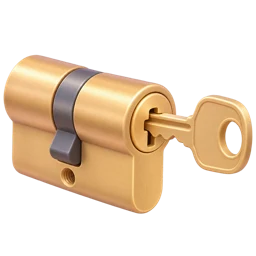
Euro cylinder locks · 14 min read
40/50 Euro Cylinder Thumbturn: What It Fits and How to Measure

By The Sparrow team · Updated 30 November 2026
Sizes checked against the Sparrow parts catalogue · How we write guides
Thumbturn cylinders are the ones people notice. You come in with shopping, turn the knob and the door opens without hunting for a key. Then the knob starts to rub, or the key gets stiff, and the lock has to come out. This guide is about the 40/50 size: the doors it belongs on, the measurement that matters, the inside clearance people forget, and the 90 mm mix-up that sends the wrong cylinder through the letterbox.
What is a 40/50 euro cylinder thumbturn?
It is a euro cylinder with a key on the outside and a turn knob on the inside. The numbers work exactly as they do on a key/key cylinder: the fixing screw through the door edge is the datum, and the two lengths run from its centre to each end.
On this size the outside length is 40 mm and the inside length is 50 mm. That makes the cylinder 90 mm from end to end, with the screw 5 mm outside the midpoint. The extra 10 mm on the inside is there for the knob and the deeper furniture that usually goes with it.
| Feature | Detail on a 40/50 | Why it matters |
|---|---|---|
| Outside length | 40 mm | Sets how far the key end sits from the handle |
| Inside length | 50 mm | Gives the thumbturn knob room |
| Overall length | 90 mm | Shared with 45/45 and other pairs |
| Screw position | 40 mm from the outside end | The part that must match your door |
| Turn side | Inside only | The cylinder is not reversible |
A thumbturn is not a different fitting. It uses the same fixing hole, screw and cam as a key/key cylinder. The cam is the lever that throws the lock. The difference is what you operate on the inside face.
Which doors use a 40/50 thumbturn?
The size turns up on doors that are thicker than a standard uPVC front door, or that have deeper furniture on the inside. Composite doors are the usual home, because the slab is thicker and the internal handle backplate often stands further off the face.
Some uPVC doors with a deep internal backplate also take it. So do doors where a previous lock was changed for a thumbturn and the inside was built out to clear the knob. The size is a fit to the door, not a style choice.
| Door type | Likely to take 40/50? | Reason |
|---|---|---|
| Composite front or back door | Yes, common | Thicker slab and deeper inside furniture |
| uPVC door with deep internal backplate | Sometimes | Inside length needed for the handle and knob |
| Standard uPVC front door | Usually not | 35/45 or 40/40 is more common |
| Timber door with a euro lock case | Possible | Depends on the lock case and door thickness |
| Flat entrance door | Possible | Check the door certificate before changing hardware |
Two doors of the same make and model can take different sizes if the handles were changed. Measure each one rather than ordering two of the same.
40/50 or 45/45? The 90 mm trap
Both sizes are 90 mm overall, and both are sold as composite-door cylinders. The difference is where the fixing screw sits. On a 40/50 it is 40 mm from the outside end. On a 45/45 it is 45 mm from the outside end, right in the middle.
Put a 45/45 into a door drilled for a 40/50 and the screw hole is 5 mm out. The cylinder may slide into the door, but the screw will not reach the tapped hole. The same happens the other way round. The overall length tells you nothing about whether the screw will line up.
| Size | Overall | Screw from outside | Outside length | Inside length |
|---|---|---|---|---|
| 40/50 | 90 mm | 40 mm | 40 mm | 50 mm |
| 45/45 | 90 mm | 45 mm | 45 mm | 45 mm |
| 40/45 | 85 mm | 40 mm | 40 mm | 45 mm |
| 45/50 | 95 mm | 45 mm | 45 mm | 50 mm |
The practical rule: buy by the pair, never by the total. If a listing only gives 90 mm, ask the seller for the outside and inside lengths before you order.
How much room does the thumbturn need?
The knob has to turn through a full circle, and your fingers have to reach it. That sounds obvious until the door is closed and the knob is 2 mm from the handle. Check the clearance with the door shut, not open.
Look at four things: the inside handle, the backplate around the cylinder, the door frame or rebate, and anything fixed near the door such as a chain or a coat hook. A knob that clears the handle when the door is open can still catch the frame when it closes.
| Obstruction | What happens | What to check |
|---|---|---|
| Inside lever handle | Knob clips the lever as it turns | Gap between knob and handle at every point of the turn |
| Deep backplate | Knob sits recessed and is hard to grip | Knob stands proud enough to hold |
| Door frame or rebate | Knob catches when the door closes | Clearance with the door shut |
| Door chain or limiter | Knob cannot complete the turn | Move the fitting or choose key/key |
If the gap is tight, the next size up on the inside may help, but only if the outside length stays right. Never add inside length by buying a longer outside as well.
Not sure which one you have?Snap it next to a £1 coin and Sparrow names the exact replacement for euro cylinder locks, with the measurements to check. Your first scan is free.
Get the appHow to measure for a 40/50 thumbturn
Measure the old cylinder in the door if it still turns, or take it out for a cleaner reading. Work in millimetres and keep the outside and inside figures separate.
- Find the fixing screw. It passes through the door edge at keyhole height. Remove any cap or trim over it.
- Measure to the outside end. From the centre of the screw hole to the outside face of the cylinder. This should read about 40 mm.
- Measure to the inside end. From the same centre to the inside face, where the knob sits. This should read about 50 mm.
- Write the pair down. If the readings are 40 and 50, the size is 40/50. Do not add the two numbers and buy by the total alone.
- Confirm the type. A knob on the inside means thumbturn. A keyhole means key/key, even if the size is the same.
- Check the knob clearance. Close the door and turn the knob through its full travel before you order.
Measuring when the old cylinder is missing or snapped
You can still find the size without a complete cylinder, but you are measuring the door rather than the lock. With the door open, find the fixing screw hole in the door edge and measure from its centre to the outside face of the handle or backplate. Then measure to the inside face of the internal backplate.
Those two figures are the lengths the new cylinder has to bridge. Compare them with the standard sizes and choose the pair that sits flush. On the outside, never round up past about 3 mm proud. On the inside, a thumbturn can take a little extra length if the knob needs clearance, but not so much that the knob stands far off the door.
If the cylinder has snapped or the door is locked, stop and call a locksmith. Do not try to drill or force the lock. The guide to euro cylinder size for door thickness covers measuring from the door itself in more detail.
If your door measures between two sizes
Very few doors measure exactly 40 mm and 50 mm. Paint, a slightly recessed backplate or a worn cylinder end can put you at 41/49 or 39/50. Cylinders are sold in 5 mm steps, so you have to choose the nearest sensible pair rather than the exact reading.
On the outside, round down. A 41 mm outside length is a 40 mm in practice, because a cylinder that sits 1 mm inside the handle face is fine. Rounding up to 45 mm would leave the end proud by about 4 mm, which is past the working limit.
On the inside, a thumbturn gives you a little more freedom, but only within the pairs that keep the same outside length. From a 40/50 there is no longer 40 mm-outside size in the common range, so if the knob is tight the answer is usually to adjust or change the handle, not to buy a 45/50. That size has a 45 mm outside and a different screw position, so it will not fit the same door.
Write both readings down before you round. If you later find the new cylinder is tight, the original figures tell you which side to change.
Thumbturn or key/key on the inside?
The size does not decide this. What you want on the inside face does. A thumbturn lets you open the door from indoors without a key. A key/key needs a key on both sides.
For a back door, a thumbturn is often the practical choice, especially for anyone who struggles with small keys. For a front door, some households prefer a key on both sides so the door cannot be opened from indoors without one. Both are available in 40/50.
| Question | Choose thumbturn if | Choose key/key if |
|---|---|---|
| How do you leave the house? | You want to turn a knob, not find a key | You are happy to use a key every time |
| Who uses the door? | Children, older people or anyone who finds keys fiddly | Everyone carries a key as a habit |
| What is on the inside face? | There is room for a knob to turn | The handle or furniture is tight to the cylinder |
| How do you want it locked? | You want a quick exit without a key | You want a key needed on both sides |
Once you choose, the type is fixed. A thumbturn body cannot be converted to key/key, and a key/key body cannot be turned into a thumbturn.
Does the thumbturn always go on the inside?
Yes. The knob is made to sit on the inside face, and the key side goes outside. That is not a convention you can swap. The body is machined with the turn mechanism on one end and the keyway on the other.
Ordering is where this goes wrong. The turn must be on the inside end, and on a 40/50 that is the 50 mm end. Check the product description and the label on the box before you fit it. If the knob is on the 40 mm end, the cylinder is not the 40/50 you ordered.
When the cylinder arrives, hold it the way it will sit in the door. The knob should be at the end that faces into the room, and the key should be at the end that faces outside. If that is not what you have, send it back rather than trying to make it fit.
What to check before you order
These are the checks that separate a cylinder that fits first time from one that comes back out. Do them with the old lock in your hand and the door closed.
- The pair, not the total. 40/50, not just 90 mm.
- The screw position. 40 mm from the outside end. Check it against the old cylinder.
- The type. Thumbturn on the inside, key on the outside.
- The handing. Confirm the knob is on the inside end before you pay.
- The outside fit. Flush with the handle or no more than about 3 mm proud.
- The inside clearance. Knob turns a full circle with the door shut.
- The rating. TS007 3-star or Sold Secure SS312 Diamond if you want a security-rated cylinder, in the 40/50 size.
- The finish and keys. Match the handle and count the keys you need.
- The door hardware. A loose handle or worn backplate can make a new cylinder feel wrong. Fix that at the same time.
Which security rating should a thumbturn have?
A thumbturn is rated the same way as a key/key cylinder. TS007 is the UK standard for replacement euro cylinders and associated hardware. Three stars means the cylinder passes on its own. One star means it needs 2-star handles to reach the same level.
Sold Secure SS312 Diamond is a separate independent test that includes snapping. Diamond is the top grade in that scheme. The rating is marked on the cylinder or the packaging, so check before it goes in the door.
| Marking | What it tells you | Check on a thumbturn |
|---|---|---|
| TS007 3-star | Cylinder rated on its own | Marking present on the body or box |
| TS007 1-star | Needs 2-star handles | Handles must carry the 2-star mark |
| SS312 Diamond | Independent top grade | Often shown alongside TS007 |
| No marking | Basic cylinder | Fine only if you accept the lower rating |
A thumbturn is operated from inside, so the outside end is the part exposed on the door face. The rating matters as much as it does on a key/key cylinder. Read how anti-snap cylinders work before you choose on price alone.
Fitting a 40/50 thumbturn
Fitting is the same sequence as any euro cylinder, with one extra check at the end for the knob. Keep the door open until you have tested both sides.
- Compare old and new. Lengths, screw position and the side the knob sits on should all match.
- Insert the key into the new body. Turn it slightly so the cam lines up with the cylinder.
- Slide it into the door. The 50 mm knob end goes inside. Keep the key in until the cylinder is home.
- Align the screw hole. Look through the door edge and centre the tapped hole in the cylinder.
- Fit the screw. Hand tight first, then snug. Overtightening can bind the cam and make both the key and the knob stiff.
- Test the knob with the door open. It should turn smoothly through its full travel and throw the cam.
- Test the key from outside. The key should turn without force and lock or unlock the door.
- Close the door and test again. Check the knob clears the handle and frame, then lift the handle and check the multipoint locks engage. Those are the hooks and bolts along the door edge.
If the door will not lock with the handle up, the cylinder may be fine and the fault elsewhere. The guide to finding which part stops a uPVC door locking helps narrow it down.
Troubleshooting a 40/50 thumbturn
Most faults show up in the first day. Work through the simple causes before you take the cylinder out again.
| Symptom | Likely cause | What to do |
|---|---|---|
| Knob rubs the handle | Inside length too short, or handle fitted too close | Check the gap with the door shut, then look at the handle position |
| Knob is stiff | Fixing screw too tight, or cam binding | Slacken the screw a quarter turn and retest |
| Key will not turn while the knob is turned | Knob left between positions | Turn the knob fully to its stop, then use the key |
| Key goes in but will not turn | Wrong key, or cam not engaged | Check the key and the cylinder position |
| Knob turns but the door stays shut | Cam not throwing the lock case | Check alignment, then the multipoint mechanism |
| Cylinder stands proud outside | Outside length too long | Measure again and size down on the outside |
If the knob has play in it or feels loose on the spindle, the cylinder is worn or faulty. A new one should feel firm with no rattle.
Common mistakes with a 40/50 thumbturn
- Buying a 45/45 because both are 90 mm overall.
- Measuring the total and halving it, which ignores the 5 mm offset.
- Ordering a thumbturn for the wrong side of the door.
- Forgetting to check knob clearance with the door closed.
- Rounding a 40/45 up to 40/50 without checking the outside fit.
- Copying a cylinder that already stood proud.
- Choosing a basic cylinder when a rated one is available in the same size.
The 40/50 and 45/45 mix-up is the one to watch. If the listing does not state the outside and inside lengths separately, do not order until it does.
When to stop and call a locksmith
Stop if the door is locked shut, the cylinder has snapped, or the key has broken inside it. Those need a locksmith, not a new cylinder from a shop. Forcing the door can damage the multipoint mechanism and turn a small job into a large one.
Call a professional if the cylinder spins in the door, if the mechanism grinds when you lift the handle, or if the door is a fire door. Fire doors are covered by a certificate, and a qualified installer decides what hardware can replace what is fitted.
If the door opens and the only problem is a worn thumbturn or a stiff key, a like-for-like swap in the right size is a reasonable DIY job.
Keeping the size on record
Write the size, type and date somewhere you can find it. A photo of the old cylinder beside a ruler, taken before it is thrown away, makes the next order a copy and paste rather than a measuring session.
If several doors in the house use thumbturns, note each one separately. Front and back doors often differ, and a composite door can change size when the handles are replaced.
Sparrow is an iPhone app made by ThinkingAI Limited that identifies worn household parts from a photo taken next to a one pound coin. For a cylinder, you photograph the door edge with the coin held flat so the lock and fixing screw are both visible. The app estimates the outside and inside lengths, shows the matching spec and lists the checks before you buy. It helps you order with confidence; it does not fit the lock for you.
For the rest of the size range, see the euro cylinder sizes chart. If you are replacing the whole lock rather than just the barrel, the euro cylinder replacement guide covers the tools and the order of work.
Frequently asked questions
What does 40/50 mean on a thumbturn cylinder?
40 mm from the centre of the fixing screw to the outside end and 50 mm to the inside end, so 90 mm overall. The thumbturn knob is on the 50 mm side, which must face into the room.
Is 40/50 the same as 45/45?
No. Both are 90 mm overall, but the fixing screw sits 40 mm from the outside on a 40/50 and 45 mm from the outside on a 45/45. The screw hole will not line up if you swap them.
Which doors use a 40/50 thumbturn?
Thicker composite doors and some uPVC doors with deep inside furniture. It is common where the inside face needs more length than the outside, and where the household wants to open the door from inside without a key.
Can I put the thumbturn on the outside?
No. A thumbturn cylinder is made with the key side out and the turn side in. Reversing it puts the screw hole in the wrong place and leaves the knob where it should not be.
How much clearance does a thumbturn need?
Enough for the knob to turn a full circle without touching the handle, backplate, door chain or frame. Check with the door closed, because the frame can be closer than it looks with the door open.
What if my door measures 40/45?
That is 85 mm overall and a different size. Do not round up to 40/50 unless the extra 5 mm on the inside is needed and the outside still sits no more than about 3 mm proud.
Not sure which one you have?Snap it next to a £1 coin and Sparrow names the exact replacement for euro cylinder locks, with the measurements to check. Your first scan is free.
Get the appParts guides, Sparrow
We build Sparrow, the iPhone app that identifies worn household parts from a photo taken next to a £1 coin. Our guides cover the six parts Sparrow matches: tap cartridges, euro cylinder locks, uPVC window handles, door handles, shower door seals and window hinges. Every size in a guide is checked against the same parts catalogue the app uses.

