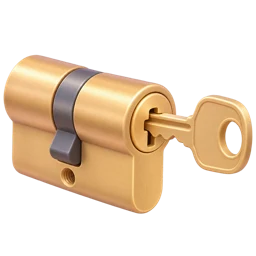
Euro cylinder locks · 7 min read
How to change a euro cylinder lock on a uPVC door

By The Sparrow team · Updated 30 November 2026
Sizes checked against the Sparrow parts catalogue · How we write guides
Maybe the key has started to stick, you have moved in and do not know who else has a key, or you want a better rated lock. Whatever the reason, swapping a euro cylinder is one of the easier jobs on a uPVC door. It needs one screwdriver, the working key and about 15 minutes. The main risk is buying the wrong size, so the measuring step matters as much as the fitting.
Before you start: can you do this yourself?
This job assumes three things: you can open the door, you have a key that turns the old cylinder, and the cylinder is not damaged. If all three are true, carry on.
If you are locked out, the key has snapped in the lock, or the cylinder is seized and the key will not turn, stop here and call a locksmith. Getting a cylinder out without a working key needs specialist tools, and forcing it can damage the lock case inside the door, which is a much bigger repair.
Tools you need
| Item | Why you need it |
|---|---|
| Screwdriver (usually Phillips or Pozidriv) | To undo and refit the long fixing screw in the door edge |
| Ruler or tape measure in millimetres | To measure the old cylinder from the screw centre to each end |
| The working key | To turn the cam so the cylinder can slide out |
| The new cylinder and its keys | The same outside/inside size as the old one |
| Something to wedge the door (optional) | So the door cannot swing shut while you work |
How to remove the old cylinder
- Open the door and keep it open. Wedge it if it tends to swing. Do not close it at any point until the new cylinder has been tested.
- Find the fixing screw. Look at the edge of the door, on the metal faceplate. The long screw level with the keyhole is the one that holds the cylinder.
- Undo the screw fully and put it somewhere safe. It is often quite long because it passes right through the lock case.
- Line up the cam. Put the key in and turn it slightly, about 10 to 15 degrees, either way. The cam is the small lever in the middle of the cylinder. When it lines up with the body, the cylinder is free.
- Slide it out. Hold the key and pull gently. The cylinder should slide out of the door. If it catches, turn the key a touch the other way and try again.
Not sure which one you have?Snap it next to a £1 coin and Sparrow names the exact replacement for euro cylinder locks, with the measurements to check. Your first scan is free.
Get the appMeasure the old cylinder and buy the same size
With the cylinder on a table, measure from the centre of the screw hole to the outside end, then to the inside end. Write it outside/inside, for example 35/45. Do not measure the overall length and halve it, because many doors are offset and the hole is not in the middle.
Check whether the inside end has a keyhole (key/key) or a knob (thumbturn), and buy the same type unless you want to change it. Common sizes run from 30/30 to 50/50 in 5 mm steps, with 35/45, 40/40 and 40/50 on many uPVC doors. Our guide on how to measure a euro cylinder lock goes into more detail, and what size euro cylinder you need explains why door thickness alone is not enough.
If you are not sure of your reading, you can snap the old cylinder next to a £1 coin in Sparrow to check the size before you order. While you are buying, it is worth looking at anti-snap rated cylinders too.
How to fit the new cylinder
- Put a key in the new cylinder and turn it slightly so the cam lines up with the body, just as you did to remove the old one.
- Check which way round it goes. On an offset cylinder, the longer side goes on the side it measured longer before. A thumbturn always goes inside.
- Slide it in through the handle and the lock case until the screw hole lines up with the hole in the door edge.
- Refit the fixing screw. Start it by hand so it does not cross-thread, then tighten until snug. Do not overtighten, as this can bend the cylinder and make the key stiff.
- Turn the key back to the position where it comes out, and remove it.
Look at the outside. The cylinder should sit flush with the handle or no more than about 3 mm proud. If it sticks out much further, it is the wrong size.
Test it with the door open, then closed
This step stops you locking yourself out with a cylinder that does not work.
- With the door still open, turn the key fully both ways from the outside, then from the inside (or turn the thumbturn).
- Lift the handle and check the hooks, rollers or bolts along the door edge all move, and that the key then throws the deadbolt.
- Unlock again and check everything retracts.
- Only then close the door and repeat from both sides.
If the key is stiff or catches, take the screw out and check the cylinder is fully home and not overtightened. If the door works open but not closed, the door may have dropped. See uPVC door won't lock for how to tell which part is at fault.
When to call a locksmith instead
Call a locksmith if you are locked out, a key has snapped inside the cylinder, the cylinder will not come out with the cam lined up, the key will not turn at all, or the door still will not lock after a new cylinder is fitted. These usually point to a damaged cylinder or a fault in the lock case or gearbox, and forcing things can make the repair bigger.
Frequently asked questions
Can I change a euro cylinder lock myself?
Usually, yes. If you have the working key and the door is open, it needs only a screwdriver: undo the fixing screw, turn the key slightly to line up the cam, and slide the cylinder out.
Why won't my euro cylinder come out?
The cam is probably not lined up with the body. Turn the key a little either way while gently pulling. If it still will not move, or the key will not turn, stop and call a locksmith rather than forcing it.
Do I need to take the handle off to change the cylinder?
Usually not. On most uPVC doors the cylinder slides out through the keyhole cut-out in the handle plates once the fixing screw is out.
What size cylinder should I buy?
The same size as the old one, measured from the centre of the screw hole to each end and written outside/inside, for example 35/45. The outside should end up flush or no more than about 3 mm proud.
Why test with the door open?
If the new cylinder is the wrong size or fitted the wrong way round, you could lock yourself out. Testing with the door open lets you fix any problem first.
What if I am locked out or the key has snapped?
Call a locksmith. Removing a cylinder without a working key needs the right tools and can damage the door if done wrongly.
Not sure which one you have?Snap it next to a £1 coin and Sparrow names the exact replacement for euro cylinder locks, with the measurements to check. Your first scan is free.
Get the appParts guides, Sparrow
We build Sparrow, the iPhone app that identifies worn household parts from a photo taken next to a £1 coin. Our guides cover the six parts Sparrow matches: tap cartridges, euro cylinder locks, uPVC window handles, door handles, shower door seals and window hinges. Every size in a guide is checked against the same parts catalogue the app uses.

