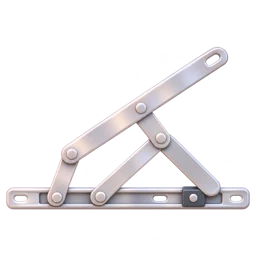
Window hinges · 14 min read
Composite Door Hinge Replacement: Types and Sizing

By The Sparrow team · Updated 30 November 2026
Sizes checked against the Sparrow parts catalogue · How we write guides
Your composite door has dropped, catches on the frame, or will not let the lock line up, and the hinges look like the likely cause. The door is heavy, the hinge may have three adjustment screws, and the replacement has to carry the same load as the original. This guide explains the two hinge families, what the adjustments do, and which measurements decide whether a new hinge will fit.
What hinge types do composite doors use?
Composite doors use two main hinge families: flag hinges and butt hinges. A flag hinge is surface-mounted. One leaf screws to the face of the door, the other to the frame, and a central pin joins them. The flag shape lets the door swing clear of the frame. A butt hinge is morticed into the edge of the door and the frame, so only the knuckle shows when the door is closed.
Flag hinges are the more common choice on composite doors because they spread the load over a plate on the door face and can be adjusted after fitting. Butt hinges look neater and suit a traditional door style, but they need a precise mortice and offer less adjustment. Some composite doors are made with one type and cannot be switched to the other without major work.
| Feature | Flag hinge | Butt hinge |
|---|---|---|
| Mounting | Screwed to the door and frame faces | Morticed into the door and frame edges |
| Visible when closed | Yes, the body sits on the face | Only the knuckle shows |
| Adjustment | Usually 2D or 3D | Limited, often none |
| Fitting skill | DIY with two people | Router and chisel work |
| Best for | Heavy composite doors | Traditional look, new door build |
| Replacement | Match the screw pattern and flag | Match the mortice exactly |
The type you have is fixed by the door. You can replace a flag hinge with another flag hinge, but you cannot easily convert a morticed door to surface hinges without filling the old cut-outs and drilling new ones.
Composite doors need a hinge that suits a solid, heavy panel. A hinge designed for a light hollow door may fit the screw holes and still flex under the weight. The door's construction also affects the fixing: the skin is thin, so the hinge has to spread its load over a plate rather than concentrate it on a few screws.
Flag hinges explained
A flag hinge has two plates and a pin. The door plate is screwed to the face of the door near the edge. The frame plate is screwed to the frame reveal. The pin runs through both plates, and the flag shape offsets the door so it clears the frame as it opens.
Because the screws go into the face of the door rather than the edge, the fixing relies on the composite skin and the reinforcing material behind it. The screws must be the right length and type, and they must not be overtightened. A hinge that is loose, or one that has been fitted with the wrong screws, can pull out and take a patch of the door skin with it.
Flag hinges are handed. The flag points one way to clear the frame, and a hinge built for the other hand will not close correctly. Some are reversible, but many are not. Check the old hinge and the product diagram before you order.
Butt hinges explained
A butt hinge is set into a recess cut in the door edge and the frame. The two leaves sit flush when the door is closed, and only the knuckle is visible. It is a neat look and a strong joint when the mortice is cut accurately.
Composite door edges can be routed, but the cut has to match the hinge exactly. The depth, height and screw positions all matter. A mortice that is too deep will leave the leaf sunk below the surface, and one that is too shallow will hold it proud. Most butt hinges have little or no adjustment, so the door has to be hung accurately in the first place.
Replacing a butt hinge is harder than replacing a flag hinge. The old mortice is a fixed size, and a new hinge with a different leaf or knuckle will not sit in it. If the door has butt hinges and one has failed, a door fitter is the safer choice.
How to identify your composite door hinge
- Open the door and look at the hinge from the inside face.
- If a metal body is screwed to the face of the door and the frame, it is a flag hinge.
- If only a knuckle shows and the leaves disappear into the door edge, it is a butt hinge.
- Count the hinges and note their positions on the door.
- Look for a maker's name, code or weight rating stamped on the hinge body.
- Measure the hinge height, leaf width and screw centres.
- Photograph the hinge straight on with a ruler beside it, and take a second photo of the door edge.
The maker's marking is the most useful clue. A code or name lets you search for the exact hinge rather than a generic one that looks similar. If there is no marking, the measurements and the screw pattern are your only guide.
Not sure which one you have?Snap it next to a £1 coin and Sparrow names the exact replacement for window hinges, with the measurements to check. Your first scan is free.
Get the appWhat 3D adjustment means
A 3D hinge adjusts in three directions. Height moves the door up and down. Lateral moves it sideways towards or away from the hinge. Compression moves the door towards or away from the frame, which controls how tightly the door pulls onto the seal.
Not every flag hinge has all three. Some are 2D, with height and lateral only. Others have a compression screw that is separate from the lateral screw. Check the hinge body and the instructions before you turn anything, because the screws are not always where you expect.
| Adjustment | What it changes | Symptom it fixes |
|---|---|---|
| Height | Door up or down | Door rubs at the top or bottom |
| Lateral | Door sideways | Door catches on the lock side or the hinge side |
| Compression | Door in or out at the seal | Draught or water at the edge |
Mark the starting position of each screw before you turn it. Count the turns so you can undo a mistake. A quarter turn is often enough to change the fit, especially on a heavy door.
Why door weight and hinge rating matter
A composite door is much heavier than a hollow uPVC panel. The hinges carry that weight every time the door opens, and they also resist the pull of the door as it swings. A hinge that is rated for a lighter door will flex, wear and eventually drop.
Hinge weight ratings are given in kilograms, either per hinge or per pair or set. Check which figure the seller is quoting. A door with three hinges shares the load, but the rating still has to cover the door's weight with some margin. If the door is taller or heavier than standard, the maker may specify four hinges.
An under-rated hinge shows itself in several ways. The door drops at the handle side, the gap around the door becomes uneven, the lock stops lining up, or the hinge screws work loose. On a composite door the screws can enlarge their holes, and a loose hinge can damage the skin. Replacing the hinge with the correct rating is cheaper than repairing the door.
The door's weight may be on a label, in the manufacturer's literature or in the installation instructions. If you cannot find it, a door fitter can advise. Do not guess from the door size alone, because the core and glazing make a big difference.
How to measure a replacement hinge
Measure the old hinge on the door if possible. If it has already come off, measure the screw holes and the outline left on the door or frame. A hinge that is 2 mm out on the screw centres will not fit without new holes, and new holes in a composite door are best avoided.
| Measurement | Where to measure | Why it matters |
|---|---|---|
| Hinge type | Face-screwed or morticed | Decides the replacement family |
| Overall height | Top to bottom of the hinge body | Must match the old hinge and the door edge |
| Leaf width | Across each plate | Must sit on the flat area of the door and frame |
| Screw centres | Centre of hole to centre of hole, both ways | The screws must use the existing holes |
| Projection | Door face to the pin centre | Sets how the door clears the frame |
| Pin diameter | Across the pin | Affects the knuckle and the door swing |
| Mortice size | Height, width and depth, butt hinges only | The new leaf must fill the old cut-out |
| Handing | Which way the flag or knuckle opens | The door must swing the same way |
Take the measurements with the door supported and the hinge still in place where you can. Once the hinge is off, the door may shift, and the screw holes are harder to line up with the frame.
Handing and hinge orientation
Hinges are handed when the flag or the knuckle only works one way. A flag hinge has a clear direction: the flag offsets the door to clear the frame, and the wrong hand will bind or leave a gap. A butt hinge is handed by the knuckle position and the way the leaves fold.
Sellers judge handing from different viewpoints. Some describe it from outside the door, some from inside. Compare the product diagram with your door from the same side, and check the flag direction in the photo against the old hinge. If the listing says reversible, read the instructions to see what has to be swapped.
Ordering the wrong hand is an expensive mistake on a heavy door. The hinge may fit the screw holes but hold the door at the wrong angle, and returning a fitted hinge is rarely possible.
How many hinges should a composite door have?
Most composite doors use three hinges, one near the top, one in the middle and one near the bottom. Taller or heavier doors may use four. The number is set by the door manufacturer and the weight of the door, not by preference.
If one hinge has failed, the others have carried the same load for the same time. Replacing all three is usually the better repair, especially if the door has dropped. A new hinge paired with two worn ones will take more than its share of the weight and may fail early.
Do not add an extra hinge to a door that was made with three unless the manufacturer says it is allowed. The door edge may not have the reinforcement in the right place, and a screw in the wrong spot can damage the core.
Hinge spacing matters as much as the number. The top hinge is usually set a short distance down from the top edge, and the bottom hinge a similar distance up from the bottom, with the middle hinge evenly between. If you are replacing a hinge, fit it in the same position. Moving a hinge means new screw holes, and the old holes will show.
How to replace a flag hinge safely
- Ask a second person to help. A composite door is heavy and awkward to hold while you work.
- Support the door with wedges or a door lifter under the bottom edge.
- Work on one hinge at a time so the other two keep the door in place.
- Undo the screws on one leaf, then the other, keeping a hand on the door as the hinge comes free.
- Keep the screws and any packers or gaskets with the old hinge.
- Fit the new hinge to the door leaf first, then to the frame, starting the screws by hand.
- Tighten the screws evenly and check the hinge sits flat on the door and frame.
- Adjust the hinge before you close the door fully, then test the swing and the lock.
If you are replacing all the hinges, take the door off its hinges with two people, lay it flat on protected bearers, and change the hinges on the bench. Do not remove every hinge while the door is standing in the frame. A door that falls can injure you and damage the frame, the glass and the floor.
Adjusting a new hinge
- Mark the starting position of each adjustment screw with a pencil or a photo.
- Start with height: raise or lower the door until the gaps at the top and bottom are even.
- Adjust lateral position until the door sits evenly in the frame and the lock lines up.
- Adjust compression until the door pulls onto the seal without being hard to close.
- Close the door gently and check the gaps, the lock and the seal.
- Make small changes, one adjuster at a time, and test after each.
- When the door is right, check that all hinge screws are snug and the caps are back on.
Adjustment is not a substitute for a worn hinge. If a screw turns without moving the door, or the hinge body moves on the door, the hinge is worn or the fixing has failed. Stop adjusting and repair the cause.
Troubleshooting composite door hinges
| What you notice | Likely cause | What to do |
|---|---|---|
| Door drops at the handle side | Hinge worn, under-rated or out of adjustment | Adjust first, then replace the set if worn |
| Door rubs at the top | Height adjustment or a dropped hinge | Raise the door on the hinges |
| Door catches on the lock side | Lateral adjustment or the door has twisted | Adjust sideways, check the lock after |
| Draught or water at the edge | Compression adjustment or a worn seal | Adjust compression, then check the seal |
| Hinge screws keep loosening | Holes enlarged or hinge under load | Check the rating and repair the fixing |
| Hinge creaks or grinds | Worn pin or dry knuckle | Check for wear; lubrication will not fix a worn pin |
| Hinge pulls out of the door | Stripped screws or damaged core | Stop and call a door fitter |
A door that has dropped often needs both adjustment and a new hinge. If the hinge is worn, adjusting it buys time but will not restore the door's position for long.
A creak is often the first sign of wear. The pin or the knuckle has lost its surface, and the hinge is moving under load rather than turning smoothly. A little lubricant may quieten it for a while, but it will not restore a worn pin. If the creak comes with a dropping door, plan to replace the hinge set rather than keep oiling it.
Fire doors and warranty
If the composite door is a fire door, the hinges are part of the tested assembly. The certificate lists the hardware the door was tested with, including the hinges, and the door's performance depends on that complete set. A hinge that looks the same but is not listed can invalidate the door's performance. Only the certificate and a qualified installer can confirm what is permitted.
Composite doors also carry manufacturer warranties that may require approved hinges and professional fitting. Check the terms before you buy, and keep the old hinge, the new receipt and the product details. This is a practical check based on the warranty document, not legal advice.
If you are unsure whether the door is a fire door, look for a certification label on the top edge or the hinge side and check the door's paperwork. If there is no label and no paperwork, treat the door as one that should not be modified without advice.
Common mistakes
- Ordering a hinge by leaf size alone and ignoring the screw centres.
- Fitting a hinge that is not rated for the door's weight.
- Buying the wrong hand because the listing uses a different viewpoint.
- Replacing one hinge when the other two are equally worn.
- Removing all the hinges while the door is still standing in the frame.
- Overtightening screws into the composite skin.
- Adjusting the hinge to cure a lock that is out of line for another reason.
- Changing the hinges on a fire door without checking the certificate.
Most hinge failures are wear or load, not a sudden break. If the door has been dropping for months, the hinge has been telling you it is tired. Replacing the set before the door damages the frame or the lock is the cheaper repair.
When to call a professional
Call a door fitter if the hinge has pulled out of the door, if the door edge or core is damaged, if the door has twisted, or if the door is a fire door that needs new hardware. A composite door is heavy, and a fall can cause serious injury.
A locksmith is the right call if the door will not lock after the hinges have been adjusted. The guide to a door that will not lock helps you decide whether the fault is the hinge, the keep or the lock. Do not force the handle to compensate for a door that is hanging wrong.
If the handle is also worn or damaged, replace it after the door is hanging correctly. The composite door handle guide covers the PZ, screw centres and spindle checks, but the hinge comes first: a handle fitted to a dropped door will not stay aligned.
How Sparrow helps
ThinkingAI Limited makes Sparrow, an iPhone app that identifies worn household parts from a photo taken next to a pound coin. Its hinge section covers window friction stays, not composite door hinges, so the measurements in this guide are the reliable route for a door. The app can still help with the door handle if you are replacing that at the same time, and with the window hinges elsewhere in the house. Photograph a part next to the coin, and Sparrow estimates the key measurements and shows what to check before buying. A first scan is free, and Sparrow Pro unlocks unlimited scans and saved parts in My Home. It matches parts only, so it will not adjust or fit a door hinge for you.
Frequently asked questions
What hinges do composite doors use?
Most use flag hinges screwed to the face of the door and frame. Some use butt hinges morticed into the door edge. Flag hinges are more adjustable, which helps with a heavy door.
What is a 3D hinge?
A 3D hinge adjusts in three directions: height, sideways position and compression against the seal. Not every flag hinge has all three, so check the hinge body and the instructions.
Why does my composite door need a weight-rated hinge?
Composite doors are heavy. An under-rated hinge can flex, drop or pull its screws, which throws the door out of line and stops the lock working.
Can I replace one hinge at a time?
Yes, if the door is supported and the new hinge matches the old one. Replacing all three is better when they are the same age, because the others are usually worn too.
Are composite door hinges handed?
Many are. The flag or knuckle opens one way, so compare the product diagram with your door from the same viewpoint before ordering.
Can I fit a fire door hinge myself?
Only if the door's certificate lists that hinge and a qualified installer fits it. Fire door performance depends on the whole tested assembly, not just a hinge that looks similar.
Not sure which one you have?Snap it next to a £1 coin and Sparrow names the exact replacement for window hinges, with the measurements to check. Your first scan is free.
Get the appParts guides, Sparrow
We build Sparrow, the iPhone app that identifies worn household parts from a photo taken next to a £1 coin. Our guides cover the six parts Sparrow matches: tap cartridges, euro cylinder locks, uPVC window handles, door handles, shower door seals and window hinges. Every size in a guide is checked against the same parts catalogue the app uses.

