uPVC window handles · 13 min read
uPVC Window Handle 40mm Spindle: Fit and Measuring

By The Sparrow team · Updated 30 November 2026
Sizes checked against the Sparrow parts catalogue · How we write guides
A window handle that has snapped, gone loose or lost its click is usually a straightforward swap. The handle is held by two screws, and the spindle slides into a gearbox in the sash. The part that catches people out is the spindle length. This guide explains what the 40 mm figure means, how to measure it properly, and when 40 mm is the wrong choice.
What the spindle on a uPVC window handle does
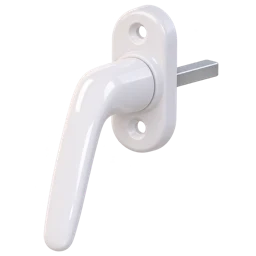
The spindle is the square metal bar that sticks out of the back of the handle. It passes through the sash and into the gearbox, which is the mechanism that drives the locking points around the opening edge. When you turn the handle, the spindle turns the gearbox, and the gearbox moves the espag strip that carries the locking cams into their keeps on the frame.
On most espag handles the spindle is 7 mm square. The square shape matters because it has to transmit torque without slipping. A round spindle would spin inside the gearbox. The length matters because the spindle has to reach the gearbox slot and sit inside it by enough to drive it, without touching the bottom of the slot.
The spindle is usually steel, sometimes with a slightly chamfered tip to help it enter the gearbox. If the tip is rounded off or twisted, the handle may spin or feel loose even when the rest of the handle is sound.
The gearbox slot has a fixed depth. The spindle needs to sit inside it by enough to drive the mechanism through its full travel. If it only enters a few millimetres, the corners of the spindle will wear the slot and the handle will slip. If it touches the bottom, the handle cannot seat against the sash.
Why 40 mm is the common default
Replacement handles are stocked in a small number of spindle lengths, and 40 mm is one of the most widely available. Many standard sash profiles need a spindle in that range, so 40 mm has become the default answer in shops and online listings. That does not make it a standard that fits every window.
A 40 mm spindle is simply a 40 mm spindle. It will fit any handle body designed for that length, but whether it fits your window depends on the depth from the handle face to the gearbox. Two windows in the same house can need different lengths if they have different profiles or if one has been repaired before.
Treat 40 mm as a starting point, not a specification. The specification is the measurement you take from the old handle.
Shops stock 40 mm because it is a common replacement size. That creates a feedback loop: the size sells, so it is stocked, so it is offered as the default. It is still possible for a window to need 30 or 35 mm, and for a 40 mm handle to be returned.
How to measure a 40 mm spindle correctly
Take the handle off the window before you measure. Measuring it in place gives a false reading because you cannot see where the base sits.
- With the window open, set the handle to the released position.
- Swivel the small cover plate at the base of the handle to reveal the two fixing screws.
- Undo both screws and pull the handle straight out of the sash. Do not twist it sideways.
- Lay the handle on a flat surface with the spindle pointing up.
- Measure from the flat face of the base, the part that touches the window, to the very tip of the spindle.
- Measure across the spindle to confirm it is 7 mm square.
- Measure the screw centres from the centre of one screw hole to the centre of the other.
- If the base is stepped, measure the height of the step as well.
Write the figures down before you search for a part. A photograph of the handle next to a ruler, taken straight on, is a useful backup and makes it easy to compare with a listing.
30, 35 and 40 mm: what the lengths suit
| Spindle length | Where it is common | What to watch |
|---|---|---|
| 30 mm | Shallow sash profiles and slim frames | Less engagement, so a worn tip may not reach |
| 35 mm | Mid-depth sashes and many replacement handles | Often confused with 40 mm when measured roughly |
| 40 mm | Deeper sashes and widely stocked replacement handles | Can bottom out in a shallow sash |
These are common lengths, not fixed rules. The same window style can use different lengths depending on the profile maker and the gearbox. Measure the old handle rather than choosing by the window's age or appearance.
Not sure which one you have?Snap it next to a £1 coin and Sparrow names the exact replacement for upvc window handles, with the measurements to check. Your first scan is free.
Get the appWhy 40 mm is not always the right answer
A 40 mm handle will only work if the spindle reaches the gearbox correctly in your sash. Several things can make the common size wrong.
| Reason | What it means | What to do |
|---|---|---|
| The old spindle is 30 or 35 mm | The gearbox sits closer to the handle face | Buy the measured length, not 40 mm |
| The sash profile is shallow | A 40 mm spindle reaches the bottom of the gearbox | Go down to 35 or 30 mm |
| The gearbox sits deeper | A 40 mm spindle does not engage enough | Go up a length if one is available |
| The base is cranked | The handle stands off the sash by the step height | Match the step height and the spindle length |
| The old handle was packed or spaced | The effective depth is not the profile depth | Measure the old spindle, not the gap |
| The old spindle was cut down | Someone shortened it to fit | Measure the true depth before buying |
The most common error is measuring from the top of the backplate or from the cover cap. Those parts add a few millimetres that are not part of the spindle. Another is measuring the old spindle while it is still in the handle at an angle, which makes it look longer than it is.
Screw centres: the other measurement that has to match
Screw centres mean the spacing from one hole centre to the other. On espag handles they are often 43 mm, but 43 mm is not the only size. A handle with a perfect 40 mm spindle and the wrong screw centres will not fit the existing holes.
Measure centre to centre, not from the outside edges of the holes. Measuring edge to edge adds the width of one hole and reads a few millimetres long. If the new handle's centres are close but not exact, do not force the screws. Enlarging the holes or drilling new ones weakens the sash and can let water in.
Some handles have a third fixing point or a different hole pattern. Count the holes and note their arrangement. A two-screw handle will not cover the holes left by a three-screw one.
Check the screw thread as well. Most handles use self-tapping screws into the uPVC or a metal insert, but a previous repair may have changed that. If the old screws turn loosely, the holes may be worn. A slightly larger screw can sometimes restore the grip, but do not overtighten it into a worn hole.
Inline and cranked bases: why the same spindle can sit differently
An inline handle has a flat base that sits directly against the sash. A cranked handle has a stepped base, so the grip stands further out from the window. Cranked handles are used where the sash sits proud of the frame or where the handle needs to clear a reveal or a blind.
The step height is the distance the base rises from the mounting face. If you fit a cranked handle with the wrong step height, the handle may sit too close to the frame or too far out. The spindle length can be correct and the handle still wrong, because the base is in the wrong place.
Look at the old handle from the side before you order. A flat base and a stepped base are obvious once you know what to look for. The uPVC window handle types and sizes guide shows the difference with each type.
What happens if a 40 mm spindle is too long or too short
| Spindle length | What you notice | What is happening |
|---|---|---|
| Too long | Handle stands off the frame, screws pull it down, window is stiff to lock | The spindle bottoms out in the gearbox before the base seats |
| Too long | Handle will not sit flat, gap around the base | The excess length holds the handle away from the sash |
| Too short | Handle spins, clicks or slips | The spindle does not engage enough of the gearbox slot |
| Too short | Window will not lock, handle turns too far | The gearbox is not being driven through its full travel |
| Wrong square size | Handle will not go on, or turns without moving the lock | The spindle does not fit the gearbox slot |
Too long is the more damaging of the two. The screws are strong enough to pull the handle down onto the sash, and that force goes through the gearbox. Over time it can crack the gearbox housing or distort the sash around the fixing holes. If a new handle will not sit flat, stop tightening and check the spindle length.
An old handle that already stood proud, or had a visible gap under the base, may have been the wrong length for years. Do not copy its measurement without checking the gap. The wear pattern on the base is a clue: a base that has been pulled down by the screws often shows a crushed seal or a shiny ring where it has been rubbing.
What if the old handle is broken or missing?
If the spindle has snapped, or the handle has been removed and lost, you cannot simply measure the old part. You can still find the right length by measuring the depth to the gearbox.
- Remove the old handle and take out any broken piece of spindle that comes away easily.
- Look into the spindle hole with a torch. The square gearbox slot is at the bottom.
- Insert a thin rod, or a spare piece of 7 mm spindle, until it rests in the slot. Stop if it meets resistance.
- Mark the rod at the face of the sash.
- Measure between the mark and the inserted end. That is the depth to the gearbox.
- Compare that depth with the spindle lengths available. The new spindle should reach the slot without touching the bottom.
The depth is the maximum the spindle can be. The right handle is usually a few millimetres shorter than the full depth, because the base has to sit flat. If the old spindle is still in one piece, its measurement is more reliable than the depth method. Use the depth only when the old part is gone.
If a broken piece is stuck in the gearbox, do not drill or pick at it. The gearbox is a small mechanism and it is easy to damage the slot beyond use. A window specialist can remove the piece or replace the gearbox.
Do tilt and turn windows use a 40 mm spindle?
Some do, but a tilt and turn handle is not the same as a standard espag handle. A tilt and turn window tips inward from the top as well as opening from the side, and the handle usually turns through a longer sequence to select each position. The handle body and spindle are often different from a standard espag.
Many tilt and turn handles use a square spindle, often 7 mm, but the length is frequently longer than the espag range. The base may also be shaped to clear the frame or to sit in a recess. A 40 mm espag handle that looks similar may not fit, even if the spindle size is right.
Measure the old tilt and turn handle in the same way: base to tip, across the spindle, and screw centres. Note the handle's turning positions and any markings on the base. If you cannot find a matching handle, the window maker or a window specialist is the best source.
What to check before buying a 40 mm handle
- Spindle length: measure from the base to the tip. Buy the measured length, even if it is 35 or 30 mm.
- Spindle size: 7 mm square on most espag handles. Measure across the flats.
- Screw centres: often 43 mm, measured centre to centre.
- Base shape: inline or cranked, with the step height if cranked.
- Lock type: keep a locking handle if the old one locks, or fit a non-locking one if it does not.
- Colour: match the other handles on the window so the finished job looks consistent.
- Handing: most espag handles fit either side, but check the old one if the base is shaped.
If you are replacing several handles, measure each one. Windows on the same elevation often match, but a door or a different-sized window may not. The handle won't turn or lock guide helps if you are not sure whether the handle or the gearbox has failed.
How to fit a replacement handle
- With the window open, turn the handle to release the locking cams.
- Swivel the cover plate and undo the two screws. Keep them safe.
- Pull the old handle straight out and check the spindle is not snapped off in the gearbox.
- Compare the new handle with the old one: spindle length, square size, screw centres and base shape.
- Insert the spindle into the gearbox slot and press the handle base against the sash.
- Fit the screws and tighten them evenly, alternating between the two.
- Turn the handle through its full travel and check the locking points move.
- Close the window and check it locks with a firm turn, with no gap around the handle base.
If the handle will not sit flat, take it off and recheck the spindle length. Do not use the screws to pull it down. If the screws will not start, check the screw centres and the thread rather than forcing them.
Before you fit the new handle, turn the old spindle or a spare piece in the gearbox by hand. It should move through its travel without grinding. If it is stiff or does not move the locking points, the handle is not the only fault, and a new one will not fix it. The handle and gearbox tests explain what to check next.
Troubleshooting a new handle that does not fit
| Problem | Likely cause | What to check |
|---|---|---|
| Handle stands off the sash | Spindle too long or base shape wrong | Measure the old spindle and the step height |
| Handle spins without locking | Spindle too short or wrong square size | Engagement in the gearbox and the 7 mm size |
| Screws do not line up | Screw centres differ | Measure centre to centre, not edge to edge |
| Handle is stiff when the window is shut | Sash out of line, not the handle | Hinges and locking keeps |
| Window will not close | Locking points out of sequence or hinges worn | The window closing guide |
A new handle cannot fix a worn gearbox. If the spindle turns but the locking points along the sash edge do not move, the gearbox is the problem. That is a job for a window specialist, not a handle swap.
Common mistakes
- Ordering 40 mm because it is the size most shops stock.
- Measuring from the top of the backplate instead of the flat base.
- Measuring the spindle while it is still fitted to the window.
- Checking the spindle length but not the screw centres.
- Ignoring the difference between an inline and a cranked base.
- Using the screws to pull a handle down onto a spindle that is too long.
- Assuming every window in the house takes the same handle.
- Blaming the handle when the gearbox or hinges have failed.
When to call a window specialist
Call a window specialist if the spindle has snapped and part of it is stuck in the gearbox, if the gearbox does not move when the spindle turns, or if the sash has dropped and the handle no longer lines up with the keeps. Also stop if the window is jammed shut on an escape route, or if the glass or frame is cracked.
Replacing a handle is a small DIY job. Replacing a gearbox or a friction stay is not, because the sash needs support while the mechanism is reset. The friction stay size guide explains what a window specialist will measure if the hinges are the cause.
If the window is an escape route, do not leave it unable to open while you wait for a part. Fit a temporary handle if you can, or keep the old handle working until the replacement arrives. A bedroom window that will not open is a safety problem, not just an inconvenience.
A handle that keeps coming loose after tightening may have worn screw holes rather than a faulty handle. Check the holes before buying another handle, because the new one will loosen in the same way.
How Sparrow helps
Sparrow is an iPhone app made by ThinkingAI Limited that identifies worn household parts from a photo taken next to a pound coin. For a window handle, Sparrow reads the type from the photo, estimates the spindle length against the coin and shows the matching spec, the checks before buying and retailer search links for Screwfix, Toolstation and Amazon UK. The library lists espag handles in 30, 35 and 40 mm and cockspur handles in both hands. The first scan is free, and Sparrow matches parts only: it does not give repair advice.
Frequently asked questions
What is the standard spindle length for a uPVC window handle?
There is no single standard. Most espag handles use a 7 mm square spindle in one of three common lengths: 30, 35 or 40 mm. A 40 mm spindle is widely stocked, but the right length is the one your old handle measures.
How do I measure a 40 mm window handle spindle?
Measure from the flat base of the handle, where it sits against the window, to the very tip of the spindle. Do not include the screw boss or a cover cap. If the measurement is 40 mm, a 40 mm handle is the right starting point.
Can I use a 40 mm spindle if my old one is 35 mm?
Only if the extra 5 mm does not bottom out in the gearbox. A longer spindle can hold the handle off the frame, so the base does not sit flat. Fit the length you measured, not the length that is easiest to find.
What happens if the window handle spindle is too long?
The spindle reaches the bottom of the gearbox before the handle base touches the sash. The handle then stands proud, the screws pull it down and the gearbox is placed under load. The window may be hard to lock or may not close properly.
Are all uPVC window handles 7 mm square?
Most espag handles are 7 mm square, but not all. Measure across the spindle with a ruler or calipers. A handle with the wrong spindle size will not turn the gearbox, and forcing it can damage the mechanism.
Do I need a locking window handle?
Fit the same type as the old one. A locking handle has a small key or push button and is useful on ground floor windows. It must still match the spindle length, screw centres and base shape.
Not sure which one you have?Snap it next to a £1 coin and Sparrow names the exact replacement for upvc window handles, with the measurements to check. Your first scan is free.
Get the appParts guides, Sparrow
We build Sparrow, the iPhone app that identifies worn household parts from a photo taken next to a £1 coin. Our guides cover the six parts Sparrow matches: tap cartridges, euro cylinder locks, uPVC window handles, door handles, shower door seals and window hinges. Every size in a guide is checked against the same parts catalogue the app uses.

