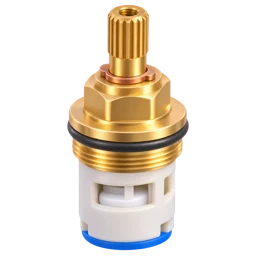
Tap cartridges · 14 min read
Tap Won't Turn Off: Cartridge, Valve or Washer?

By The Sparrow team · Updated 30 November 2026
Sizes checked against the Sparrow parts catalogue · How we write guides
A tap that will not shut off is more than an annoyance. It wastes water, stains the sink and can overflow if the plug is left in. The right fix depends on what is inside the tap, and the wrong part wastes a trip to the shop. This guide helps you decide whether the fault is the cartridge, the valve, the washer or the handle, and it starts with the step that keeps the kitchen dry.
The isolate-first rule
Before you take a handle off or buy a part, stop the water. A tap that is passing can turn into a flood as soon as the cartridge comes out. Close the isolating valves on the hot and cold pipes, or the main stopcock if there are none.
- Find the isolating valves under the sink, basin or bath. They may have a slot or a small lever.
- Shut both supplies. Close a slot valve so the slot sits across the pipe.
- Open the tap fully and let the water drain. If it keeps running, the supply is not off.
- If there are no isolating valves, close the main stopcock.
- On a gravity system, close the feed to the hot cylinder as well. The cold main may not stop the hot supply.
- If a valve will not close, stop. Do not undo a live tap.
Keep the tap open while you work. That releases pressure from the valve and gives any water left in the pipe somewhere to go. Put a bucket under the trap and a towel over the sink, because a little water always escapes.
Isolating valves are not all the same. A slot valve has a screwdriver slot and usually turns through a quarter turn. A lever valve has a handle that sits across the pipe when closed. A gate valve has a round wheel and may take several turns. Know which one you have before you assume it is closed, and mark the open and closed positions with a pencil if they are not obvious.
What "won't turn off" actually means
The symptom narrows the fault. A drip, a trickle and a full-flow leak are not the same problem, and a handle that moves without resistance is different again.
| What happens | What it suggests | First check |
|---|---|---|
| Drips from the spout when the handle is off | The valve is passing slightly | Cartridge, valve or washer, depending on the tap type |
| Steady trickle that will not stop | The valve is passing badly or is not closing fully | Handle travel, splines and the valve seat |
| Full flow with the handle closed | The valve has failed or the handle is not turning the spindle | Remove the handle and turn the spindle directly |
| Handle spins with no resistance | Stripped splines or a broken stem | The teeth on the handle and spindle |
| Handle will not move | Scale, a seized cartridge or a wrong part | Do not force it; isolate and strip the tap |
| Water at the base of the tap | A seal, O-ring or body fault | Dry the area and trace the leak |
If the tap runs only when another tap is used, the fault may be pressure-related rather than the valve. A valve that is slightly passing can be pushed open by a pressure surge. Note when it happens before you buy anything.
Time of day can help too. A tap that passes only after the heating comes on may be affected by expansion in the pipework. A tap that passes all the time is more likely to have a worn seal or a damaged seat. Write down the pattern; it narrows the cause before you take anything apart.
Diagnosis by tap type
The mechanism inside the tap decides the part. You can usually tell it from the handle before you remove anything.
| Tap type | How the handle behaves | Part that controls the water |
|---|---|---|
| Single-lever mixer | Lifts for flow, swivels for temperature | Ceramic mixer cartridge |
| Quarter-turn tap | Stops after about 90 degrees | Ceramic disc valve, 20 or 24 splines |
| Compression tap | Turns several full turns | Rubber washer on a jumper, or the headgear |
| Bath mixer with diverter | Lever plus a diverter knob or button | Mixer cartridge plus a separate diverter |
A tap with one lever is a mixer, but a tap with two handles can be either quarter-turn or compression. The label on the tap is less reliable than the way the handle moves. If you are unsure, the guide to tap cartridge sizes sets out the three mechanisms side by side.
You can test the mechanism without water. Turn the handle slowly and count how far it travels. A quarter-turn tap has a hard stop at about 90 degrees. A compression tap keeps turning and may feel springy near the end. A mixer lever moves in two directions and has no single stop. That test takes seconds and saves a wrong purchase.
Not sure which one you have?Snap it next to a £1 coin and Sparrow names the exact replacement for tap cartridges, with the measurements to check. Your first scan is free.
Get the appSingle-lever mixer that will not shut off
A single-lever mixer uses a ceramic cartridge. Two polished discs slide over each other to close the hot and cold ports. When the discs wear, scale gets between them, or the cartridge is not seated, water passes even with the lever down.
Check the easy things first. Is the lever hitting the shroud before it reaches the closed position? Has the cartridge been fitted with its lugs out of line? Is there a piece of grit on the ceramic face? If the lever feels gritty or stiff, scale is likely. If it moves freely but the water still runs, the discs or the seals have failed.
Replacing the cartridge is usually the fix. Match the body width (25, 35 or 40 mm), the height, the base pins and the stem. A cartridge that is the right width but the wrong pin pattern will sit proud and leak. If the tap is a kitchen or basin mixer, the mixer cartridge guide walks through the replacement.
When you refit the lever, check it reaches the closed position without hitting the shroud. A lever that stops short leaves the cartridge partly open, which looks like a failed valve. Some cartridges also have a small amount of rotational adjustment; check the maker's mark before you assume the lever is in the right place.
Quarter-turn tap that will not shut off
A quarter-turn tap has a ceramic disc valve under each handle. The valve screws into the tap body and seals with a washer or O-ring. When the handle turns, the discs rotate and close the port. A drip means the discs are worn, scratched or held open by debris.
Before buying a valve, check the handle. If the handle spins without turning the spindle, the splines are stripped. If the handle turns but the valve does not, the stem may be broken. Take the handle off and look at the teeth on both parts. A new valve will not fix a handle that no longer grips.
Match the spline count (20 or 24), the thread (1/2 inch BSP for basin and kitchen, 3/4 inch for bath) and the opening direction. Hot and cold valves often turn opposite ways, so a single replacement may need to be the correct hand. The spline guide explains how to count the teeth.
If the valve body is stuck, do not use a pipe wrench on the chrome. Protect the surface with a cloth and use the correct spanner on the brass hexagon. A valve that turns a little and then stops may be cross-threaded, which is a plumber's job if it will not come out cleanly.
Compression tap that will not shut off
A compression tap turns several full turns and winds a rubber washer down onto a brass seat. When the washer wears, the tap drips. When the seat is pitted, even a new washer will not seal.
Remove the headgear and inspect the washer. If it is flat, split or grooved, replace it. Check the jumper moves freely and the seat inside the tap body is smooth. A seat with a groove or a rough patch needs re-cutting by a plumber, or the tap needs replacing. Do not grind the seat yourself unless you have the right tool and know how much brass to remove.
If the tap is a bath tap, the fitting is often 3/4 inch BSP. A basin or kitchen tap is usually 1/2 inch. Buy the washer or headgear by the thread and the tap type, not by the handle shape.
A compression tap that has been leaking for a while can wear a groove in the seat. You may fit a new washer and find the drip returns within days. That is the sign the seat needs re-cutting. A plumber can do this with a seat grinder, or you can replace the tap if the body is old and the chrome is tired.
Handle spins, slips or will not move
A handle that spins is a mechanical fault before it is a water fault. The handle grips the spindle with splines, a flat or a grub screw. If those teeth wear, the handle turns but the valve does not. The tap may be fine; the handle is not.
Tighten the grub screw first. If the handle still slips, take it off and look at the splines. Worn teeth on the handle can sometimes be replaced with a new handle; worn teeth on the spindle mean a new cartridge or valve. Do not pack the joint with tape or glue. It will not take the turning force and may leave the tap stuck open.
A handle that will not move is the opposite problem. Scale, a seized cartridge or a cartridge fitted crooked can lock it. Do not force it with a wrench. Isolate the water, remove the handle and try the spindle with the correct tool. If the spindle will not move, the cartridge or valve needs replacing, and a plumber may be needed to free it.
Handle fixings vary. Some have a screw under a cap, some a grub screw at the back, and some a collar that unscrews. Find the fixing before you pull. A handle that is held by a hidden grub screw will not come off with force, and the lever can break before the screw gives way.
Water at the base or under the tap
Water at the base is not always the valve that controls the flow. It can come from a cartridge O-ring, the spout joint, the supply tail or a cracked body. Trace it before you buy a part.
| Where the water appears | Likely cause | What to check |
|---|---|---|
| Around the lever or handle | Cartridge seal or spindle O-ring | Remove the handle and check the seals. |
| At the base of a swivel spout | Spout O-rings | Turn the spout and watch the joint. |
| On the sink around the tap | Base seal or water tracking | Dry the area and run the tap. |
| Under the sink at a tail | Supply connector or isolator | Tighten the connector and check the washer. |
| From a hairline in the body | Cracked tap body | Replace the tap; a cartridge will not seal it. |
Dry everything with tissue, run the tap for a minute and watch where the first drop forms. Water can travel along the underside of a worktop, so the visible puddle may be far from the leak.
If the tap has a pull-out hose or a filter, check those connections too. A leak at the hose joint can drip onto the cupboard floor and look like a tap base leak. The cartridge only controls the water at the spout; it does not seal the hose or the filter housing.
When the isolating valve is the problem
An isolating valve that will not close is a bigger problem than the tap. If the slot valve spins without shutting the water off, or the lever valve is stiff and weeping, do not force it. A broken valve under pressure can flood the cupboard.
If the valve closes but the tap still runs, the valve may not be seating. Older slot valves can snap internally, and lever valves can seize in the open position. Call a plumber to replace the valve. Do not use the tap as the only way to stop the supply while you work on the valve.
If there are no isolating valves at all, the stopcock is your only safe shutdown. Check that it turns before you start the tap repair. A stopcock that is stiff but moves is usable; one that will not move at all is a plumber's job.
Some homes have a second valve on the cold feed to the cylinder or a valve in the loft. Find them before you need them. A tap that will not turn off is much less stressful when you know where the next valve is.
When the stopcock will not close
A seized stopcock can leave the whole house without a safe shutdown. Do not put a wrench on the handle and force it. The spindle or the body can break, and then the water cannot be stopped at all.
If the stopcock turns but drips, the packing may be worn. A plumber can repack or replace it. If it turns a little and then stops, scale or a worn washer inside is likely. Either way, the repair is at the main supply, not at the tap.
Keep the stopcock accessible. If it is painted over or buried behind a cupboard, clear the access before you need it. A tap that will not turn off is much easier to handle when the main valve works.
The part to buy for each tap
Buy by mechanism and measurement, not by the look of the handle. The same handle shape can hide different valves.
| Tap | Part | What to measure |
|---|---|---|
| Single-lever mixer | Mixer cartridge | Body width (25, 35 or 40 mm), height, pins, stem |
| Quarter-turn basin or kitchen | 1/2 inch BSP ceramic valve | 20 or 24 splines, opening direction |
| Quarter-turn bath | 3/4 inch BSP ceramic valve | 20 or 24 splines, opening direction |
| Compression tap | Washer, jumper or headgear | Thread, washer size, seat condition |
| Mixer with diverter | Cartridge plus diverter parts | Cartridge size and diverter type |
Take the old part with you if you can. If not, photograph it next to a pound coin and note any numbers on the body. A part that looks the same but has a different spline count or pin pattern will not work.
Measure the thread across the outside of the threads, not across a nut. A 1/2 inch BSP thread is about 21 mm across and a 3/4 inch BSP thread about 26.4 mm. If the reading is close to one of those, you have the family right; the splines and opening direction decide the exact part.
What to do while you wait for the part
Keep the supply off if you can. A tap that is passing can overflow a sink or a bath, and a cloth over the spout only redirects the water; it does not stop it.
- Close the isolating valves or the stopcock and leave them closed.
- Open the tap to release the pressure, then close it again if the supply is off.
- Put a bucket under the trap and a towel around the base if the tap weeps.
- Do not use the tap. Use another tap in the house until the part arrives.
- If the tap is the only supply and it cannot be isolated, keep the stopcock closed and call a plumber.
Do not tape, clamp or tie off a pressurised valve. A temporary patch can fail without warning, and it can damage the cartridge seat. If the leak is hot water, take extra care and keep children away.
If the tap is in a bathroom, keep the plug out of the basin or bath so a drip cannot fill it. A towel around the spout can direct water into the waste, but change it before it soaks through. Do not leave a running tap unattended while you wait for a part.
Common mistakes
- Taking the tap apart with the water on. Isolate first and open the tap to prove it.
- Buying a cartridge before identifying the mechanism. A washer tap does not take a cartridge.
- Forcing a stiff handle. That can break the spindle or the valve body.
- Blaming the cartridge for a base leak. The spout O-rings or a tail may be the real source.
- Ignoring the handle splines. A replacement valve cannot cure worn teeth on the handle.
- Reusing a worn washer. Fit a new one of the correct size.
- Overtightening the replacement. Firm is enough; extra force distorts seals.
- Not testing the repair. Run the tap, then dry the joints and check again.
When to call a plumber
Call a plumber if you cannot isolate the water, if the stopcock is seized or broken, or if the tap body is cracked. A tap that will not turn off and cannot be isolated is an emergency, not a DIY project.
Also stop if the tap is on an unvented cylinder, a boiling water tap or a pumped system you do not understand. Water near electrics, a leak under a floor, or a valve that has already been forced are all reasons to hand over. If you have replaced the correct part and the tap still passes, a second look is cheaper than another flood.
How Sparrow helps
If the tap has no brand and the handle tells you nothing, Sparrow can narrow the part. The iPhone app, made by ThinkingAI Limited, takes a photo of the old cartridge or valve beside a pound coin. It names the type, estimates the size and lists the checks before you buy. It is a parts matcher, not a repair guide.
The parts library and size finder are free, and the first photo scan is free. In a rented flat or a family home with several bathrooms, My Home keeps each tap's part on record so the next drip is a reorder rather than a research project.
Frequently asked questions
Why won't my tap turn off?
The valve inside is passing water. In a single-lever mixer that is usually a worn ceramic cartridge; in a quarter-turn tap it is a ceramic valve; in a multi-turn tap it is a worn washer or a damaged seat. The handle mechanism can also fail, so check whether the spindle turns.
How do I know if it is the cartridge or the washer?
Turn the handle from off to full. A quarter turn means a ceramic valve or cartridge. Several full turns means a compression tap with a washer and jumper. Single-lever mixers use a cartridge, whatever the handle feels like.
The handle spins but the water still runs. What is wrong?
The splines inside the handle or on the spindle are probably worn, so the handle no longer grips. A loose grub screw can do the same. Take the handle off and inspect the teeth before buying a cartridge.
Can I turn the water off at the stopcock instead?
Yes, if the tap has no isolating valves or they will not close. Close the stopcock, open the tap to drain it, and keep it closed until the repair is done. If the stopcock is seized, call a plumber.
Why does my tap drip after I replaced the cartridge?
The cartridge may be seated crooked, an O-ring may be pinched, or debris may be trapped on the ceramic discs. Check the seating and the seals before assuming the new part is faulty.
When should I call a plumber?
Call one if you cannot isolate the water, the stopcock is seized, the tap body is cracked, or the tap is on an unvented or boiling water system. Water near electrics is also a reason to stop.
Not sure which one you have?Snap it next to a £1 coin and Sparrow names the exact replacement for tap cartridges, with the measurements to check. Your first scan is free.
Get the appParts guides, Sparrow
We build Sparrow, the iPhone app that identifies worn household parts from a photo taken next to a £1 coin. Our guides cover the six parts Sparrow matches: tap cartridges, euro cylinder locks, uPVC window handles, door handles, shower door seals and window hinges. Every size in a guide is checked against the same parts catalogue the app uses.

