Tap cartridges · 6 min read
How to fix a dripping mixer tap: replace the cartridge

By The Sparrow team · Updated 30 November 2026
Sizes checked against the Sparrow parts catalogue · How we write guides
A single-lever mixer that keeps dripping after you turn it off wastes water and leaves limescale marks in the sink. The good news is that the fix is usually one part: the cartridge inside the tap. You do not need to replace the whole tap. The hard part is buying the right cartridge first time, because many look almost the same. This guide takes you through the job from turning the water off to checking for leaks.
Why does a mixer tap drip?
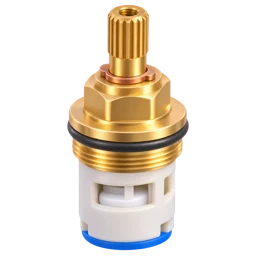
A single-lever mixer tap (one lever that moves up and down for flow and left and right for temperature) has a ceramic disc cartridge inside. Two polished ceramic discs slide over each other to open and close the hot and cold ways. When the tap is off, the discs press together and hold back the water.
Over time the discs wear, or limescale and grit scratch them. Once that happens, water seeps past even when the lever is fully down, and you get a steady drip from the spout. Seals on the base of the cartridge can also wear. In both cases the normal fix is to replace the whole cartridge, not to repair it.
Before you start, check where the water is actually coming from:
- Drip from the spout outlet when the tap is off: almost always the cartridge.
- Water around the base of the lever: often the cartridge or its seals.
- Leak at the base of a swivel spout: usually the spout O-rings, a different part.
- Leak under the sink: check the flexible tap connectors and isolating valves. If water is coming from mains pipework, call a plumber.
If your tap has two separate handles instead of one lever, it has quarter-turn valves or washers, not a mixer cartridge. See quarter-turn tap leaking: replace the valve instead.
How to turn off the water safely
Always turn the water off before you touch the cartridge. Look under the sink or basin for isolating valves on the hot and cold pipes. These are small valves with a slot or a little lever. Turn the slot a quarter turn so it sits across the pipe, not along it. Turn off both hot and cold, because a mixer has both supplies.
If there are no isolating valves, turn off the main stopcock. In many UK homes it is under the kitchen sink, but it can be in a hallway, cupboard or cellar. The hot supply may need turning off separately, depending on your system.
Then open the tap fully, to hot and cold, to release the pressure and let the water in the tap drain out. If water keeps flowing strongly, the supply is not off yet. If an isolating valve or stopcock will not turn, or it leaks when you move it, stop and call a plumber rather than forcing it.
How to take the old cartridge out
- Remove the cap. Most levers have a small decorative cap, often a red and blue disc, on the front or top. Prise it off gently with a small flat screwdriver.
- Undo the fixing. Underneath is a screw, or there is a small grub screw on the side or back of the lever. Undo it with a screwdriver or Allen key.
- Lift off the lever. Pull it straight up. If the tap has a chrome shroud or collar over the cartridge, unscrew or lift that off too.
- Undo the cartridge nut. You will see a brass nut holding the cartridge in. Turn it anticlockwise with a spanner, holding the tap body steady with your other hand so it does not twist.
- Lift the cartridge out. Pull it straight up. Note which way round it sat, and look at the small lugs (pins) on its base and the holes they fit into.
Not sure which one you have?Snap it next to a £1 coin and Sparrow names the exact replacement for tap cartridges, with the measurements to check. Your first scan is free.
Get the appHow to identify the replacement cartridge
Mixer cartridges are mainly sized by the width of the body, measured across the widest part. The common sizes are below, but width alone is not enough to be sure of a match.
| Check | How to check it | Common values |
|---|---|---|
| Body width | Measure across the widest part of the body | 25, 35 or 40 mm |
| Height | Measure from the base to the top of the stem | Varies by brand: check your old part |
| Stem shape | Look at the top the lever fits onto: splined (teeth) or flat-sided | Match your old part |
| Base lugs | Count the pins on the base that locate it in the tap | Match your old part |
35 mm and 40 mm cartridges are the most common in kitchen and basin mixers. 25 mm cartridges turn up in smaller and some designer taps. Two cartridges with the same width can still differ in height, stem and lugs, and one that is slightly wrong may not seat or may stop the lever fitting. For more detail on each type, read tap cartridge sizes: how to identify yours.
The safest approach is to take the old cartridge to the shop, or lay it on its side next to a £1 coin (23.43 mm across) and photograph it straight down. In Sparrow, that photo gives you an estimated width against the coin and the matching cartridge spec.
How to fit the new cartridge
- Clean the seat. Wipe out the tap body where the cartridge sits. Remove loose limescale or grit, which can damage the new discs.
- Line it up. Drop the new cartridge in the same way round as the old one, with the base lugs in their holes. It should sit flat without being pushed.
- Tighten the nut. Screw the brass nut on by hand, then tighten it firmly with the spanner while you hold the tap steady. Do not overtighten, as that can make the lever stiff or damage the cartridge.
- Refit the shroud and lever. Push the lever onto the stem, refit the screw or grub screw and press the cap back on.
- Restore the water slowly. Close the tap, then open the isolating valves or stopcock a little at a time. Run the tap on hot and cold to clear any air.
- Check for leaks. Turn the tap off and watch the spout for a few minutes. Check around the lever and under the sink too.
What if the cartridge is stuck?
In hard water areas, limescale can lock the cartridge nut or the cartridge itself into the tap body. Be careful here. The tap body is usually brass with a chrome finish, and it is fixed to the sink or worktop. If you force the nut, you can twist the whole tap on its mounting, strip the thread or crack the body.
- Hold the tap body firmly while you turn the nut, so the force goes into the nut, not the mounting.
- Use steady pressure. Do not hammer the spanner or use a long bar for extra leverage.
- Never lever the cartridge out against the tap body with a screwdriver.
- If it still will not move, stop. A plumber has the tools to free it without damaging the tap or the worktop.
Still dripping after a new cartridge?
If the drip carries on, first check the cartridge is fully seated, with the lugs in their holes and the nut tight. A cartridge that sits slightly crooked will not seal. Next, compare the new and old cartridges side by side: a near match in width but a different height or lug pattern is a common cause. Grit from the pipes can also lodge in a new cartridge after the water goes back on. If the tap body itself is worn, or water is coming from somewhere other than the spout, it may be time to call a plumber or replace the tap.
Frequently asked questions
Why does my mixer tap drip when it is turned off?
In a single-lever mixer the seal is made by two ceramic discs inside the cartridge. When they wear or get scratched by limescale or grit, water gets past them and the tap drips. Replacing the cartridge usually fixes it.
What size cartridge is in my mixer tap?
Measure the widest part of the cartridge body. The common sizes are 25, 35 and 40 mm. Also compare the height, the spline pattern on the stem and the lugs on the base before you buy.
Can I fix a dripping mixer tap without turning off the water?
No. Turn off the isolating valve under the sink or the main stopcock first, then open the tap to release the pressure. Undoing the cartridge with the water on will flood the sink area.
What if the cartridge nut will not undo?
Do not force it or lever against the tap body, as you can twist the tap on the worktop or crack the body. If it will not move with steady pressure while you hold the tap still, it is safest to call a plumber.
My mixer tap leaks from the base of the spout, not the outlet. Is that the cartridge?
Usually not. A leak around the base of a swivel spout is normally worn O-rings in the spout joint, not the cartridge. Check the tap maker's spares for the right part.
Will any 35 mm or 40 mm cartridge fit my tap?
Not always. Cartridges with the same width can differ in height, stem shape and the number of lugs on the base. Match all of these to your old cartridge.
Not sure which one you have?Snap it next to a £1 coin and Sparrow names the exact replacement for tap cartridges, with the measurements to check. Your first scan is free.
Get the appParts guides, Sparrow
We build Sparrow, the iPhone app that identifies worn household parts from a photo taken next to a £1 coin. Our guides cover the six parts Sparrow matches: tap cartridges, euro cylinder locks, uPVC window handles, door handles, shower door seals and window hinges. Every size in a guide is checked against the same parts catalogue the app uses.

