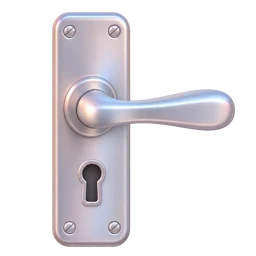
Door handles · 14 min read
Lever/Pad vs Lever/Lever Door Handles: Which Is Yours?

By The Sparrow team · Updated 30 November 2026
Sizes checked against the Sparrow parts catalogue · How we write guides
You are outside your front door with the old handle in your hand, or looking at a product page that offers left, right, lever and pad options. Every photo looks much the same. The plate is the same shape, the keyhole is in the same place, and the measurements may even match. What changes is what the outside of your door is allowed to do, and which way the lever sits when the door is shut.
What is a lever/pad door handle?
A lever/pad handle is a pair. The inside is a normal lever that retracts the latch. The outside is a fixed pad: a shaped grip with no moving lever. The keyhole or cylinder sits in the same backplate. To open the door from outside you unlock the cylinder, then pull the pad. The pad gives you something to hold. It does not operate the latch.
That is why lever/pad sets are common on front doors. When the door is pulled shut, the latch is the only thing holding it. With a pad outside, a caller cannot press a lever and walk in. They need the key. The pad also gives a firm pull point for closing the door behind you, which is why it suits a door that is pulled rather than pushed.
A lever/pad set is not a different lock. It uses the same multipoint lock, the same spindle and the same cylinder as a lever/lever set. Only the outside furniture changes.
The pad is sometimes shaped like a lever that does not move, and sometimes like a small rectangular grip. Both are still pads, because neither operates the latch. If a listing calls the outside part a dummy lever, check that it is fixed rather than sprung. A dummy lever that moves is really a lever/lever handle with a different name.
What is a lever/lever door handle?
Both sides have a moving lever. Press the outside lever and the latch retracts, unless the lock is deadlocked. On a back door, that is convenient. You can open the door from the garden without a key while you are at home. On a front door, it means the door is only as secure as your habit of locking it every time.
Lever/lever handles are also used on front doors where the multipoint lock has a deadlocking latch. On those doors, closing the door throws the bolts, and the outside lever has nothing to open until the cylinder is used. The handle looks the same as a standard lever/lever set, so the lock inside the door decides how the door behaves, not the handle alone.
Most lever/lever pairs are symmetrical in shape but not in handing. The lever boss is offset on the plate, so the lever points one way when the door is closed. That direction has to match the door.
Lever/pad vs lever/lever at a glance
| Feature | Lever/pad | Lever/lever |
|---|---|---|
| Outside furniture | Fixed pad | Moving lever |
| Inside furniture | Moving lever | Moving lever |
| Latch from outside | No, unlock first | Yes, unless deadlocked |
| Key needed to enter | Always | Only when deadlocked |
| Typical door | Front door, door onto a street | Back door, garden door, some front doors |
| Main benefit | Outside cannot try the latch | Easy passage from outside |
| Main risk | You always need the key | Door left on the latch is open to anyone |
| Fixing holes | PZ and screw centres | PZ and screw centres |
The table shows why the two types are not interchangeable in use, even when they are interchangeable in fit. The holes are the easy part. The behaviour of the outside furniture is the part that matters.
Which type is on your door?
- Stand outside with the door closed and look at the furniture at handle height.
- Grip the part you would pull. If it moves down or up when you press it, it is a lever. If it is rigid, it is a pad.
- Check the inside face. A moving lever is normal on both types, so the inside alone does not tell you which pair you have.
- Look at the keyhole or thumbturn. A pad outside usually has a keyhole, because the key is the only way to release the lock from that side.
- Photograph the outside plate straight on, with a ruler held across the screw positions and the keyhole.
- If the outside handle is missing, look at the inside plate and the door edge. The latch and the screw holes tell you what was fitted before.
If the door is new to you and the outside furniture has been removed, the safest clue is the lock. A multipoint lock with a deadlocking latch is often paired with a lever/lever set. A lock that stays on the latch until you turn the key is often paired with a pad. That is a pattern, not a rule, so check the door's behaviour before you order.
Not sure which one you have?Snap it next to a £1 coin and Sparrow names the exact replacement for door handles, with the measurements to check. Your first scan is free.
Get the appWhy the outside configuration matters for security
The pad removes the easiest way to test whether a door is on the latch: pressing the handle. That is the whole point. A lever outside lets anyone who reaches the door try the latch. If the door is deadlocked, the lever does nothing. If the door is only on the latch, the door opens.
This is why the choice is not just style. Fitting lever/lever to a front door changes how the door behaves when it is shut but not locked. If you want to keep the pad's protection, keep the pad. If you want the convenience of a lever outside, make sure the lock deadlocks when the door closes, or accept that the door has to be locked with the key every time.
Do not rely on the handle alone for security. The cylinder and the lock are the parts that resist force. The handle is furniture that operates them. A strong handle on a weak cylinder is still a weak door, and a pad on a door with a failed lock is no safer than a lever. For the lock side of the job, see how to change a euro cylinder lock on a uPVC door.
How handing works on each type
Handing is the direction the handle is built for. On a lever pair, the levers usually sit horizontally when the door is closed, pointing towards the hinge or away from it. The plate is not symmetrical: the lever boss is offset, and the pad on a lever/pad set sits at one end. A handle built for the wrong side will point the wrong way, and the pad may sit under your hand rather than where you expect it.
Sellers describe handing differently. Some judge it from outside with the door closed and the hinges on the left or right. Others judge from inside. A few call a handle reversible because the lever can be moved from one side of the plate to the other. There is no safe shortcut. Look at the product diagram, note the viewpoint it uses, and compare it with your door from that same side.
| Term | What it means | How to check |
|---|---|---|
| Handed | Built for one side only | Compare the product diagram with your door from its stated viewpoint |
| Reversible | Can be changed from left to right | Look for a screw or circlip on the lever boss, and read the listing |
| Pair | Inside and outside plates sold together | The screws pass through both plates |
| Pad side | Which end of the outside plate the fixed pad sits | Look at the outside face, not the inside |
| Lever rest position | Where the lever sits when the door is closed | Photograph the outside face straight on |
A handle that is described as reversible is not always reversible on the door. Some can be flipped on the bench but not once the spindle is through the lock. Check the instructions before you rely on it.
How to order the correct handed pair
- Choose the configuration first: fixed pad outside or moving lever outside.
- Stand outside with the door closed and note which side the hinges are on.
- Note which way the outside lever or pad points when the door is at rest.
- Measure the PZ from the centre of the spindle to the centre of the keyhole.
- Measure the screw centres between the two fixing screws.
- Measure the backplate length and width, so the new plate covers the old marks.
- Check the spindle is 8 mm square and measure its length tip to tip.
- Check whether the old handle is sprung or unsprung, and whether it has a spring cassette.
- Order a pair, then compare the product photo with your outside photo before you pay.
If the listing shows only one plate, ask whether it is a pair. A single outside plate is little use without its matching inside plate, because the screws clamp the two together through the door.
Measuring PZ, screw centres and spindle
PZ is the distance from the centre of the square spindle to the centre of the keyhole. Most uPVC and composite doors use 92 mm, but 68 mm and other sizes exist, so measure. Screw centres are the distance between the centres of the two fixing screws, typically 122 mm on uPVC doors. The spindle is the square bar through the lock, usually 8 mm across.
Measure the old handle on the door if you can. If it has already come off, measure the door: the spindle hole and the cylinder cut-out give you the PZ, and the screw holes give you the screw centres. The uPVC door handle sizes guide shows each measurement on the plate.
To measure the spindle, take it out of the door and lay it flat. Measure from one tip to the other, not the length of the square section that shows. The spindle usually sits in the lock follower with a little play at each end, so a replacement within a few millimetres of the old one will work. A spindle that is much too long will hold the plates off the door. One that is too short will not reach the outside lever.
| Measurement | Where to measure | Typical UK value | Why it matters |
|---|---|---|---|
| PZ | Spindle centre to keyhole centre | 92 mm | The key and spindle line up with the lock |
| Screw centres | Top screw centre to bottom screw centre | 122 mm | The screws pass through both plates |
| Spindle | Across the square bar | 8 mm | The lever engages the lock follower |
| Spindle length | Tip to tip | Measure the old one | The spindle must reach both handles |
| Backplate | Overall length and width | Measure the old one | Covers old marks and holes |
A plate that is 5 mm narrower than the old one will leave a faded outline on the door. That is not a fitting fault, but it is the reason to measure the plate as well as the holes.
Can you change lever/pad to lever/lever?
Usually the door does not care. The fixing holes are in the same places if the PZ and screw centres match, and the spindle and latch are unchanged. What changes is the outside behaviour. Only change to lever/lever if the lock deadlocks when the door is closed, or if you are happy to lock the door with the key every time.
If the door is a front door on a street, the pad is the safer default. If the door is a back door that you want to open from the garden, lever/lever is the practical choice. If you are unsure what the lock does, test it with the door open. Put the door on the latch, then try the outside handle. If the latch moves, the door would open. That is the behaviour you are choosing.
Changing the other way, from lever/lever to lever/pad, is the safer swap. You lose the outside lever but keep the same lock. The only extra check is that the pad clears the door frame and the cylinder, and that the new plate covers the old screw holes.
What to check before you buy
- PZ: centre of spindle to centre of keyhole. Measure to the nearest millimetre.
- Screw centres: centre of one fixing screw to the other. Do not measure the outside edges.
- Backplate size: length and width, so the new plate covers the old outline.
- Handing: compare the product diagram with your door from the same viewpoint.
- Sprung or unsprung: match the old handle, or the lever may droop.
- Spindle: 8 mm square, long enough to pass through the door and engage both handles.
- Cylinder clearance: the cut-out must match the shape of your cylinder and its surround.
- Fixings: check the pair includes the screws and any spindle or cassette you need.
- Door stile width: a long backplate may overhang a narrow stile or foul a letterbox.
One more check that saves a return: look at the door edge. If the latch is a single small tongue, the door is probably a standard latch door. If the edge has several hooks or rollers, it is a multipoint lock, and the handle has to suit the follower inside it. The plate measurements alone do not tell you that.
How to fit a lever/pad or lever/lever pair
- Open the door and put a wedge under it so it cannot swing while you work.
- Find the fixing screws on the inside plate. They may be hidden under caps or a cover.
- Support the outside handle with one hand and undo the screws.
- Ease both plates away from the door. Note the spindle and any spring cassette.
- Transfer the old spindle or cassette if the new handle needs them. If the new handle comes with its own, use those parts.
- Fit the outside plate first, with the pad or lever in the correct position.
- Fit the inside plate, push the spindle through, and start both screws by hand.
- Tighten evenly, a little at a time. Do not overtighten, because the plate can crack or the thread can strip.
- Test with the door open: the lever returns, the latch moves, and the key turns. Then close the door and test from both sides.
If the new plate will not sit flat, stop. A casting fault or a spindle that is too long will hold the plate off the door, and forcing the screws will crack it. Check the spindle length against the old one before you tighten anything.
You normally do not need to remove the euro cylinder to change the handle. On most doors the handle plates fit around the cylinder. If a new plate catches on the cylinder surround, loosen the cylinder retaining screw on the door edge rather than levering the plate. On a thumbturn cylinder, keep the turn on the inside when you put it back.
Troubleshooting after fitting
| What happens | Likely cause | What to do |
|---|---|---|
| Lever flops and does not return | New handle is unsprung, or the cassette was not transferred | Fit a sprung handle or the correct cassette |
| Outside lever spins but the latch does not move | Spindle too short or not engaged | Check the spindle length and seating |
| Handle rocks on the door | Screws loose, or backplate cracked | Tighten evenly, or replace the plate |
| Key is stiff after fitting | Plate slightly out of line with the cylinder | Loosen, align, and retighten |
| Door will not lock | Latch or gearbox, not the handle | Check the door and lock before buying another handle |
| Pad rubs the frame | Wrong handing or plate offset | Check the orientation against the old plate |
| Screws will not tighten | Threads in the door or plate are stripped | Stop and have the fixings repaired |
A handle that droops after fitting is usually a spring problem, not a lock problem. The guide to drooping handles and spring cassettes explains how to tell the difference.
Common mistakes
- Ordering one plate instead of a pair, then finding the screws have nothing to clamp.
- Measuring PZ from the edge of the keyhole rather than its centre.
- Assuming lever/lever is an upgrade. It changes how the door opens from outside.
- Ignoring handing because the plate looks symmetrical.
- Reusing a bent or worn spindle with a new handle.
- Buying an unsprung handle for a door that needs a sprung one.
- Choosing a plate that is narrower than the old one and leaving a faded outline.
- Forcing screws when the plate will not sit flat.
The most expensive mistake is the first one, because a single plate often cannot be returned once it has been fitted. The second most expensive is ignoring the lock's behaviour and fitting a lever outside to a door that stays on the latch.
When to call a locksmith
Call a locksmith or a door fitter if the multipoint mechanism has failed, if the door will not secure with the handle fitted, if the cylinder is broken or snapped, or if the screw holes in the door are stripped and will not hold a screw. A handle replacement is a straightforward job. A lock or door repair is not, and forcing it can turn a small fault into a new door.
If the door is a fire door, the certificate and a qualified installer decide what hardware can be fitted. Do not swap the handle on a fire door on the strength of a size match alone. The same applies to a composite door still under a manufacturer's warranty: check the terms before you change the hardware.
How Sparrow helps
Sparrow is an iPhone app made by ThinkingAI Limited that identifies worn household parts from a photo taken next to a pound coin. It covers door handles, including uPVC lever/lever and lever/pad pairs, and shows the matching PZ, screw centres and spindle spec. Photograph the old plate face-on with the coin beside it, and the app estimates the key measurements, lists what to check before buying, and links to searches at UK retailers. You can try the first scan without paying, and Sparrow Pro adds unlimited scans and saved parts in My Home. It matches parts only, so it will not tell you whether to choose a pad or a lever; that part is your call, and the security section above is the place to start.
Frequently asked questions
What is the difference between lever/pad and lever/lever?
A lever/pad set has a fixed pad outside and a lever inside, so you need the key before the outside will open the door. A lever/lever set has a moving lever on both sides, so the latch can be opened from outside when the door is not deadlocked.
Can I replace lever/pad with lever/lever?
Yes, if the PZ, screw centres and spindle match, because the fixing holes are the same. The door will then open from outside on the latch unless the lock deadlocks when it closes, so check that behaviour before you swap.
Are lever/pad handles left or right handed?
Some are handed and some are reversible. There is no single labelling convention, so check the product diagram and compare it with your door from the same viewpoint. If the listing says reversible, the lever can usually be moved to the other side of the plate.
Do lever/pad and lever/lever handles use the same screws?
Yes, when the PZ and screw centres match. The fixing screws pass through the inside plate, through the door, and into the outside plate on both types.
What is PZ on a door handle?
PZ is the distance from the centre of the square spindle to the centre of the keyhole. Most uPVC and composite doors use 92 mm, but other sizes exist, so measure your old handle.
Why does my new handle not spring back?
The new handle may be unsprung while the old one was sprung, or the spring cassette may not have been transferred. Check the old handle for a cassette and match the sprung or unsprung specification.
Not sure which one you have?Snap it next to a £1 coin and Sparrow names the exact replacement for door handles, with the measurements to check. Your first scan is free.
Get the appParts guides, Sparrow
We build Sparrow, the iPhone app that identifies worn household parts from a photo taken next to a £1 coin. Our guides cover the six parts Sparrow matches: tap cartridges, euro cylinder locks, uPVC window handles, door handles, shower door seals and window hinges. Every size in a guide is checked against the same parts catalogue the app uses.

