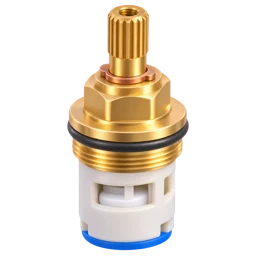
For landlords and multi-home owners · 14 min read
Landlord Guide to Tap Cartridges Across Properties

By The Sparrow team · Updated 30 November 2026
Sizes checked against the Sparrow parts catalogue · How we write guides
A dripping tap is one of the smallest jobs in a rental property and one of the easiest to turn into two visits. The first visit finds out which cartridge is inside. The second fits it. Across several flats, that pattern repeats unless someone keeps a record of what is fitted where. This guide covers identifying cartridges, recording them and cutting the repeat trips.
Why do tap cartridges cause repeat visits?
The cartridge is hidden inside the tap. Two taps that look the same from the outside can take different cartridges, and the difference is often a few millimetres or a different pin pattern on the base. Without a record, the first visit is spent taking the tap apart to find out what is inside.
Ordering from a photo alone can also go wrong. A cartridge photographed from the side shows its height but not the pins underneath. A quarter-turn valve photographed from above shows the splines but not the thread. The measurements that decide fit are the ones a quick photo often misses.
A simple register per flat, plus a small stock of the most common cartridges, turns most drip repairs into a single visit. The same applies to quarter-turn valves, where the spline count is hidden under the handle. The rest of this guide shows what to measure and what to keep.
Mixer cartridge, quarter-turn valve or washer valve: which is it?
Start with how the tap works, not with the size. The type decides which measurements matter and which part you order. A mixer cartridge will not fit a quarter-turn tap, and a washer valve is a different repair again.
| How the tap works | Part inside | How it is sized |
|---|---|---|
| One lever, moves up and down and side to side | Single-lever mixer cartridge | Body width: 25, 35 or 40 mm, plus pins and spindle |
| Two handles, quarter turn from off to full | Quarter-turn ceramic disc valve | Spline count (20 or 24) and thread (1/2 inch or 3/4 inch BSP) |
| Two handles, several full turns | Traditional washer valve or headgear | Thread size and washer, not a cartridge |
| Shower mixer with a temperature dial | Thermostatic cartridge | Make and model of the shower valve |
If the tap has a single lever but the water runs from a separate spout, it is still a mixer cartridge. If the tap has two handles but they turn several times, do not order a ceramic valve. The repair is a washer or headgear, and the cartridge route does not apply. A single-lever tap with a pull-out spray is also a mixer; the spray is a diverter, not a second cartridge.
How do you identify a single-lever mixer cartridge?
Work with the water off and the tap open to drain the pressure. Put the plug in the basin or a cloth over the waste, so small parts cannot disappear down the drain.
- Turn off the isolating valve under the sink or the main stopcock, then open the tap.
- Prise off the decorative cap on the handle and undo the screw or grub screw underneath.
- Lift off the handle and any shroud. Note how they sit so they go back the same way.
- Undo the retaining nut or remove the horseshoe clip that holds the cartridge.
- Lift the cartridge out by the body. If it is tight, wiggle it gently rather than levering the tap body.
- Measure the widest part of the body in millimetres. Common sizes are 25, 35 and 40 mm.
- Count the pins or lugs on the base and note their positions.
- Note the spindle shape: splined or flat-sided, and how long it is.
- Measure the overall height from the base to the top of the spindle.
- Photograph the cartridge on its side next to a coin, with the base visible in a second photo.
Do not lose the retaining clip. Some cartridges are held by a nut, some by a clip, and some by both. If the cartridge is stuck, limescale may be holding it. Keep the tap body steady while you work, and stop if the tap starts to move under the sink.
If the handle will not come off, look for a hidden grub screw under a cap or behind the lever. Do not prise the handle with a screwdriver, because a bent handle or a scratched tap is harder to fix than the drip.
How do you identify a quarter-turn valve?
A quarter-turn tap has two handles, each turning through 90 degrees from off to full. Inside each handle is a ceramic disc valve. The valve screws into the tap body, so the thread and the splines are the two sizes that matter.
- Turn off the water and open both taps to drain the pressure.
- Remove the handle: lift the cap and undo the screw or grub screw.
- Hold the tap body steady and undo the valve with an adjustable spanner on the flats.
- Lift the valve out and count the splines (teeth) on the top of the spindle. Most are 20 or 24.
- Check the thread: basin and kitchen taps are usually 1/2 inch BSP, bath taps 3/4 inch BSP.
- Note which way the valve turns to open, because hot and cold valves often turn opposite ways.
- Measure the overall height and note any markings on the body.
- If both hot and cold valves are the same age, replace them as a pair.
Count the splines twice. They are small, and 20 and 24 look similar at a glance. A valve with the wrong spline count will not accept the handle, even if the thread fits. The guide to 20 or 24 spline quarter-turn valves shows what to look for.
Look after more than one home?Snap each part next to a £1 coin and Sparrow names the exact replacement, then saves it in My Home by property and room, so the next order is right first time.
Get the appWhich measurements have to match?
Width or spline count is the headline, but it is not the whole specification. A cartridge that matches the width and misses the pins will not seat. A valve that matches the splines and misses the thread will not screw in.
| Measurement | Mixer cartridge | Quarter-turn valve | Why it matters |
|---|---|---|---|
| Body size | 25, 35 or 40 mm wide | Not applicable | The cartridge must fit the housing |
| Base pins | Count and position | Not applicable | They locate the cartridge and stop it turning |
| Spindle | Splined or flat, and its length | Splines: 20 or 24 | The handle has to fit and sit at the right height |
| Overall height | Base to top of spindle | Base to top of spindle | The shroud or nut may not go back on if it differs |
| Thread | Not usually threaded; held by a nut or clip | 1/2 inch or 3/4 inch BSP | The valve must screw into the tap body |
| Retaining method | Nut, clip or both | Threaded body | The fitter needs the right fixing and tools |
| Turn direction | Lever moves up and sideways | Hot and cold may turn opposite ways | The handle must open the valve the right way |
Record the retaining method as well: nut, clip or both. It is the detail that stops a fitter hunting for a clip that does not exist. The wider guide to tap cartridge sizes covers the same measurements with more detail on look-alike parts.
Use calipers for the body width if you have them. A tape measure held across a round body can read a millimetre or two out, and that is enough to order the wrong size. For the overall height, stand the cartridge on a flat surface and measure to the top of the spindle, not to the top of the handle splines.
What should the tap register contain?
Keep one row per tap, not one row per flat. A kitchen mixer and a basin pair in the same flat are different parts, and the bath taps may be a third type. A spreadsheet with one tab per property works well.
| Field | Example | Why it matters |
|---|---|---|
| Property | Flat 3, Example House | Keeps each property separate |
| Room and position | Kitchen, sink, single lever | Identifies the exact tap |
| Tap type | Single-lever mixer | Decides which part to order |
| Body or splines | 35 mm, 24 splines | The headline size |
| Pins or spindle | Two pins, splined spindle | Stops a near match being ordered |
| Thread | 1/2 inch BSP | Applies to quarter-turn valves |
| Markings | Any name or number on the part | Helps match a discontinued cartridge |
| Photo reference | IMG_4021 and IMG_4022 | Shows the side and the base |
| Last replaced | Date and fitter | Shows age and who did the work |
| Spare held | One 35 mm cartridge | Shows what is already in stock |
Add a note for anything unusual: a tap that drips only when hot, a handle that is stiff, or a cartridge that had to be ordered specially. Those notes are the difference between a useful record and a list of numbers.
How do you match the same cartridge across flats?
Flats fitted at the same time often have the same taps. That is a useful starting point, not a guarantee. A tap may have been replaced after a leak, or the builder may have used a different range in a later phase. Check the part, not the flat number.
Group taps by exact specification: body width, pin count and position, spindle shape, overall height and retaining method. For quarter-turn valves, group by spline count, thread and turn direction. Two taps that look the same on the outside can sit in different groups.
Markings are the best shortcut. Many cartridges have a name, number or logo moulded or stamped on the body. Record it exactly, including any letters that look like a batch code. When you find a match between flats, record the group name so the next order is obvious.
Do not swap cartridges between taps to test a fit. A used cartridge may be contaminated or damaged, and a cartridge that is forced into the wrong housing can crack the ceramic discs. Compare the measurements instead. If two flats share a group, note the group name in both rows so the link is obvious.
Which spares are worth keeping?
Keep a spare only for a cartridge group that appears more than once in the portfolio. One spare for a group of six taps is useful. One spare for a one-off tap is clutter unless the tap is known to fail often.
| Spare | What to keep | How to label it |
|---|---|---|
| Mixer cartridge | One per common group | Body size, pin count, spindle type and height |
| Quarter-turn valve | A pair of the most common type | Splines, thread and hot/cold direction |
| Washer valve parts | A few washers and a headgear if common | Thread size and washer size |
| O-rings and seals | Only the sizes used by your taps | Tap model and location |
Keep spares in labelled bags with the size and group written on the outside. Store them with the register, not in a general toolbox where they lose their identity. A cartridge without a label is a cartridge nobody will trust to fit. Review the spares once a year against the register and remove anything that no longer matches a tap.
What if the old cartridge is seized or has no markings?
A cartridge that has been in place for years can be held by limescale. Keep the tap body steady and use the correct spanner on the retaining nut. Do not lever against the basin or the tap spout. If the nut will not move, apply a little penetrating oil to the threads, wait, and try again. If it still will not move, stop and call a plumber.
No markings is normal. Many cartridges have none, and the ones that do may carry a number that means nothing outside the tap maker's range. In that case the measurements are the identification: body width, pin count and position, spindle shape, overall height and retaining method. Photograph the base as well as the side, because the pins are the detail that separates two cartridges of the same width.
If the cartridge came out in pieces, measure the largest part of the body and count what is left of the pins. Note the tap make if it is visible on the body or the handle. A plumber or a specialist tap retailer can often identify a part from good photos and the tap model, even when the old cartridge is damaged.
How do you turn a drip repair into one visit?
The visit-once routine is mostly preparation. Check the register before you go, ask for a photo of the tap, and take the likely parts with you. The aim is to arrive with the right cartridge and leave with the tap working.
- Check the register for the flat and the exact tap.
- Ask for a photo of the tap and, if possible, the cartridge once removed.
- Take the matching spare and the tools: spanner, screwdriver or Allen key, cloth and plug.
- Turn off the water, open the tap and confirm the flow has stopped.
- Remove the handle and cartridge, keeping the parts in order.
- Compare the old and new parts before fitting. Check pins, spindle, height and thread.
- Fit the new part, tighten the retaining nut or clip, and turn the water on slowly.
- Run hot and cold, check for leaks at the base and under the sink, and refit the handle.
- Update the register with the date and the exact part fitted.
If the spare does not match, stop and record the exact measurements. Do not force a near match. A second visit with the right part is cheaper than a damaged tap body or a leak behind the unit. Take a small container for the old parts and a torch for the cupboard under the sink.
When is the cartridge not the fault?
Not every drip or stiff handle is a cartridge. Check the symptom before you order, because a new cartridge will not fix a split O-ring or a damaged tap seat.
| Symptom | Likely cause | What to do |
|---|---|---|
| Drips from the spout when the tap is off | Worn cartridge or valve | Replace the cartridge or valve |
| Water around the base of the tap | O-ring, seal or body, not the cartridge | Find the source before ordering |
| Low pressure on one side only | Debris, filter or a partly closed valve | Check the supply and the aerator |
| Handle is stiff or gritty | Limescale or a dry cartridge | Clean or replace; do not force the handle |
| Water runs hot when cold is selected | Cartridge orientation or a crossed supply | Check the fitting and the supply, not just the part |
| Tap will not stop running | Seized or broken valve | Turn off the water and call a plumber |
A tap that drips only when hot can be a cartridge worn on the hot side, but check the supply before ordering. For a mixer that drips, the guide to fixing a dripping mixer tap cartridge walks through the replacement. For a quarter-turn tap, see quarter-turn tap leaking.
Should you standardise taps across a portfolio?
When a tap is due for replacement, choosing the same model across several flats makes future cartridge orders simpler. One spare can fit every tap in the group, and the register becomes a short list instead of a catalogue.
Do not replace a working tap just to standardise. The cost and disruption are rarely worth it. Standardise when a tap fails or when a kitchen or bathroom is being refurbished, and record the model and cartridge at the same time.
Choose a tap with a common cartridge size where you have the choice. A 35 mm mixer cartridge is widely available, while an unusual size may be special order. Keep the box or the specification sheet with the register, and record the tap model and cartridge group on the same row so a future refurbishment does not undo the standard.
What mistakes do landlords make with tap cartridges?
- Ordering by body width alone and ignoring the pins and spindle.
- Counting splines once and ordering the wrong valve.
- Assuming every flat has the same tap.
- Fitting a cartridge that is the right width but the wrong height.
- Losing the retaining clip and refitting the cartridge without it.
- Keeping a box of unlabelled spares that nobody can identify.
- Forcing a stiff cartridge and cracking the tap body.
- Forgetting to update the register after a replacement.
- Buying a spare before checking that the tap group appears more than once.
- Leaving the old cartridge in the tap when the new one is the wrong size.
What are the water isolation and safety rules?
Always isolate before you take a tap apart. Find the isolating valve under the sink, or turn off the main stopcock. Open the tap afterwards to release the pressure and confirm the water has stopped. Put the plug in the basin and keep small parts in a container.
Parts that contact drinking water should be suitable for the job. In the UK, WRAS approval is the usual sign that a product has been assessed for water fittings and materials in contact with drinking water. Ask for a WRAS-approved part where the tap supplies drinking water, and check that the replacement matches the old one.
Call a plumber if there is no isolating valve and you cannot turn off the mains safely, if a cartridge is seized, if the tap body is cracked, or if water will not stop. If the isolating valve is stiff, do not force it; a broken isolator turns a small job into a mains shut-off. Concealed shower valves and thermostatic cartridges are usually model-specific and are not a generic part swap.
How does Sparrow help across flats?
Sparrow (iPhone, ThinkingAI Limited) identifies worn household parts from a photo taken next to a one pound coin. Photograph a cartridge on its side with the base visible, and Sparrow estimates the body size, then shows the matching cartridge type and what to check before you order.
Sparrow Pro keeps each part in My Home, filed by property and room, so the kitchen tap in Flat 3 stays with Flat 3. There is no charge for the parts library and size finder, and no account to create. For a landlord with several flats, that saved record is what turns a two-visit drip into a one-visit fix.
Frequently asked questions
How do I identify the tap cartridge in a rental flat?
Check how the tap works first. One lever that moves up, down and sideways uses a mixer cartridge, sized by body width (commonly 25, 35 or 40 mm). Two handles that turn a quarter turn use ceramic disc valves, identified by 20 or 24 splines and a 1/2 inch or 3/4 inch thread.
Can I use the same cartridge in every flat?
Only if the tap body and the cartridge match exactly. Flats fitted at the same time often have the same taps, but a later replacement or a different range can look identical and take a different cartridge. Check the pins, spindle and height, not just the width.
How many tap cartridges should a landlord keep as spares?
Keep one spare for each cartridge group that appears more than once in the portfolio, plus a pair of the most common quarter-turn valves. Label each one and store it with the register. A random box of cartridges is not useful stock.
Why does my tap still drip after changing the cartridge?
The new cartridge may be the wrong height or pin pattern, or debris may be trapped between the ceramic discs. Check the tap seat and the O-ring as well. If the body is damaged or the cartridge will not seat, a plumber should look at it.
Do I need to turn the water off to change a cartridge?
Yes. Turn off the isolating valve under the sink or the main stopcock, then open the tap to release the pressure. If there is no isolator and you cannot turn off the mains safely, call a plumber.
Are all 35 mm tap cartridges the same?
No. The body width is only the main size. The number and position of pins on the base, the spindle shape, the overall height and the retaining method vary between taps, so compare the old and new side by side.
Look after more than one home?Snap each part next to a £1 coin and Sparrow names the exact replacement, then saves it in My Home by property and room, so the next order is right first time.
Get the appParts guides, Sparrow
We build Sparrow, the iPhone app that identifies worn household parts from a photo taken next to a £1 coin. Our guides cover the six parts Sparrow matches: tap cartridges, euro cylinder locks, uPVC window handles, door handles, shower door seals and window hinges. Every size in a guide is checked against the same parts catalogue the app uses.