uPVC window handles · 13 min read
Espag vs Cockspur Window Handles: How to Tell

By The Sparrow team · Updated 30 November 2026
Sizes checked against the Sparrow parts catalogue · How we write guides
Both handles look similar from the inside of the room, and both are held on by two screws. The difference is what happens behind the handle. Order the wrong type and it will not lock the window, however well the screws line up. This guide shows how to tell them apart, how to measure each one, and which windows use which.
Look at the tip first
Open the window and look at the back of the handle, or at the part that projects into the frame. The tip settles the question in most cases.
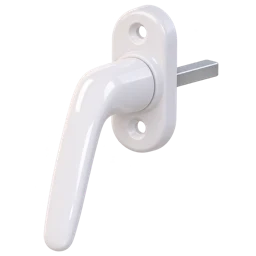
- Square metal bar. That is an espag handle. The bar is the spindle, and it fits into a square slot in the gearbox.
- Curved hook or beak. That is a cockspur handle. The hook reaches over a wedge-shaped block on the frame and pulls the sash tight as you close the handle.
- Neither, but the window tips inward from the top. It may be a tilt and turn handle, which needs its own type.
If the handle is already off, look at the window instead. An espag window has a square spindle hole leading to a gearbox. A cockspur window has screw holes and a wedge on the frame, with no spindle hole. That difference is just as reliable as the handle itself.
What an espag handle is
An espag handle is the common handle on modern uPVC casement windows. The word espag comes from the espagnolette mechanism behind it: a long metal strip that runs around the opening edge of the sash and carries the locking points. The handle turns a gearbox, and the gearbox slides the strip.
The spindle is usually 7 mm square. Common lengths are 30, 35 and 40 mm, measured from the flat base of the handle to the tip. Screw centres are often 43 mm, measured from the centre of one fixing hole to the other. The base can be inline, with a flat back, or cranked, with a step that holds the grip away from the window.
Espag handles can be locking or non-locking. A locking handle has a small key or push button, and it is useful on ground floor windows. The locking mechanism is inside the handle, so the spindle and screw measurements are the same as a non-locking version.
Behind the handle, the gearbox converts the quarter turn into a sliding motion. The espag strip carries several locking points, usually cams or rollers, which engage keeps on the frame. If the handle turns but the strip does not move, the gearbox has failed and a new handle will not help.
What a cockspur handle is
A cockspur handle does not have a spindle. Instead, it has a hook that catches a wedge, sometimes called a striker or wedge block, fixed to the frame. When you close the handle, the hook pulls the sash towards the frame and compresses the seal. It is a simpler mechanism than an espag, and it was common on older uPVC and aluminium windows.
The handle is handed. The hook points to one side, and it has to meet the wedge on the correct side of the frame. A left-handed handle will not work on a right-handed window, even if the screw holes line up. The hand is judged from inside, with the handle closed, and the old handle is the best reference.
Cockspur handles often sit proud of the window because the hook needs room to reach over the wedge. The base may be shaped or stepped to suit the frame. Screw centres vary between systems, so measure rather than assuming a standard figure.
The hook pulls the sash onto the frame, so the seal compresses as the handle closes. If the hook is worn or the wedge has moved, the sash will not pull tight and the window may rattle or let in a draught. That is a different fault from a handle that will not turn.
Espag vs cockspur: side by side
| Feature | Espag | Cockspur |
|---|---|---|
| What engages the window | 7 mm square spindle into a gearbox | Hook over a wedge on the frame |
| Locking action | Turns the espag strip and its locking points | Pulls the sash onto the frame |
| Handed | Usually not handed | Left- or right-handed |
| Screw centres | Often 43 mm | Varies, so measure |
| Base | Inline or cranked | Often stepped or shaped |
| Typical window | Modern uPVC casement and tilt and turn | Older uPVC and aluminium |
| Spare parts | Handle, spindle and gearbox are separate | Handle and wedge are separate |
The table describes the common versions, not every window. Some older espag handles have unusual bases, and some cockspur handles have a locking key. The tip and the window mechanism are the reliable tests.
One more difference is the way the two handles feel. An espag handle usually has a firm quarter turn with a positive stop at each end. A cockspur handle folds over and pulls down, often with a softer feel and a visible hook at the tip. If you have both types in the house, the difference is obvious once you look at the back.
Not sure which one you have?Snap it next to a £1 coin and Sparrow names the exact replacement for upvc window handles, with the measurements to check. Your first scan is free.
Get the appScrew centres and fixing holes
Screw centres are the distance between the centres of the two fixing holes. On an espag handle they are often 43 mm, but that is a common size, not a rule. On a cockspur handle they vary more widely, because the handle has to clear the wedge and suit the frame profile.
Measure from the centre of one hole to the centre of the other. Measuring edge to edge adds the hole width, so the figure comes out too big. If there are three holes, measure the spacing between each pair and note the pattern.
The new handle must cover the old holes. If the spacing is slightly out, do not ream the holes to suit. That can break the seal, let water in and weaken the frame around the fixing. Buy a handle with the right centres, or ask a window specialist about an adaptor.
Check the screw length too. Screws that are too long can reach the gearbox or come through the inside face and cause damage. Screws that are too short will not grip. Use the screws supplied with the handle if they match the old ones, and do not overtighten them into plastic.
Cockspur handedness: which side does the hook face?
Stand inside the room, facing the window, with the window closed and the handle in its closed position. Look at the hook. If it points to the left, the handle is left-handed. If it points to the right, it is right-handed. That is the convention to use when ordering, and it is the one the old handle will match.
Do not judge the hand from outside the window, because everything is reversed. Do not judge it with the handle open either, because the hook swings away from the wedge and the direction can look different. Closed, from inside, is the position that matters.
If the old handle is missing, look at the wedge on the frame. The hook has to approach it from the correct side. A window with two opening sashes side by side often needs one left-handed and one right-handed handle, so check each one separately.
Before fitting, hold the new handle against the old one and check the hook sits at the same height and points the same way. A hook that is offset will miss the wedge even when the screw holes line up. If the two hooks look different, stop and check the part number before you fit it.
Are espag handles left- or right-handed?
Most espag handles are not handed. The spindle is square and the base is symmetrical, so the same handle can be fitted to a left-opening or right-opening window. The handle is simply rotated to suit.
Some espag handles have a shaped or cranked base that only fits one way. A cranked handle may need to clear a reveal on one side, and the step can be on the left or right of the base. If the old handle has an asymmetric base, match its shape rather than assuming a universal fit.
Locking espag handles can also have the key on one side. That does not usually make them handed, but it can affect which way the key is accessible. Check the old handle if the key position matters.
If the base is asymmetrical, photograph it from the back before ordering. A shaped base that is fitted upside down or on the wrong side will not sit flat, and the spindle may not line up with the gearbox even though the length is correct.
Which windows use which handle
| Window type | Typical handle | What to check |
|---|---|---|
| Modern uPVC casement | Espag, inline or cranked | Spindle length (30, 35 or 40 mm), screw centres, base shape |
| Tilt and turn uPVC | Espag-style tilt and turn handle | Longer spindle and a different handle body |
| Older uPVC casement | Cockspur, left or right | Hand, screw centres, wedge position |
| Aluminium casement | Cockspur or espag, depending on the lock | The tip and the window mechanism, not the frame material |
| Timber casement | Either, depending on the lock fitted | Look for a spindle hole or a wedge |
Do not choose by the frame material alone. Aluminium windows can use either type, and some timber windows have espag locks. The handle tip and the presence of a gearbox or a wedge tell you what the window needs.
A tilt and turn window is a special case. It uses an espag-style spindle, but the handle often has a longer spindle and a different body to suit the tilt position. A standard casement handle may fit the spindle but not operate the tilt sequence correctly. Measure the old handle and match the type.
Which parts wear on each type
The handle is only one part of the system, and the window side wears too. Knowing which part is worn stops you buying a handle that cannot fix the fault.
| Part | Espag | Cockspur |
|---|---|---|
| Handle | Spring and click wear, body cracks, splines round off | Hook wears, body cracks, screw holes enlarge |
| Link to the window | 7 mm spindle, tip can round or snap | No spindle; the hook is part of the handle |
| Window mechanism | Gearbox and espag strip wear | Wedge or striker wears or moves |
| First fix | Replace the handle, then check the gearbox | Replace the handle, then check the wedge |
| Sign of wear | Handle turns but locking points do not move | Handle closes but the sash stays loose |
An espag handle can be perfect and the window still fail to lock, because the gearbox behind it has worn. A cockspur handle can be perfect and the window still rattle, because the wedge has moved or the seal has flattened. Check the window side before you spend money on a handle.
To test an espag gearbox, remove the handle and turn the spindle by hand. The locking points should move smoothly along the sash edge. To test a cockspur wedge, close the window gently and try to lift the sash. If it moves, the wedge is not pulling it tight. Both tests take a minute and tell you whether a handle will help.
How to measure either type
- Start with the window open and the handle turned to release the locking points.
- Take out the two screws under the cover plate and keep them together.
- Draw the handle away and identify the tip before measuring anything.
- Espag: run a rule from the mounting face to the spindle tip, then check the square is 7 mm.
- Cockspur: with the handle closed, note the direction of the hook.
- For both, measure from hole centre to hole centre for the screw spacing.
- Note a flat, stepped or shaped base, and the step height if there is one.
- Photograph the handle beside a rule and note whether it locks.
If the handle is stuck, do not force it. A handle that will not come off may have a hidden grub screw under a cap, or the screws may be seized. The handle won't turn or lock guide covers the common reasons before you damage the frame.
What to check before buying
- Type: espag or cockspur, confirmed by the tip and the window mechanism.
- Spindle: 7 mm square on most espag handles, and the measured length (30, 35 or 40 mm).
- Screw centres: measured centre to centre, often 43 mm on espag but variable on cockspur.
- Base: inline or cranked, with the step height if cranked.
- Hand: left or right on a cockspur, judged from inside with the handle closed.
- Locking: locking or non-locking, matching the old handle.
- Finish: white, chrome, satin or gold, to match the window.
If you are buying for several windows, measure each one. Two windows that look identical from inside can have different screw centres or spindle lengths, especially if one has been repaired before. The window handle types guide explains the inline, cranked and tilt and turn variations.
Buy from a seller that accepts returns. Handles are small, so a return is simple if the fit is wrong. Keep the packaging until the handle is fitted and the window locks properly.
How to replace the handle
The two types come off the same way but go back differently. Follow the section that matches your handle.
Espag handle
- Turn the handle to the open position and undo the screws behind the cover.
- Ease the old handle out and check the spindle is not left in the gearbox.
- Slide the new spindle into the slot and seat the base against the sash.
- Drive the screws in evenly, then test the full turn and the locking points.
Cockspur handle
- Open the window and free the old handle from its screws.
- Lift the hook clear of the wedge and pull the handle away.
- Offer up the new handle with the hook on the wedge side.
- Close the handle to engage the hook, then fit the screws.
- Check the sash pulls tight and the handle folds fully.
A cockspur handle that misses the wedge will not pull the window shut, even if the screws are tight. Check the hook engages before you tighten anything. An espag handle that stands off the sash usually has a spindle that is too long, not a screw that needs more force.
Test the handle before you close the window fully. Turn it through its travel and watch the locking points or the hook. If something binds, stop and check the alignment rather than forcing the handle. A small adjustment now is easier than repairing a damaged gearbox later.
Troubleshooting
| Problem | Likely cause | What to check |
|---|---|---|
| Handle is loose on the frame | Loose screws or worn holes | The fixing screws and the holes |
| Handle turns but the window will not lock | Spindle too short or gearbox fault | Spindle engagement and the locking points |
| Handle spins freely | Worn splines or a snapped spindle | The spindle and the handle teeth |
| Cockspur hook misses the wedge | Wrong hand or the handle is not closed | The hook direction and the wedge position |
| Window will not close flush | Hinges or the wedge, not the handle | The window closing guide |
| Handle does not sit flush | Spindle overlong or base mismatch | Compare the spindle length and base profile |
If the handle is the right type and the window still will not lock, the fault may be in the gearbox or the wedge. A new handle will not fix a worn gearbox, and a cockspur handle will not fix a wedge that has moved or broken.
Common mistakes
- Calling every uPVC window handle an espag handle.
- Ordering by screw centres without checking the type.
- Getting the cockspur hand wrong by judging it from outside.
- Assuming 43 mm screw centres apply to every handle.
- Fitting an espag handle to a cockspur window, or the other way round.
- Ignoring a cranked base and ordering a flat one.
- Forcing screws into holes that do not line up.
- Blaming the handle when the gearbox or wedge has failed.
When to call a window specialist
Bring in a window specialist if turning the spindle does not shift the gearbox, if a cockspur wedge has broken or shifted, or if a dropped sash has put the handle out of line. The same applies when a window on an escape route is stuck, or when the frame or glazing is damaged.
Changing the handle type is not a DIY swap. A cockspur window has no gearbox for a spindle, and an espag window has no wedge for a hook. Converting one to the other means changing the locking mechanism, which is a specialist job. The identify a replacement part from a photo guide helps if you are unsure what you have.
If the window is an escape route, keep it able to open until the replacement is ready. A handle that is loose but still works is better than no handle at all. Do not remove the only means of opening a bedroom window and leave it overnight.
How Sparrow helps
Sparrow is an iPhone app made by ThinkingAI Limited that identifies worn household parts from a photo taken next to a pound coin. It can name an espag or cockspur handle from a photo, estimate the spindle length against the coin and show the matching spec, the checks before buying and links to search Screwfix, Toolstation and Amazon UK. The library covers espag spindles in 30, 35 and 40 mm and cockspur handles in both hands. The first scan is free, and Sparrow matches parts only: it does not give repair advice.
If the old handle is snapped, photograph the part that came out beside the coin. The type and the spindle length are often still readable.
Frequently asked questions
How can I tell an espag handle from a cockspur handle?
Look at the part that goes into the window. An espag handle has a square metal spindle, usually 7 mm, that turns a gearbox. A cockspur handle has a curved hook that catches a wedge on the frame. If the handle is still fitted, the hook is visible at the tip when the window is open.
What is the difference between an espag and a cockspur window handle?
An espag handle drives a locking mechanism through a square spindle. A cockspur handle pulls the sash onto the frame with a hook and a wedge. Espag handles are common on modern uPVC windows; cockspur handles are common on older uPVC and aluminium windows.
Are cockspur handles left- or right-handed?
Yes. The hook points to one side, and the handle must match the wedge on the frame. Judge the hand from inside, with the handle closed, and compare it with the old handle before ordering.
Do espag handles have a handedness?
Most do not. The square spindle and symmetrical base let the handle fit either side of a window. Some shaped or cranked bases are handed, so check the old handle if the base is not symmetrical.
What screw centres does a cockspur handle have?
They vary between window systems, so there is no single figure to rely on. Measure from the centre of one fixing hole to the centre of the other, and note whether there are two or three holes.
Can I replace a cockspur handle with an espag handle?
No. A cockspur window has a wedge on the frame and no espag gearbox for a spindle to drive. An espag window has a gearbox and no wedge. Converting means changing the window's locking mechanism, which is a job for a window specialist.
Not sure which one you have?Snap it next to a £1 coin and Sparrow names the exact replacement for upvc window handles, with the measurements to check. Your first scan is free.
Get the appParts guides, Sparrow
We build Sparrow, the iPhone app that identifies worn household parts from a photo taken next to a £1 coin. Our guides cover the six parts Sparrow matches: tap cartridges, euro cylinder locks, uPVC window handles, door handles, shower door seals and window hinges. Every size in a guide is checked against the same parts catalogue the app uses.

