Tap cartridges · 13 min read
Ceramic Disc vs Compression Tap: Which Have You Got?

By The Sparrow team · Updated 30 November 2026
Sizes checked against the Sparrow parts catalogue · How we write guides
Both types drip when they wear, and both are fixed by replacing a small part. The mistake is buying the wrong part. A ceramic valve will not fit a compression tap body, and a rubber washer has no place in a ceramic valve. This guide shows how to tell them apart in seconds, what fails in each, and exactly what to buy.
Quarter turn or multi-turn: the ten-second test
You do not need any tools for the first test. Turn the handle slowly from fully off to fully on and watch how far it travels. The movement is the clearest difference between the two types.
| What the handle does | What is inside | What you will be buying |
|---|---|---|
| Stops after about 90 degrees, with a firm end stop | Ceramic disc valve | A complete valve, matched by splines and thread |
| Winds two or three full turns, with a soft stop | Compression valve (headgear) | A rubber washer, jumper or complete headgear |
| One lever moves up and down and side to side | Single-lever mixer cartridge | A cartridge, matched by body width |
| Push button or sensor, no handle travel | Electronic or push-button valve | A maker-specific part, not covered here |
Do the test with the water running if you can. A dry tap can feel stiff and give a false impression, especially if the washer has stuck to the seat. If the handle turns but the water does not come on, the fault may be the supply rather than the valve.
What is inside a ceramic disc tap?
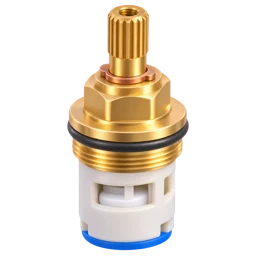
A ceramic disc valve has two polished ceramic plates inside a brass or plastic housing. One plate is fixed to the body. The other is attached to the spindle and turns with the handle. Each plate has ports cut through it. When the ports line up, water flows; when the moving plate covers them, the water stops.
The plates are lapped flat, so they seal against each other without a rubber washer in the water path. A set of O-rings seals the housing against the tap body and the spindle. The whole assembly screws into the tap with a threaded body, usually 1/2 inch BSP on a basin or kitchen tap and 3/4 inch BSP on a bath tap.
The spindle that the handle sits on is splined, with fine teeth around its top. Those teeth are what the handle grips. A ceramic valve is a sealed unit for practical purposes: you replace it rather than rebuilding it, although some can be cleaned if the fault is only grit between the plates.
What is inside a compression tap?
A compression tap uses a threaded spindle to push a small plunger, called a jumper, down onto a seat. A rubber washer sits on the bottom of the jumper. When you turn the handle, the spindle winds the jumper down and the washer closes the waterway. Turning the other way lets the jumper rise and the water flows.
The washer is the part that seals, and it is also the part that wears. Rubber hardens, cracks and loses its shape, so the tap drips when it is closed. The metal seat below it can pit or scratch, especially in hard water. A rough seat will tear a new washer, which is why some compression taps drip again soon after a washer change.
The removable assembly is called the headgear. It includes the spindle, the jumper, the washer and the nut that holds it into the tap body. You can buy just a washer, a jumper, or the complete headgear, depending on what has worn.
Ceramic disc vs compression: side by side
| Feature | Ceramic disc | Compression |
|---|---|---|
| Handle travel | About a quarter turn | Two or three full turns |
| What seals the water | Two ceramic plates | A rubber washer on a metal seat |
| Common failure | Scored plates, hardened O-rings, worn splines | Perished washer, pitted seat, worn jumper |
| Usual repair | Replace the valve | Replace the washer, then the headgear |
| What to measure | Splines (20 or 24), thread, body length | Thread, washer diameter and thickness |
| Handle fitting | Splined spindle | Often a screw on top, sometimes splined |
| Feel when worn | Gritty or loose | Stiff, squeaky or slow to close |
The table is a guide, not a guarantee. Some ceramic valves are half turn rather than quarter turn, and some old compression taps have a coarse thread that moves quickly. The handle travel tells you the family; the parts inside confirm it.
Not sure which one you have?Snap it next to a £1 coin and Sparrow names the exact replacement for tap cartridges, with the measurements to check. Your first scan is free.
Get the appWhat wears out in each type
| Part | Ceramic disc | Compression |
|---|---|---|
| Sealing surface | Ceramic plates score or chip | Rubber washer perishes or splits |
| Seat | No separate seat | Metal seat pits or scratches |
| Spindle | Splines wear, handle slips | Thread wears, handle turns without lifting the jumper |
| Body seals | O-rings harden and weep | Gland packing or O-ring weeps |
| Handle | Grub screw loosens, teeth wear | Top screw loosens, handle cracks |
In a ceramic tap, the plates usually fail because grit or scale gets between them and scores the faces. The valve then drips when closed, even though the handle still feels firm. In a compression tap, the washer fails first because it is soft and constantly compressed. The tap drips, and the drip gets worse as the washer splits further.
The two types also fail differently when they are stiff. A ceramic valve that is gritty needs replacing, because the plates cannot be resurfaced at home. A compression tap that is stiff may only need the jumper cleaned and a little silicone grease on the spindle, although a worn thread means a new headgear.
Where the water appears matters too. A drip from the spout when the tap is closed points to the sealing part: the ceramic plates or the rubber washer. Water appearing around the base of the handle usually means the O-ring or gland that seals the spindle, not the main valve. Water under the tap body can be the thread seal or a cracked body, which is a different repair again.
A tap that drips only when the hot water is running can be a thermal expansion fault. The seat or the ceramic plates change shape slightly as they heat, and a marginal seal opens. Note when the drip happens before you buy a part, because it narrows down which surface has failed.
The parts to buy for a ceramic disc tap
A ceramic valve is matched on four things, and all four matter:
- Spline count. Count the teeth on the spindle. Most UK valves have 20 or 24. The handle has to mesh with them.
- Thread. Basin and kitchen taps usually take 1/2 inch BSP. Bath taps usually take 3/4 inch BSP.
- Body length and shape. The new valve must sit at the same depth so the handle and shroud fit back on.
- Hot or cold direction. Valves are often sold in pairs, with one turning clockwise to open and the other anticlockwise. Match the old one.
Take the old valve with you if you can, or photograph it from the side and from the top. The splines are easier to count from a straight-down photo. If the handle is worn rather than the valve, a new handle may be enough, but check the teeth inside the handle before you buy.
The parts to buy for a compression tap
Start with the washer. It is the simplest part and the most likely culprit. Take the old washer to the shop and match its outside diameter and its thickness. A washer that is too thick will stop the tap closing fully. One that is too thin will not seal, however hard you turn the handle.
If a new washer does not stop the drip, look at the seat. A pitted seat needs reseating, which means cutting a new smooth face with a reseating tool. That is a job for someone who has done it before, because it is easy to cut too deep. If the seat is badly damaged, a new tap is often the simpler answer.
If the spindle thread is worn, the jumper will not lift or lower properly even with a new washer. Buy the complete headgear, matched by thread and overall length. Some headgear is sold as a hot or cold version, so note which side you are replacing.
Washers come in flat and bevelled shapes. Fit the same shape as the old one, because a bevelled washer sits into a matching recess and a flat one may not seal there. Never fit two washers to take up wear: the extra thickness stops the tap closing and can damage the jumper.
If the old washer has crumbled, scrape out every fragment before fitting the new one. A stray piece of rubber on the seat will cause a drip that looks like a failed washer.
Thread sizes: 1/2 inch and 3/4 inch BSP
BSP is the British Standard Pipe thread used on tap valves. It describes the thread, not the width of the waterway. Basin and kitchen taps usually use 1/2 inch BSP. Bath taps usually use 3/4 inch BSP. The difference is visible when you put the old valve beside the new one: the bath valve is noticeably larger across the thread.
Do not assume that matching taps in a house use the same valves. A basin and a bath may look like a set but take different threads. Check each one. If you are unsure, take the old valve to the shop and try it in the new one, or measure across the threaded body with calipers.
Older or imported taps can use a different thread altogether. If the old valve does not match either size, stop and take it to a plumber's merchant rather than forcing a 1/2 inch valve into a 3/4 inch body.
To measure the thread, use calipers across the outside of the threaded section, not across the flats of a nut. Compare the figure with the old valve rather than with the pipe. BSP sizes are nominal, so the measured outside diameter will not equal the number in the name.
Spline count and handle fit
The splines are the fine teeth on top of the spindle. They transfer the turn of the handle to the valve. Count them once, mark a starting tooth, and count again. Twenty and twenty-four are the common UK counts, but the only reliable number is the one on your valve.
A handle with the wrong spline count will not sit down properly. It may go on part way and slip as soon as you turn it, or it may not go on at all. Do not force it. If the handle goes on but slips, check whether the teeth inside the handle are worn. A worn handle can make a good valve feel broken, and a new handle is usually the simpler part to replace.
Hot and cold valves often turn in opposite directions, so the handles close towards the centre or away from it. If you replace both, fit the hot valve on the hot side and the cold valve on the cold side, then check that both handles turn the way you expect.
How to strip a tap and identify the valve
- Turn off the water at the isolating valve or stopcock, then open the tap to release the pressure.
- Prise off the decorative cap on the handle and undo the screw or grub screw underneath.
- Lift the handle off. If it is tight, wiggle it gently rather than levering against the tap body.
- For a ceramic valve, undo the retaining nut or shroud and lift the valve out.
- For a compression tap, undo the headgear nut, usually a hex, and lift the headgear out with the jumper and washer.
- Lay the parts out in the order they came off, and photograph them before anything rolls away.
- Measure the thread, count the splines if there are any, and measure the washer if it is a compression tap.
If the valve or headgear will not move, hold the tap body steady with a second spanner. Forcing it can twist the tap on its pipe and start a leak under the sink. If it still will not move, stop and call a plumber.
Where single-lever mixer taps fit
A single-lever mixer is neither of the two types above in terms of the part you buy. It uses one mixer cartridge that controls both flow and temperature. The cartridge is sized by the width of its body, commonly 25, 35 or 40 mm, and it has a stem that the lever fits onto.
Do not buy two quarter-turn valves for a single-lever tap. A mixer has one cartridge and one body, not two separate hot and cold valves. If you are unsure which you have, move the lever: one lever that sweeps side to side is a mixer, while two separate handles are the pair type.
The tap cartridge sizes guide covers mixer cartridges in detail. For the pair type, the 20 or 24 spline valve guide shows how to count the teeth.
How to replace each type
The two repairs are different, so follow the one that matches your tap. Isolate the water and open the tap before either.
Fitting a ceramic valve
- Remove the handle and the retaining nut or shroud.
- Lift the old valve out and clean the inside of the tap body.
- Check the new valve has the same spline count, thread and body length.
- Fit the new valve with the hot port on the hot side and the cold port on the cold side.
- Tighten the retaining nut firmly, then refit the handle and cap.
- Open the water slowly and check for leaks before running the tap through hot and cold.
Fitting a compression washer
- Remove the handle and undo the headgear nut.
- Lift out the headgear and take off the jumper and old washer.
- Clean the seat and check it is smooth. A pitted seat needs reseating.
- Fit the new washer to the jumper, making sure it sits flat and square.
- Refit the jumper and headgear, then tighten the nut without overdoing it.
- Open the water slowly, run the tap, and check for drips at the spout and around the nut.
If a new ceramic valve drips, check it is seated square and that the O-rings are not pinched. If a new compression washer still drips, the seat is the next suspect. The quarter-turn tap leaking guide and the dripping mixer tap guide take each repair further.
Can you convert one type to the other?
No, not as a straightforward part swap. A compression tap body has a machined seat at the bottom of the waterway. The rubber washer closes against that seat. A ceramic valve does not use the seat: it seals on its own plates and O-rings, and its ports have to line up with the waterways in the body.
The threads may look similar, and a ceramic valve may even screw into a compression body, but that does not make it safe or reliable. The internal depth, the port positions and the handle fitting all differ. A valve that sits too deep or too shallow will leak, or the handle will not sit down.
If you want to change the style of tap, replace the whole tap. A plumber can do that without altering the pipework beyond the tap connectors. Do not buy a conversion kit unless the tap maker specifically lists one for your model.
A new tap also gives you new seats, new seals and a known spare part for the future. On an old tap with worn plating and a pitted seat, that is often better value than chasing a conversion that may never seal properly.
Common mistakes
- Buying a ceramic valve for a tap that winds several turns.
- Buying a washer by diameter only, without checking its thickness.
- Counting splines once and ordering the wrong valve.
- Forcing a stiff ceramic valve instead of replacing it.
- Replacing a whole tap when only a washer has failed.
- Fitting a hot valve on the cold side, so the handle turns the wrong way.
- Ignoring a pitted seat and fitting washer after washer.
- Assuming a basin and bath tap from the same range use the same thread.
When to call a plumber
Call a plumber if the water will not isolate, if the valve or headgear is seized, or if the tap body moves when you turn the spanner. Stop if the seat is deeply pitted and you do not have a reseating tool, or if the tap body is cracked. A crack can spray water as soon as the supply is back on.
Also call for help if the tap is on a pressurised unvented cylinder, a communal system, or a concealed pipework arrangement you cannot isolate safely. A washer change is a small job, but a leak inside a wall or ceiling is not.
If you have replaced the washer or valve twice and the drip returns within a short time, stop buying parts. That pattern points to a rough seat, a distorted tap body or the wrong part, and a plumber can tell you which without another trip to the shop.
How Sparrow helps
Sparrow is an iPhone app made by ThinkingAI Limited that identifies worn household parts from a photo taken next to a pound coin. Point it at a tap cartridge or valve and it names the type, estimates the size against the coin and shows the matching spec, the checks before buying and retailer search links for Screwfix, Toolstation and Amazon UK. The library includes 25, 35 and 40 mm mixer cartridges and 20 or 24 spline quarter-turn valves. The first scan is free, and Sparrow matches parts only: it does not give plumbing advice.
Frequently asked questions
How can I tell if my tap is ceramic disc or compression?
Turn the handle from fully off to fully on. If it stops after about a quarter turn, it is a ceramic disc valve. If it winds round two or three times, it is a compression valve with a rubber washer. A single lever that moves up and down and side to side is a mixer cartridge, which is a different part again.
What wears out in a ceramic disc tap?
The ceramic faces can be scored by grit or scale, the O-rings can harden, and the splines on the spindle can wear. The valve is usually replaced as a unit rather than repaired. A drip when the tap is off points to the discs or the O-rings.
What wears out in a compression tap?
The rubber washer perishes and splits, the metal seat it presses against can pit, and the threaded spindle or jumper can wear. A new washer fixes most drips, but a rough seat will keep damaging new washers.
Can I replace just the washer in a compression tap?
Yes, if the seat is smooth. Take the old washer with you to match its diameter and thickness, because a washer that is too thick will stop the tap closing and one that is too thin will still drip. If the seat is pitted, it needs reseating or the tap needs replacing.
Are all quarter-turn tap valves 20 or 24 splines?
Most UK quarter-turn valves are 20 or 24 splines, but not all. Count the teeth on the spindle and check the handle grooves match. A 20 spline handle will not fit a 24 spline valve.
Can I fit a ceramic valve in a compression tap?
No, not as a reliable repair. A compression tap body has a seat for a rubber washer and a different internal depth. A ceramic valve seals on its own ports and O-rings, so the two are not interchangeable even when the thread looks similar.
Not sure which one you have?Snap it next to a £1 coin and Sparrow names the exact replacement for tap cartridges, with the measurements to check. Your first scan is free.
Get the appParts guides, Sparrow
We build Sparrow, the iPhone app that identifies worn household parts from a photo taken next to a £1 coin. Our guides cover the six parts Sparrow matches: tap cartridges, euro cylinder locks, uPVC window handles, door handles, shower door seals and window hinges. Every size in a guide is checked against the same parts catalogue the app uses.

