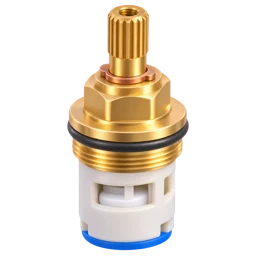
Tap cartridges · 14 min read
40mm Tap Cartridge: Identification and Replacement

By The Sparrow team · Updated 30 November 2026
Sizes checked against the Sparrow parts catalogue · How we write guides
The tap is a big kitchen mixer, the lever has gone stiff, and the cartridge inside is wider than the one you replaced in the bathroom. A 35 mm part looks close in a photo, but close is not enough. The body has to enter the housing, the pins have to locate and the lever has to clamp.
This guide covers the 40 mm cartridge specifically: where it is used, how to measure it without being misled by the collar, the spindle types you will meet, and the one case where a 40 mm housing legitimately holds a smaller cartridge.
Where you will find a 40 mm cartridge
Forty millimetre cartridges turn up in taps that need to move a lot of water: large kitchen mixers, pull-out spray taps, and mixers with a high spout and a wide body. The bigger body carries larger ports, which means less restriction and a stronger flow at the same pressure.
They also appear in some bath mixers and in taps styled like commercial fittings. A large, heavy tap is a hint, but it is not proof. Some big-looking taps use a 35 mm cartridge, and some compact ones use a 40 mm, so the outside of the tap tells you very little.
If the tap has a single lever and a spout that swivels, and the body is wider than your palm, start by assuming 40 mm but confirm by measurement. If it is a small cloakroom mixer, start at 25 mm instead.
Kitchen taps with a pull-out hose are the most likely to use a 40 mm cartridge, because the spray head and hose add restriction, and the tap needs a larger cartridge to keep the flow up. If yours has a hose, check the cartridge before ordering a 35 mm part out of habit.
How to measure the body of a 40 mm cartridge
The measurement that matters is the widest smooth part of the cartridge body, the section that carries the seals and sits inside the tap housing. The retaining nut, the collar and the top flange are all wider, and measuring across them is a common cause of a wrong order.
- Remove the cartridge and wipe off limescale with a cloth. Do not scrape the body.
- Find the smooth cylinder between the base and the collar.
- Measure across its widest point with calipers held square to the body.
- Measure the overall height, from the base to the top of the spindle.
- Count the pins on the base and note their positions.
- Note whether the spindle is splined or flat-sided, and measure its length.
If the measurement lands at 43 or 44 mm, you have almost certainly measured the collar. A 40 mm body should read close to 40 mm once the scale and dirt are off. If it reads 35, you have a 35 mm cartridge in a housing that may be larger, which is the case covered further down.
Measuring with the cartridge still in the tap is possible but unreliable. The collar, the shroud and the tap body all get in the way, and the calipers cannot sit square. Take it out, even if that means the water has to stay off for a while.
Housing size vs cartridge size
The bore in the tap body and the cartridge that sits in it are not always the same size. Some taps are machined with a 40 mm bore and use a threaded reducing collar to hold a 35 mm cartridge. The collar stays in the tap when you remove the cartridge, and the part you order is a 35 mm.
You can spot this by looking at the cartridge once it is out. If there is a separate ring or sleeve around the body, or the housing is clearly wider than the part that came out, measure the cartridge and not the hole. Ordering a 40 mm because the hole is 40 mm will leave you with a part that does not fit.
| What you see | What it means | What to order |
|---|---|---|
| Body measures 40 mm, no sleeve | A standard 40 mm housing | 40 mm cartridge |
| Body measures 35 mm, sleeve or collar around it | A 40 mm bore with a reducing collar | 35 mm cartridge, keep the collar |
| Body measures 35 mm, housing looks 35 mm | A standard 35 mm tap | 35 mm cartridge |
| Body measures 25 mm | A small mixer or cloakroom tap | 25 mm cartridge |
The reverse does not work. A 40 mm cartridge cannot be squeezed into a 35 mm housing, and no adapter makes it safe. If the body will not enter, the size is wrong, whatever the listing said.
Collar threads vary as well. A reducing collar may be a coarse thread that screws into the tap body, or a fine thread on the outside of the cartridge. If you are replacing the collar as well as the cartridge, check that the thread matches; if the collar is sound, keep it and change only the cartridge.
Not sure which one you have?Snap it next to a £1 coin and Sparrow names the exact replacement for tap cartridges, with the measurements to check. Your first scan is free.
Get the appFlat or splined: matching the spindle
The spindle is the stem the lever clamps onto. On 40 mm cartridges you will meet both splined and flat-sided versions, and neither is a sign of quality. What matters is that the lever you have fits the stem you buy.
A splined spindle has fine teeth running around it. The lever socket has matching teeth, and a grub screw pulls it tight. A flat-sided spindle has one or two machined flats, and the lever socket has a matching shape so it can only go on in one or two positions.
| Spindle | How to recognise it | What goes wrong if mismatched |
|---|---|---|
| Splined | Fine teeth around the stem | Lever slips or will not seat; grub screw cannot grip |
| Flat-sided | One or two machined flats | Lever sits at the wrong angle or rocks on the stem |
| Square | Four distinct sides | Rare on mixers, but check before ordering |
Spindle length is part of the same check. A stem that is too short will not reach through the lever, and one that is too long holds the lever away from the body. Compare the old and new parts with the lever off, not just by eye through the packaging.
Look at the old spindle for marks left by the grub screw. They show where the lever sat and how far down the stem it went. If the new spindle is the same length but the marks would land past the top, the lever will not clamp.
Height, ports and the retaining collar
Two 40 mm cartridges can differ in height, port spacing and the way they are retained. Some are held by a large nut that screws onto the tap body. Others use a collar that threads into the body itself. The thread and the collar are part of the tap, so you need a cartridge that matches them.
Port layout is the other detail that catches people out. The hot and cold inlets have to line up with the holes in the tap body, and the outlet has to feed the spout. A cartridge with the same diameter and height but a different port pattern can fit physically and still deliver the wrong temperature or a restricted flow.
Before you fit, lay the new cartridge beside the old one with the bases facing the same way. Compare the port openings, the pin positions and the height of the collar. If anything looks different, stop and check the listing again.
Height affects the lever as well as the seal. A cartridge that is a few millimetres taller can lift the lever, change the angle of the grub screw and make the tap feel loose even when the nut is tight. If the lever sits higher than it used to, take the cartridge out and measure again.
Why big mixers use a 40 mm cartridge
Flow through a cartridge is limited by the size of its ports and the distance the disc has to move. A wider body lets the manufacturer build bigger openings, so a 40 mm cartridge can pass more water with less pressure loss. That is why large kitchen mixers, especially those with a pull-out spray, tend to use one.
A bigger cartridge is not automatically better for every tap. Fitting one where the housing is designed for 35 mm is not possible, and fitting a 35 mm cartridge into a 40 mm tap without the right collar restricts flow and risks leaks. Match the tap, not the specification you wish it had.
If your tap has always had weak flow on hot, the cartridge may be partly blocked rather than too small. Descale or replace it before you conclude that the tap is under-specified.
Flow also depends on the rest of the installation. A tap fed by narrow flexi tails or a partly closed isolation valve will never feel like a high-flow mixer, whatever cartridge is inside. Check the valves are fully open before you spend money on a part.
What do the numbers on the old cartridge mean?
Most cartridges carry a moulded number, or a set of letters, on the base or the side of the body. Sometimes it is the manufacturer's part number. Sometimes it is a mould number, a date code or a code for the tool that made it. Two cartridges that look identical can carry different numbers for reasons that have nothing to do with size.
Treat the number as a cross-check, not the answer. If you find a listing that quotes the same number and the measurements match, that is a good sign. If the number is worn or unreadable, the measurements still tell you what you need.
Photograph the base and the body before you put the old cartridge down. A clear photo of the number, the pins and the ports is often more useful than a note, especially if you are ordering online and want to compare listings later.
Does the tap brand tell you the cartridge size?
Not reliably. A manufacturer can use a 35 mm cartridge in one range and a 40 mm in another, and the same tap model can change cartridge partway through production. Buying "the cartridge for this tap" without measuring is a gamble, even when the brand and model are correct.
This is why listings that say "fits most kitchen mixers" are close to useless. The seller may be right about the tap family and wrong about the revision. Your old cartridge is the only sample that definitely came out of your tap.
If the tap is new enough to have instructions, check whether they list a cartridge number. Otherwise, measure the body and the height, count the pins and note the spindle. Those four facts travel better than a brand name.
40 mm vs 35 mm vs 25 mm at a glance
| Cartridge | Typical tap | Flow character | Where it fits |
|---|---|---|---|
| 25 mm | Small basin and cloakroom mixers | Lower flow, compact body | 25 mm housing |
| 35 mm | Most kitchen and basin mixers | Standard flow | 35 mm housing, or 40 mm with a reducing collar |
| 40 mm | Large kitchen and high-flow mixers | Higher flow, larger ports | 40 mm housing only |
If you are unsure between 35 and 40, the body measurement decides it. A 40 mm body is visibly wider than the collar of a 35 mm cartridge, and the difference is easy to see once both are out of the tap.
If you have already bought the wrong size, do not try to make it fit by sanding the body or trimming a seal. The cartridge relies on a precise fit to seal and to locate, and a modified part can leak inside the cabinet where you will not see it until the shelf is wet.
What to check before you buy a 40 mm cartridge
- Body diameter: close to 40 mm across the smooth body.
- Height: base to body top and base to spindle tip, compared with the old part.
- Pins: number and position on the base.
- Spindle: splined or flat, and the length.
- Ports: hot and cold positions, and the outlet alignment.
- Retaining method: nut or threaded collar, and the thread if the collar is part of the cartridge.
- O-rings: included, and the same profile as the old ones.
A listing that gives only the diameter is not enough. Ask for the height and the spindle type if they are missing, and keep the old cartridge until the new one is fitted and tested.
If you are ordering two cartridges for a pair of taps, measure both. Two taps bought together can have different cartridges, and a spare that does not fit is no use when the second tap starts to drip.
How to remove the old 40 mm cartridge
- Turn off the water at the isolating valves or the stopcock, then open the tap to release pressure.
- Remove the handle: lift the cap, undo the screw or grub screw, and pull the lever off the spindle.
- Remove the shroud or cover, taking care not to lose any small seals.
- Hold the tap body with one hand and undo the retaining nut or collar with the other. A large nut may need an adjustable spanner or a box spanner.
- Lift the cartridge out by the spindle. If a reducing collar comes with it, note which way round it sits.
- Check the seat inside the tap for limescale, grit or a torn O-ring.
Do not lever against the spout or the body to free a stuck cartridge. The tap is often fixed only by the tails below, and a hard twist can loosen the connection under the worktop.
If the cartridge comes out with the collar still attached, separate them over a bowl rather than over the sink. Small rings and seals are easy to lose down the plug hole, and a replacement collar can be harder to find than the cartridge.
Some large mixers have a grub screw in the side of the body that locks the collar. Check for one before you put a spanner on the collar, because turning a locked collar can crack the housing.
How to fit the new cartridge
- Clean the seat and rinse out any grit. A dirty seat will hold the cartridge off its seals.
- Check the new part against the old one: diameter, height, pins, ports, spindle and collar thread.
- Fit the O-rings, lubricating them lightly with silicone grease. Do not use oil-based grease.
- Lower the cartridge in, aligning the pins and ports, and press it down gently. It should seat without force.
- Refit the retaining nut or collar and tighten it firmly. Stop when it is held; excessive force distorts the seals and can crack the housing.
- Refit the shroud and lever, checking the lever's resting position before tightening the grub screw.
- Turn the water on slowly and test hot, cold and full flow, watching the base for leaks.
Troubleshooting a 40 mm cartridge
| Symptom | Likely cause | What to do |
|---|---|---|
| Drips from the spout when off | Worn ceramic discs or a cartridge that is not seated | Reseat it, then replace if the drip continues |
| Leak at the base of the tap | Pinched O-ring or loose collar | Refit the ring and tighten the collar a little more |
| Lever stiff or gritty | Limescale on the spindle or inside the cartridge | Clean the spindle and socket; replace the cartridge if it persists |
| Flow weaker than before | Debris in the ports or the wrong cartridge | Flush the body, check the port size and the part number |
| Hot and cold reversed | Ports fitted the wrong way round | Remove and refit with the ports matched to the old part |
| Cartridge will not seat | Pins misaligned or a reducing collar left in place | Check the pin layout and whether the collar should stay |
Common mistakes with 40 mm cartridges
- Measuring across the retaining nut and ordering a size that does not exist.
- Assuming a large tap always takes a 40 mm cartridge.
- Buying a 35 mm cartridge for a 40 mm bore without checking for a reducing collar.
- Losing or discarding the collar when the old cartridge comes out.
- Matching the diameter but not the spindle, so the lever will not clamp.
- Over-tightening the collar and cracking the tap body.
- Fitting the cartridge with the ports reversed and blaming the mixer.
- Assuming a replacement collar is included when it is not.
- Ordering a 40 mm part for a tap that has a 35 mm cartridge behind a reducing collar.
When to stop and call a plumber
Stop if the retaining collar will not move, if the tap body turns when you apply pressure, or if the water will not shut off at the isolation valve. A seized collar on a large mixer is easy to damage, and the repair can cost more than the cartridge.
Call a plumber if the tap is on a pressurised system you cannot drain, if the pipework under the worktop is corroded, or if the tap body is cracked. If you are unsure of the cartridge type after measuring, the cartridge identification guide and the dripping mixer tap guide cover the next steps.
A tap that has been repaired several times can also have a worn housing, where the collar no longer grips properly. If the new cartridge will not stay tight, the thread in the tap body may be damaged, and that is a tap replacement rather than a cartridge job.
How Sparrow helps
Sparrow is a UK iPhone app built by ThinkingAI Limited. It identifies worn household parts from a photo taken next to a pound coin. Photograph the old cartridge on its side with the coin beside it, and the app estimates the body diameter, names the part and shows the matching spec, including the checks for pins and spindle shape. It links searches at UK retailers so you can compare 40 mm cartridges directly. If the tap has two handles, see the quarter-turn valve guide instead.
Frequently asked questions
What taps use a 40 mm cartridge?
Large kitchen mixers, pull-out spray mixers and other high-flow single-lever taps most often use a 40 mm cartridge. Some bath mixers and commercial-style taps use one too. A large tap body is a hint, but the only reliable check is to measure the cartridge.
Is a 40 mm cartridge the same as a 35 mm?
No. The body is 5 mm wider, the ports are usually larger and the height often differs. A 40 mm cartridge will not fit a 35 mm housing. A 35 mm cartridge can sit in a 40 mm housing only when the tap has a purpose-made reducing collar, which is a different part.
How do I measure a 40 mm cartridge?
Measure across the smooth cylindrical body, below the collar and above the base, with calipers held square. Do not measure across the retaining nut or the top flange, which are wider and will give you a false reading.
What does a flat-sided spindle mean?
The lever fits onto a stem with one or two machined flats rather than splines. The lever socket must match. A splined lever on a flat spindle will not clamp properly and will work loose.
Can I fit a 35 mm cartridge in a 40 mm tap?
Only if the tap was designed with a reducing collar for a 35 mm cartridge. In that case the collar stays in the tap and you order a 35 mm cartridge. Never fit a smaller cartridge without the correct collar; it will not seal or locate.
Why is my new 40 mm cartridge leaking at the base?
The cartridge is probably not seated squarely, the O-ring is pinched, or the collar is not tight enough. Take it out, clean the seat, check the ring and refit. If it still leaks, compare the height with the old part.
Not sure which one you have?Snap it next to a £1 coin and Sparrow names the exact replacement for tap cartridges, with the measurements to check. Your first scan is free.
Get the appParts guides, Sparrow
We build Sparrow, the iPhone app that identifies worn household parts from a photo taken next to a £1 coin. Our guides cover the six parts Sparrow matches: tap cartridges, euro cylinder locks, uPVC window handles, door handles, shower door seals and window hinges. Every size in a guide is checked against the same parts catalogue the app uses.

