Tap cartridges · 14 min read
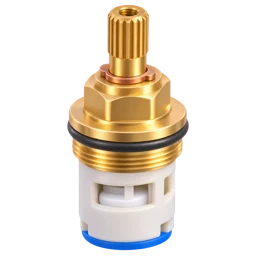
35mm Tap Cartridge: Which Taps Use It and How to Measure

By The Sparrow team · Updated 30 November 2026
Sizes checked against the Sparrow parts catalogue · How we write guides
The tap drips, or the lever has gone stiff, and the fix is a cartridge. You take the old one out, measure across the top, order the number you read, and the part arrives too wide or too narrow. The measurement was taken in the wrong place, or the tap was never a 35 mm in the first place.
This guide is about that one cartridge: where the 35 mm figure comes from, which taps use it, and the four details that decide whether the replacement fits. It also covers the confusion with 40 mm, which is the mistake most people make when ordering in a hurry.
Which taps use a 35 mm cartridge?
A 35 mm cartridge turns up in single-lever mixers of every shape: kitchen taps with a swivel spout, basin mixers, deck-mounted mixers and many mid-size bath mixers. If the tap has one lever that moves up and down for flow and side to side for temperature, it probably has a mixer cartridge, and 35 mm is the size you are most likely to find.
The tap's outside size does not settle it. A tall kitchen mixer can use a 35 mm cartridge, and so can a compact basin mixer with a similar body. The only reliable method is to take the old cartridge out and measure it.
Two groups sit outside the 35 mm norm. Small cloakroom and low-flow mixers often use a 25 mm cartridge, and large kitchen mixers with a high flow rate often use a 40 mm. If your tap is at either extreme, measure before you assume.
The lever itself tells you something too. A single lever that swivels smoothly through a wide arc and clicks into a central position is likely a ceramic mixer cartridge. A lever with a short, firm quarter-turn movement on each side is more likely a pair of quarter-turn valves under one body, which is a different repair.
What does the 35 mm actually measure?
It measures the body diameter: the widest smooth part of the cartridge that sits inside the tap body. That is the part that has to pass through the housing and seal against it, so it is the dimension the tap is built around.
It is not the diameter of the threaded collar, the retaining nut or the top flange. Those parts are often wider than the body, and measuring across them adds several millimetres. A cartridge that measures 38 mm across the collar is still a 35 mm cartridge.
It is also not the height, although height is the next thing to check. Two 35 mm cartridges can be different heights, and a taller one can stop the shroud or the lever from going back on.
The number is nominal. A cartridge sold as 35 mm may measure a fraction under or over, and that is normal. What matters is that it is closer to 35 mm than to 40 mm or 25 mm. If your measurement lands at 37 or 38 mm and you are sure you measured the body, recheck with the collar out of the way before you order a 40 mm.
Body diameter vs overall diameter: which do you measure?
The distinction sounds fussy until you have a cartridge in your hand. The body is the cylinder that carries the seals and the ports. The overall diameter is the widest point anywhere on the part, which is usually the collar at the top or the flange at the base.
| What you measure | What it tells you | Typical result |
|---|---|---|
| Body, smooth widest part | The size you order | 25, 35 or 40 mm |
| Top collar or flange | How the cartridge is retained | Often wider than the body |
| Overall height, base to spindle tip | Whether the lever and shroud fit | Varies by model |
| Base pins | Orientation in the tap body | Usually two, positions vary |
If you only have a ruler, measure the body across its widest point with the jaws square to the cartridge. A plastic rule with a worn end can be a millimetre or two out, which is enough to send you to the wrong size. Calipers are better if you have them.
Measure the old part after cleaning, not before. Limescale adds a skin that can push a 35 mm body to 36 or 37 mm, and a rushed measurement on a dirty cartridge is a common reason for ordering a 40 mm by mistake.
Not sure which one you have?Snap it next to a £1 coin and Sparrow names the exact replacement for tap cartridges, with the measurements to check. Your first scan is free.
Get the appHow to measure a 35 mm cartridge properly
- Take the cartridge out of the tap and wipe off the limescale with a cloth. Do not scrape the body with a blade.
- Find the smooth cylindrical body, below the collar and above the base.
- Measure across the widest point of that body. Keep the jaws or the ruler square, not angled.
- Measure the overall height from the base to the top of the spindle.
- Count the pins on the base and note their positions, for example opposite each other or offset.
- Look at the top of the spindle: splined with teeth, or flat-sided.
- Write all four numbers down before you put the old cartridge down somewhere safe.
If the cartridge is stuck in the tap, measure what you can see and photograph it next to a pound coin. The coin gives a known reference, which is how Sparrow estimates sizes from a photo.
How many pins should the base have?
Most 35 mm cartridges have two locating pins on the base, but the number and position vary. The pins drop into matching holes in the tap body and stop the cartridge turning when you move the lever. If they do not line up, the cartridge will sit proud or the lever will not operate the ports correctly.
Count the pins and note whether they are opposite each other or offset. A cartridge with the right diameter and the wrong pin layout is another common wrong purchase. Some cartridges have a single lug instead of pins, and some have a shaped base that only fits one way.
The base also carries the inlet ports. Note which side is hot and which is cold, and how the ports line up with the holes in the tap body. On a mixer, getting this wrong can give you hot on the cold side or a tap that only runs one temperature.
Some bases have a rubber seal moulded around the ports rather than separate O-rings. If yours does, check that the seal is not torn and that the new cartridge has the same arrangement. A flat base with two rings will not seal against a recessed seat designed for a moulded seal.
Splined or flat: why the spindle shape matters
The spindle is the stem the lever fits onto. It is either splined, with fine teeth around it, or flat-sided, with one or two machined flats. The lever has a matching socket, and a grub screw or a nut clamps it on.
| Spindle type | How it looks | What happens if you mix them |
|---|---|---|
| Splined | Fine teeth around the stem | A flat-socket lever will not grip; the lever slips |
| Flat-sided | One or two machined flats | A splined socket will not seat; the lever sits loose |
| Square or hex | Four or six distinct sides | Less common, but check before ordering |
Spindle length matters too. A stem that is too short will not reach the lever; one that is too long holds the lever away from the body. Compare the old and new parts side by side with the lever off.
Why height matters as much as width
A 35 mm cartridge is not a single standard part. Manufacturers use different body heights, different collar depths and different spindle lengths, even when the body diameter is the same. The retaining nut may sit at a different height, and the shroud may cover more or less of the cartridge.
If the new cartridge is taller than the old one, the nut may not engage enough threads, or the shroud may not clip back on. If it is shorter, the nut may bottom out before the cartridge seals. Either way, the tap leaks or the lever feels loose, and it is easy to blame the cartridge's quality when the problem is the height.
Measure from the base of the cartridge to the top of the body, and separately to the top of the spindle. Compare both with the new part before you fit it.
Height is also where cheap replacements vary most. A cartridge that matches on diameter and pins can still be a few millimetres out on height, which is enough to make the lever sit high or the nut bottom out. If the listing gives no height, ask before you buy.
35 mm vs 40 mm: which one do you have?
The two sizes look similar in a photo and are easy to confuse in a listing. A 40 mm cartridge is wider, and usually taller, and it will not fit a 35 mm housing. A tap takes one size, not either.
| Feature | 35 mm cartridge | 40 mm cartridge |
|---|---|---|
| Body diameter | 35 mm | 40 mm |
| Typical tap | Most kitchen and basin single-lever mixers | Large kitchen mixers, high-flow mixers |
| Flow | Standard | Higher, with larger ports |
| Will it swap? | No | No, unless a reducing collar is fitted |
There is one exception worth knowing. Some tap bodies have a 40 mm bore and hold a 35 mm cartridge in a threaded reducing collar. If you find a collar around the cartridge, the part you need is the cartridge size, not the bore size. Measure the cartridge itself, and note the collar as well.
What is inside a 35 mm cartridge?
A single-lever cartridge is a small assembly: a body, two ceramic discs, a spindle, O-rings and a base plate with inlet ports. The fixed disc has openings for hot and cold water. The moving disc slides across it to blend the two and to control how much flows. Ceramic is hard and smooth, which is why the mechanism lasts, but grit and limescale score the faces and the tap starts to drip.
When you buy a replacement, you are buying the whole assembly. The discs are rarely sold separately, and matching a pair to an unknown cartridge is harder than swapping the unit. That is why the trade replaces the cartridge rather than rebuilding it.
Do not confuse this with a quarter-turn valve. A tap with two separate handles that each turn a quarter turn uses a ceramic disc valve with a threaded body and a splined spindle, not a mixer cartridge. The two look unrelated once you have them out, but the words get used loosely online.
What to check before you order
| Check | What to compare | Why it matters |
|---|---|---|
| Body diameter | 35 mm across the smooth body | The cartridge must enter the housing and seal |
| Height | Base to body top, base to spindle tip | The nut and shroud must go back on |
| Pins | Number and position | The cartridge must locate and stay still |
| Spindle | Splined or flat, and its length | The lever must fit and clamp |
| Ports | Hot and cold positions | The tap must mix the right way round |
| O-rings | Supplied with the cartridge | Old rings can leak even with a new cartridge |
Buy from a seller who lists the dimensions, not just the tap type. "Fits most kitchen mixers" is not a specification. A listing with a body diameter, a height and a pin count is one you can check against the old part.
If two cartridges match on paper, compare the photos closely. Look at the number of ports, the shape of the base and the length of the spindle. Small differences in casting are a sign of a different mould, even when the headline sizes agree.
How to remove the old cartridge
- Turn off the water at the isolating valve under the sink, or at the main stopcock if there is no valve. Open the tap to release the pressure.
- Prise off the cap on the handle, usually a small plastic disc, and undo the screw or grub screw underneath.
- Lift off the handle and any shroud or cover. Keep the screws in a cup.
- Hold the tap body steady with one hand and undo the retaining nut with a spanner with the other.
- Ease the cartridge out by the spindle. If it is stuck, wiggle it gently rather than levering against the tap body.
- Note the orientation of the ports and pins before you put it down.
If the nut will not move, stop rather than forcing it. Corrosion or limescale can seize the thread, and a twisted tap body can crack or loosen the pipe connections below.
Handles can be stubborn in other ways. A cap that has been painted over will not lift with a fingernail; score the paint line with a craft knife first. A grub screw that has rusted may need a drop of penetrating oil and a few minutes before it will turn, and a screw with a chewed head is better left to a plumber than drilled out over a sink.
How to fit the new cartridge
- Clean the seat inside the tap body. Remove limescale with a cloth and a little descaler, then rinse.
- Check the new cartridge against the old one: diameter, height, pins, spindle and ports.
- Fit the O-rings if they are supplied separately, and smear them with silicone grease. Do not use oil or petroleum grease, which can damage rubber.
- Lower the cartridge in, aligning the pins and ports. It should drop into place without force.
- Refit the retaining nut and tighten it firmly by hand, then a little more with the spanner. Stop when the cartridge is held; over-tightening distorts the seals.
- Refit the shroud and handle, aligning the lever so it sits in the position you expect.
- Turn the water on slowly, check for leaks around the base and the spout, then run hot and cold.
Run the tap for a minute and watch the base. A small weep that stops after a few seconds is usually trapped air. A drip that continues means the nut is loose, the cartridge is not seated or an O-ring is pinched.
Check the lever's resting position before you tighten the grub screw. Most mixers sit with the lever centred and pointing forward when off, but some are designed to sit to one side. If the lever ends up at an odd angle, lift it off and move it a spline or a flat, rather than forcing it against the stop.
On a tap with a pull-out hose or a spray head, run the water through both settings before you put everything away. Back pressure at the diverter can show up a weep that the spout setting hides.
Troubleshooting a 35 mm cartridge swap
| What you see | Likely cause | What to do |
|---|---|---|
| Tap still drips when off | Cartridge not seated, or wrong height | Remove, clean the seat, refit and check the height against the old part |
| Lever is stiff or gritty | Limescale in the cartridge or on the spindle | Clean the spindle and the lever socket; replace if it persists |
| Lever is loose and slips | Wrong spindle type, or the grub screw is loose | Check the spindle shape and tighten the grub screw |
| Water runs from the base of the tap | Pinched O-ring or loose retaining nut | Refit the O-ring and tighten the nut a little more |
| Only hot or only cold runs | Ports fitted the wrong way round | Remove and refit with the ports aligned as the old cartridge |
| Flow is weaker than before | Debris in the ports or a low-flow cartridge | Flush the tap body and compare the port sizes |
Common mistakes with 35 mm cartridges
- Measuring across the collar instead of the body, which turns a 35 mm into a 38 mm and sends you looking for a size that does not exist.
- Assuming the tap's outside size tells you the cartridge size.
- Ordering by tap brand without measuring, when the same brand uses more than one cartridge across its range.
- Ignoring the pin positions because the count matched.
- Reusing old O-rings that have hardened or flattened.
- Over-tightening the retaining nut and distorting the seals.
- Losing the small grub screw from the handle, which is often an unusual size.
- Refitting the lever with the grub screw bearing on the splines instead of the flat, so it works loose again.
- Throwing away the old cartridge before the new one is tested, which leaves you with no reference if it does not fit.
When to stop and call a plumber
Stop if the water will not turn off at the isolating valve, if the retaining nut will not move, or if the tap body moves when you apply pressure. A seized valve or a corroded tap can turn a simple cartridge swap into a leak inside the cabinet or a broken fitting.
Call a plumber if you cannot isolate the water, if the pipework is older and looks brittle, or if the tap is on a pressurised system and you are not sure how to drain it. The dripping mixer tap guide covers the repair in more detail, and the cartridge identification guide helps if you are still unsure of the type. If the tap body itself is cracked or the spout is loose, a cartridge will not fix it.
How Sparrow helps
Sparrow, an iPhone app made by ThinkingAI Limited, identifies worn household parts from a photo taken next to a pound coin. Lay the old cartridge on its side beside the coin, shoot straight down, and the app estimates the body diameter, names the part and shows the matching spec with the checks to make before buying. It also links searches at UK retailers, so you can compare 35 mm cartridges with the right pin count and spindle. For taps with two handles, see the 20 vs 24 spline valve guide instead.
Frequently asked questions
Which taps use a 35 mm cartridge?
Most single-lever kitchen and basin mixers use a 35 mm cartridge, along with many mid-size bath mixers and deck-mounted mixers. Smaller cloakroom and low-flow taps often use 25 mm, and large kitchen mixers often use 40 mm. Measure the old part rather than assuming from the tap's size.
Is a 35 mm cartridge measured across the body or the top?
Across the body. Measure the smooth widest part of the cartridge below the threaded collar or top flange. Measuring across the collar or the nut gives a larger number and is a common reason people order the wrong size.
Will a 40 mm cartridge fit a 35 mm tap?
No. The 40 mm body is wider and will not enter a 35 mm housing. The reverse is also true unless the tap has a purpose-made reducing collar, which is unusual. Replace like for like.
How many pins should a 35 mm cartridge have?
Most have two locating pins on the base, but the position varies between models. Count them and note where they sit, because a cartridge with the right diameter and the wrong pin layout will not seat.
Why does my new cartridge still drip?
The ceramic discs may be fine but the cartridge may not be seated squarely, or the O-rings may be pinched. Take it out, check the seat is clean and refit it. If it still drips, compare the new part with the old one; a slightly different height or port layout can cause it.
Can I replace just the ceramic discs?
Some cartridges can be opened and rebuilt, but most are sealed units and the parts are not sold separately. Replacing the whole cartridge is the reliable repair, and it is usually quicker than matching discs.
Not sure which one you have?Snap it next to a £1 coin and Sparrow names the exact replacement for tap cartridges, with the measurements to check. Your first scan is free.
Get the appParts guides, Sparrow
We build Sparrow, the iPhone app that identifies worn household parts from a photo taken next to a £1 coin. Our guides cover the six parts Sparrow matches: tap cartridges, euro cylinder locks, uPVC window handles, door handles, shower door seals and window hinges. Every size in a guide is checked against the same parts catalogue the app uses.

