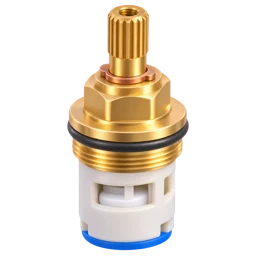
Tap cartridges · 14 min read
25mm Tap Cartridge: Small Mixer Taps Explained

By The Sparrow team · Updated 30 November 2026
Sizes checked against the Sparrow parts catalogue · How we write guides
The tap is small, maybe in a cloakroom or a downstairs basin, and the lever has started to drip or feel gritty. You take the cartridge out, measure it quickly, and the number on the ruler looks like 30-something. Nothing in the shop matches, and the tap stays in pieces.
Small cartridges are less forgiving than large ones. There is less metal around the body, the collar is proportionally bigger, and the difference between sizes is easy to lose in a rushed measurement. This guide covers the 25 mm cartridge, the taps that use it, and the checks that stop you ordering a 35 mm by mistake.
Which taps use a 25 mm cartridge?
Twenty-five millimetre cartridges are built for compact mixers: small basin taps, cloakroom basins, secondary bathrooms and utility sinks. They also appear in low-flow and eco taps, where the smaller ports suit a restricted flow and the body has to fit inside a slim spout or column.
The tap is usually small in the hand and close to the wall or the basin edge. A single lever still controls flow and temperature, so it looks like any other mixer from above. The difference is inside the body, where there is less room for a large cartridge.
A 25 mm cartridge is also common on taps with a slim column or a short spout, where the body has to fit inside a narrow casting. If the tap looks delicate rather than chunky, that is a hint, though not a substitute for measuring.
If the tap is a full-size kitchen mixer, the cartridge is almost certainly not 25 mm. Start at 35 mm and check for 40 mm on a large high-flow model. If the tap is a compact basin mixer with a short spout, 25 mm is a real possibility.
Age is a rough guide too. Older small basin taps are often simple, with a short body and a fine retaining nut. Newer compact mixers may use a taller 25 mm cartridge with a longer spindle to reach through a slimmer handle. Both are 25 mm, but they are not the same part.
Why is the smallest cartridge the easiest to mis-measure?
Three things work against you. First, the body is small, so the collar and the retaining nut are a larger share of the overall size, and it is easy to put the calipers across the wrong part. Second, the body is often short, so the height is easy to overlook. Third, a 2 mm error is a much bigger proportion of 25 mm than of 40 mm.
That last point matters more than it sounds. If you measure a 40 mm body and read 42 mm, you still know it is a 40 mm. If you measure a 25 mm body and read 28 mm because the calipers caught the edge of the collar, you may decide the part is bigger than it is and order the next familiar size up.
Small taps also have less room around the cartridge. The shroud or the handle may cover part of the body, so you cannot see where the body ends and the collar begins until the part is out and clean.
There is a fourth trap: the same tap can be sold with different cartridges in different markets or revisions. A replacement from a listing that looks identical may have a slightly different collar or spindle. That is why the old part, not the tap model, is the reference.
How to measure a 25 mm cartridge
- Take the cartridge out and wipe it clean. Limescale can add a millimetre to a small body.
- Find the smooth cylindrical body between the base and the collar.
- Measure across the widest point with calipers held square. Read to the nearest half millimetre if the scale allows.
- Measure the overall height, and the height of the body on its own.
- Note how many pins are on the base and where they sit.
- Note the spindle type and length, and whether the lever fits with a grub screw or a splined cap.
- Photograph the cartridge next to a pound coin before you put it down.
If the reading is 25 or 26 mm, you have a 25 mm cartridge. If it is 34 or 36 mm, it is a 35 mm. If it is 28 or 30 mm, measure again with the collar clear of the jaws; a true 25 mm body rarely reads 30 mm unless the calipers are on an angle.
Take two measurements at right angles to each other. A cartridge body is round, but a worn or swollen one can be slightly oval, and the two readings tell you whether the calipers are sitting square. If they differ by more than half a millimetre, the body is worn or you are not measuring the smooth section.
Write the numbers down before you put the cartridge aside. On a part this small, it is easy to forget whether the reading was 25 or 26 mm, and the difference matters when the listing only offers whole sizes.
Housing depth and the short body
The 25 mm cartridge is often shorter than its larger cousins, and the housing in a small tap is shallower. That means the height matters as much as the diameter. A cartridge that is too tall will not let the shroud sit down, and one that is too short may not reach the seals at the base.
Some small taps use a spacer or a collar to take up depth. If one comes out with the old cartridge, keep it and refit it with the new part. A spacer left on the bench is a common reason for a leak or a loose lever after a repair.
The depth of the housing is worth measuring while the cartridge is out. Put the end of a ruler or a pencil down the bore and mark the depth, then compare it with the new cartridge's body height. If the body is taller than the bore, the cartridge will sit proud no matter how tight the nut is.
| Part | What it does | What to check |
|---|---|---|
| Cartridge body | Carries the seals and ports | 25 mm across the smooth body |
| Collar or spacer | Takes up depth in a shallow housing | Keep it and refit it the same way round |
| Retaining nut | Holds the cartridge down | Thread and size, often small and fine |
| O-ring | Seals the body to the housing | Profile and position, not just diameter |
Not sure which one you have?Snap it next to a £1 coin and Sparrow names the exact replacement for tap cartridges, with the measurements to check. Your first scan is free.
Get the appPins, spindle and the lever on a small tap
Small cartridges use the same locating idea as large ones: pins or lugs on the base drop into holes in the tap body. The pins are smaller, and there are usually two. Note whether they sit opposite each other or offset, because a cartridge with the right diameter and the wrong layout will not seat.
The spindle is usually splined on a small mixer, with a lever that pushes onto the teeth and is held by a grub screw underneath. Some have a flat-sided stem. Either way, the lever has to match, and the grub screw has to land on the right part of the stem.
Small levers are easy to cross-thread or over-tighten. If the grub screw is tiny, use the right size key and turn it gently. A chewed grub screw on a cloakroom tap can mean replacing the handle, which may be harder to source than the cartridge.
Before you take the lever off, note its position. A lever that sits at an odd angle after the repair is usually one spline out, not a faulty cartridge. Photograph the tap from above with the lever closed so you have a reference.
Low-flow taps and flow restrictors
A 25 mm cartridge is often paired with a low-flow tap, but the cartridge is not always the thing that sets the flow. Many low-flow taps have a restrictor or a small aerator in the spout, and the cartridge is a standard part behind it.
If the flow is poor, check the aerator first. Unscrew it, rinse it and look for grit or scale. Check the isolation valves are fully open. Only then suspect the cartridge, and if you replace it, match the port size rather than assuming a bigger cartridge will increase flow.
Do not fit a larger cartridge to a small tap in the hope of better flow. It will not fit the housing, and if it did, the restrictor and the spout would still set the limit. The tap is designed as a system.
A restrictor is sometimes fitted inside the cartridge inlet rather than the spout. If you find a small coloured insert when you take the old cartridge out, keep it and fit it to the new part. Without it, the tap may run faster than the basin can drain, or splash more than it used to.
25 mm vs 35 mm vs 40 mm
| Size | Typical tap | Body character | Common mistake |
|---|---|---|---|
| 25 mm | Cloakroom and small basin mixers | Short, small body, fine threads | Measuring the collar and ordering 35 mm |
| 35 mm | Most kitchen and basin mixers | Standard body | Assuming every mixer is 35 mm |
| 40 mm | Large kitchen and high-flow mixers | Wide body, larger ports | Measuring the nut and ordering 40 mm |
The sizes are not interchangeable. A 35 mm cartridge will not enter a 25 mm housing, and a 25 mm cartridge in a 35 mm housing will not seal, even if it drops in and the nut appears to hold it. Match the body, the height and the pins.
How to tell 25 mm from 35 mm without calipers
A pound coin is 23.43 mm across. That makes it a useful rough gauge for small cartridges. Hold the coin against the body: a 25 mm body is only slightly wider than the coin, while a 35 mm body is about half as wide again and clearly larger than the coin.
The trick is good for sorting a 25 mm from a 35 mm at a glance, and it is how a photo next to a coin can be turned into a size estimate. It is not good enough for the final order. Once you know which family you are in, borrow or buy a cheap pair of calipers and measure properly.
If the body is close to the coin but the collar is much wider, do not be tempted to call it a 35 mm. Measure the body again with the collar clear. The coin test is about the body, not the widest part of the part.
When a small tap is not a mixer cartridge
A single lever that moves up and down and side to side uses a mixer cartridge. A small tap with two separate handles does not. Each handle turns a quarter-turn ceramic valve, and those are identified by the thread and the spline count, not by a body diameter.
Basin and kitchen valves are usually 1/2 inch BSP, and bath valves 3/4 inch BSP. The spindle has 20 or 24 splines in most cases. If you order a 25 mm cartridge for a two-handle tap, it will not fit, however small the tap is.
Some small taps have a single lever but a cartridge that looks unlike the usual mixer part, with a threaded body and a short spindle. In that case, photograph it and compare with both families before ordering. The 20 or 24 spline guide covers the two-handle case in detail.
What to check before you order
- Body: 25 mm across the smooth part, measured with calipers.
- Height: body height and overall height, including any spacer.
- Pins: how many, and where they sit on the base.
- Spindle: splined or flat, plus how far it stands above the body.
- Retaining nut: thread and size, especially on small taps with fine threads.
- O-ring: profile and thickness, not just the diameter.
- Spacer or collar: whether one is fitted and which way round it goes.
A 25 mm cartridge is cheap enough that some people buy two and return one. That only works if you know the size. Measure first, and keep the old part until the new one is tested.
If you are buying in person, take the old cartridge with you. It is the only specification that cannot be argued with.
Check the listing photos for the shape of the base, not just the size. A 25 mm cartridge for a small basin mixer often has a narrower base than the body, with the ports close together. A base that looks wide and flat is more likely to belong to a larger cartridge.
How to remove the old cartridge
- Turn off the water at the isolating valves or the stopcock, then open the tap.
- Lift the cap on the handle and undo the screw or grub screw underneath.
- Pull the lever off and remove the shroud. Small taps often have a decorative ring that unscrews.
- Hold the tap body steady and undo the retaining nut with a small spanner.
- Lift the cartridge out. If a spacer comes with it, note its position.
- Check the seat for scale and the O-ring for damage.
Small taps can be fixed to the basin by a back nut that is hard to reach. If the whole tap turns when you undo the cartridge nut, stop and support the tap from below before you continue.
A basin wrench makes the job easier than a standard spanner in the tight space under a cloakroom basin. If you do not have one, a small adjustable spanner with the jaws turned sideways can work, but keep the force on the nut rather than the tap body.
How to fit the new 25 mm cartridge
- Clean the seat and rinse away any grit. A small body has little tolerance for debris.
- Compare the new cartridge with the old one: diameter, height, pins, ports and spindle.
- Fit the O-ring and any spacer, lubricating the rubber lightly with silicone grease.
- Set the cartridge into the housing with the pins and ports lined up, then press it home without force.
- Tighten the retaining nut by hand, then a little more with the spanner. Small threads strip easily.
- Refit the shroud and lever, checking the lever sits at the right angle before tightening the grub screw.
- Open the valve slowly and run hot, then cold, then full flow, checking the base of the tap for leaks.
Run the tap for a minute before you put the cabinet shelf back. Small leaks often show as a bead of water at the back of the tap or a damp patch on the pipe below, and it is much easier to spot with everything open. If the tap has a swivel spout, turn it through its full arc while you watch.
Troubleshooting a 25 mm cartridge swap
| Symptom | Likely cause | What to do |
|---|---|---|
| Drips from the spout | Cartridge not seated, or worn discs | Reseat it; replace if the drip continues |
| Leak at the base of the tap | Pinched O-ring or loose nut | Refit the ring and tighten gently |
| Lever loose or slipping | Grub screw not on the flat, or wrong spindle | Reposition the lever and tighten the screw |
| Flow very low | Restrictor, aerator or partly closed valve | Clean the aerator and open the valves fully |
| Hot and cold reversed | Ports fitted the wrong way | Remove and refit with the ports matched |
| Tap will not stop dripping after two tries | Housing seat damaged or cartridge wrong height | Compare heights and inspect the seat; call a plumber if the seat is marked |
| Water runs from under the handle | Spindle seal or a cartridge that is not seated | Reseat the cartridge; replace if the spindle seal is worn |
Common mistakes with 25 mm cartridges
- Measuring across the collar, which turns a 25 mm body into a 30 mm reading.
- Assuming a small tap must take a 35 mm because that is "the standard size".
- Forgetting the spacer or collar when refitting.
- Over-tightening a small nut and stripping the thread.
- Blaming the cartridge for low flow when the aerator is blocked.
- Buying a cartridge without checking the spindle type.
- Losing the grub screw, which is often smaller than the keys in a standard set.
- Buying a 35 mm cartridge because the 25 mm one looks "too small to be right".
- Refitting the lever a spline out and deciding the cartridge is faulty.
When to stop and call a plumber
Stop if the tap body turns when you undo the nut, if the retaining nut will not move, or if the water will not shut off. Small taps are often fitted to thin basins and can crack if they are twisted, and a cracked basin is a much bigger job than a cartridge.
Call a plumber if the tap is plastic-bodied and the thread looks worn, if the housing seat is scored, or if the pipework is corroded. If you are still unsure of the size, the cartridge identification guide and the dripping mixer tap guide cover the next steps.
If the tap is a cheap imported model with no markings and no spares available, a replacement tap may be the better answer. That is a bigger job than a cartridge, and one for a plumber if the pipework is not straightforward.
How Sparrow helps
Made by ThinkingAI Limited, Sparrow is an iPhone app that identifies worn household parts from a photo taken next to a pound coin. A small cartridge is hard to measure with a ruler but easy to photograph: lay it beside the coin, shoot straight down, and the app estimates the body diameter and shows the matching spec with the checks for pins and spindle. It links searches at UK retailers, so you can compare 25 mm cartridges directly. For a two-handle tap, a quarter-turn valve is the better starting point, and the photo identification guide shows how to capture the old part clearly.
Frequently asked questions
Which taps use a 25 mm cartridge?
Small basin mixers, cloakroom taps and compact low-flow mixers most often use a 25 mm cartridge. Some utility and secondary taps use one too. A large kitchen mixer almost never does, so if the tap is big, check for 35 or 40 mm first.
Why is a 25 mm cartridge hard to measure?
The body is small and the collar, nut and shroud take up more of the total size, so it is easy to measure the wrong part. A 2 mm error is also a bigger proportion of 25 mm than of 40 mm, which is enough to make a 25 mm look like a 35 mm.
Is a 25 mm cartridge the same as a 35 mm?
No. The body is 10 mm narrower and usually shorter. A 35 mm cartridge will not fit a 25 mm housing, and a 25 mm cartridge in a 35 mm housing will not seal or locate, even if it drops in.
Can I fit a 25 mm cartridge to improve flow?
No. A smaller cartridge restricts flow rather than improving it, and it will not seal in a larger housing. If flow is poor, check the aerator, the isolation valves and the cartridge for scale before changing parts.
Why does my small basin tap drip after a cartridge change?
The cartridge may not be seated squarely, the O-ring may be pinched, or the nut may be too loose. Small taps have less room for error, so clean the seat and refit carefully before deciding the part is wrong.
Do low-flow taps use a special cartridge?
Some do, and some use a standard 25 mm cartridge with a flow restrictor or aerator elsewhere in the tap. Check whether the restriction is in the spout before you order a cartridge to solve a flow problem.
Not sure which one you have?Snap it next to a £1 coin and Sparrow names the exact replacement for tap cartridges, with the measurements to check. Your first scan is free.
Get the appParts guides, Sparrow
We build Sparrow, the iPhone app that identifies worn household parts from a photo taken next to a £1 coin. Our guides cover the six parts Sparrow matches: tap cartridges, euro cylinder locks, uPVC window handles, door handles, shower door seals and window hinges. Every size in a guide is checked against the same parts catalogue the app uses.

