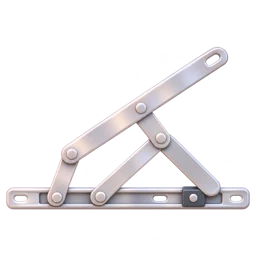
Window hinges · 13 min read
12 inch friction stay: side vs top hung

By The Sparrow team · Updated 30 November 2026
Sizes checked against the Sparrow parts catalogue · How we write guides
You have measured the old hinge and the figure is 12 inch, but the listing still asks questions you cannot answer. Side-hung or top-hung, 13 mm or 17 mm, left or right. Get one wrong and the window will not sit straight, however carefully you fit it. Here is how to answer each one from the old part.
What does 12 inch mean on a friction stay?
It is the length of the track, measured end to end. It is not the length of the arm, and it is not the overall length of the stay when the window is open.
Friction stays are sold by nominal track length in inches in the UK trade, even though most other window measurements are in millimetres. A 12 inch stay is therefore about 305 mm, because one inch is 25.4 mm. The nominal figure is a size label, not a precision measurement, and two makers can differ by a millimetre or two.
Measure with the window closed. When the window is open, the arm slides along the track and the geometry changes, so a tape run along the open stay will give you a false figure. If the stay is already off the window, lay it flat and measure the track from one end to the other.
Do not measure the arm and assume it matches the track. On many stays the arm is shorter or longer than the track, and ordering by the arm is a common reason for a wrong part.
Because the nominal size is a label, the safest check is always the old stay. Take it off, lay it flat and measure the track yourself. If the old one is missing or too bent to read, measure the frame and compare the figure with the table below, then check the hole pattern before you order.
Is a 12 inch stay for a side-hung or top-hung window?
Both. The 12 inch size appears in the side-hung range and in the top-hung range, but the two parts are not the same. The length matches; the geometry does not.
A side-hung window opens like a door, hinged down one side. Its stays run horizontally along the top and bottom of the frame. Side-hung stays commonly come in 10, 12, 16 and 20 inch.
A top-hung window hinges at the top, and the bottom edge swings outward. Its stays run vertically down the left and right sides of the frame. Top-hung stays commonly come in 12, 16, 20 and 24 inch, so 12 inch is the smallest standard size in that range.
| Feature | Side-hung 12 inch | Top-hung 12 inch |
|---|---|---|
| How the window opens | From the side, like a door | Outward at the bottom, hinged at the top |
| Where the stays fit | Top and bottom of the frame | Left and right sides of the frame |
| Track orientation | Horizontal | Vertical |
| Pair needed | One top, one bottom | One left, one right |
| Common use | Small casements and bathroom windows | Small top-opening lights |
If you are not sure which you have, open the window and watch which edge moves. A side-hung sash swings sideways. A top-hung sash pushes out at the bottom while the top stays put.
The handle position can mislead you. A top-hung window often has its handle at the bottom centre of the sash, which looks similar to a side-hung handle near the opening edge. Watch the sash, not the handle.
How to measure a 12 inch stay correctly
Take the measurement with the window closed, and take the other three figures at the same time. Length alone will not get you the right part.
- Identify the hang: side-hung or top-hung.
- Close the window and find the track. On a side-hung window it is at the top and bottom of the frame; on a top-hung window it is down each side.
- Measure the track from one end to the other in millimetres.
- Divide by 25.4 to check the inch size, or compare the figure with 305 mm for a 12 inch stay.
- Measure the stack height from the frame face to the top of the stay.
- Note which side is left and which is right, looking at the window from inside.
- Count the fixing holes and measure their spacing, then compare with the new stay before you buy.
If the old stay is too damaged to measure, use a matching window in the same house. Check the stack height and the hole pattern as well, because two windows of the same size can still use different stays.
Stack height: 13 mm or 17 mm
Stack height is how far the stay stands off the frame. It is the height of the folded metal stack, measured from the frame face to the top of the stay when the window is closed.
The two common figures are 13 mm and 17 mm. They are not interchangeable. A stay with the wrong stack height holds the sash at the wrong depth, so the window may sit proud, rub on the frame or fail to compress its seals.
| Stack height | What it affects | If it is wrong |
|---|---|---|
| 13 mm | How close the sash sits to the frame | Sash stands proud or the seals do not compress |
| 17 mm | Clearance for deeper frames and beads | Sash rubs or the handle will not line up |
Measure the old stay on a flat surface if it is off the window. Stand it on its track and measure from the surface to the highest point of the folded stack. If the stay is still fitted, use a steel rule against the frame face and measure up to the top of the track.
Not sure which one you have?Snap it next to a £1 coin and Sparrow names the exact replacement for window hinges, with the measurements to check. Your first scan is free.
Get the appHanded pairs: left and right
Most friction stays are handed. The arm folds to one side of the track, and that fold has to face the right way for the window to close.
On a side-hung window, the top stay and the bottom stay are mirror images, so you need one of each. On a top-hung window, the left stay and the right stay are mirror images, again one of each. A pair is normally sold as one left and one right.
Check the old stay before you order. Lay it on the bench and look at which way the arm folds. Then compare it with the listing photograph, not just the description. Some sellers use "left" and "right" differently depending on whether you are looking from inside or outside, so the photograph is the safer guide.
A few stays are non-handed and can be used either way. If the listing says non-handed, check that the arm still folds correctly for your window before you rely on it.
Why friction stays are replaced in pairs
Both stays on a window share the weight of the sash. If one is new and tight while the other is old and loose, the sash is pulled unevenly. It sits at a slight angle, the seals compress more on one side, and the new stay takes more than its share of the load.
The result is a window that closes stiffly, a sash that drops over time, and a new stay that wears out faster than it should. The saving from buying one stay is small compared with doing the job twice.
There is a second reason. Stays from different makers can have different hole patterns, even at the same nominal length. Replacing both keeps the fixings and the geometry consistent across the window.
Fit the pair together, in the same session, so both are at the same stage of wear from day one.
If one stay has failed and the other looks fine, the second one is still the same age and has done the same work. Replacing it now costs one extra part. Replacing it later means taking the window apart twice.
Can a 12 inch stay carry your window?
The window's size and weight decide the stay, and the original length was chosen for that sash. If a 12 inch stay was fitted, a 12 inch replacement is the right starting point.
Do not fit a shorter stay to save money, and do not fit a longer one to make the window open wider. Either change alters the geometry and the load on the frame. A longer stay can let the sash swing past its intended limit, and a shorter one can stop it opening far enough to clean or escape.
If the sash has been replaced or reglazed and is now heavier than before, the original stay may no longer be right. That is a question for the window manufacturer or a specialist, not something to guess from the track length alone.
Double glazing adds weight compared with a single pane, and a large opening light puts more load on each stay than a small one. A 12 inch stay is usually found on smaller lights for that reason. If your window looks larger than the others in the house, check the old stay's markings before assuming the size is right.
12 inch in millimetres and the sizes around it
Conversion is simple, but the nominal size and the measured size rarely match to the millimetre. Use the table to check which nominal size your measurement is closest to.
| Nominal size | Approximate track length | Typical hang |
|---|---|---|
| 10 inch | 254 mm | Side-hung |
| 12 inch | 305 mm | Side-hung and top-hung |
| 16 inch | 406 mm | Side-hung and top-hung |
| 20 inch | 508 mm | Side-hung and top-hung |
| 24 inch | 610 mm | Top-hung |
A measurement of 300 to 310 mm is a 12 inch stay. If your figure sits halfway between two nominal sizes, the hole pattern is the tie-breaker, and the old stay is the best template.
Screw holes and fixing pattern
Two 12 inch stays can have different hole patterns. Count the holes, measure the spacing and note whether any are slotted.
Slotted holes allow a little adjustment during fitting, which helps if the frame holes are slightly out. Fixed holes give a more rigid fit but leave no room to move the stay.
If the new stay's holes do not line up with the old ones, do not drill fresh holes in the frame without checking what is behind the plastic. The reinforcement may not extend to the new position, and a screw into hollow uPVC will not hold a window.
The safest approach is to buy a stay whose hole pattern matches the old one. Take the old stay with you, or photograph it flat next to a rule, and compare it with the listing.
If the new track is slightly longer or shorter than the old one, the holes will not line up even if the nominal size matches. That is the point at which to send it back rather than reach for the drill.
How to remove an old 12 inch stay
Support the sash before you take the weight off the stays. A top-hung sash in particular can swing once the second stay is undone.
- Open the window enough to reach the fixing screws, and support the sash with one hand or a prop.
- Undo the screws at the sash end of the stay first, while the frame end still holds it.
- Support the stay with your free hand so it does not drop.
- Undo the frame screws and lift the stay clear.
- Keep the screws in a pot. They are a useful pattern if the new stay comes without fixings.
- Repeat on the second stay, keeping the sash supported throughout.
If the screws are tight, use a screwdriver that fits the head and press down firmly as you turn. Do not lever the stay against the frame to gain access.
A large sash is easier with two people: one supports the window while the other works the screws. On a top-hung window, the sash can swing away from you as soon as the second stay is released, so keep a firm hold until both stays are off and the window is resting safely.
How to fit a new 12 inch stay
Fit the pair loosely first, check the geometry, then tighten. Tightening as you go can pull the track out of line.
- Check the new stays against the old ones: length, stack height, hand and hole pattern.
- Offer the arm up to the sash and start the screws by hand.
- Offer the track up to the frame and start those screws by hand.
- Repeat on the second stay, leaving every screw loose enough to allow a little movement.
- Open and close the window slowly. The stays should fold without binding and the sash should sit square.
- Tighten the screws in a cross pattern, a little at a time, keeping the track straight.
- Check the window closes flush and locks before you finish.
If a screw hole does not line up, loosen the other fixings and try again. Forcing a screw into a misaligned hole cross-threads it and weakens the fixing.
Testing and adjusting the new stay
Open the window through its full travel and let go. A correctly fitted friction stay holds the sash where you leave it, without drooping or springing shut.
Close the window and look at the gap around the sash. It should be even, and the handle should turn to lock without extra force. If the window is stiff, check that the track is straight and the screws are not over-tightened, because a distorted track grips the arm.
Some stays have a friction adjusting screw on the shoe. A small turn changes how stiff the opening feels. Adjust it in small steps and test after each one. If there is no adjuster, the friction is set by the maker and cannot be changed. A stay with no friction at all needs replacing rather than adjusting.
Listen for a dry scraping sound as the window moves. That usually means grit in the track or metal rubbing where it should not, and it is worth cleaning before the stay wears.
Why does a friction stay squeak or click?
A noise from the stay is a useful clue, because each sound points at a different fault. Work out which one you have before you reach for a lubricant.
| Noise | Likely cause | What to do |
|---|---|---|
| Dry squeak as the window moves | Grit or dry metal in the track | Clean the track and wipe it dry |
| Creak when the window is nearly closed | Movement at a fixing screw | Check and tighten the screws evenly |
| Click or knock at the joint | Worn rivet or loose arm | Replace the stay |
| Grinding under load | Bent track or a worn shoe | Replace the stay |
| Rattle in wind | Loose sash or worn friction | Check both stays and the fixings |
A squeak that disappears after a clean is just dirt. A click that comes back at the same point in the travel is wear in the joint, and no amount of cleaning will fix it. A grinding noise under load often means the track is bent, especially if the window has been forced shut at some point.
Do not spray oil or grease into the track. It holds dust, and the mixture turns into a paste that wears the shoe faster. A dry brush and a cloth are the right tools for routine cleaning.
Common mistakes with a 12 inch stay
- Measuring the arm instead of the track. The arm is not the size label.
- Measuring with the window open. The arm has moved along the track and the figure is wrong.
- Ignoring stack height. A 13 mm stay in a 17 mm frame will not sit correctly.
- Buying one stay. The pair shares the load, and one new stay against a worn one skews the sash.
- Getting the hand wrong. The arm folds the wrong way and the window will not close.
- Drilling new holes. The reinforcement may not be there, and the screw will not hold.
- Over-tightening the screws. The track distorts and the arm binds.
- Using oil on the track. It attracts grit and turns into a grinding paste. Keep the track clean and dry.
When to call a window specialist
Call a specialist if the frame reinforcement is damaged, if the sash has to come out, or if the window is an egress window on an upper floor. Egress stays are part of the escape route, and the wrong replacement can reduce the opening.
Also stop if the new stays will not line up with the old holes, if the frame is cracked around a fixing, or if the window is above ground floor and you would be working at an open edge. A top-hung sash can swing out unexpectedly when a stay is released, and a fall from height is not worth the saving.
How Sparrow helps you match a 12 inch stay
Sparrow is an iPhone app made by ThinkingAI Limited that identifies worn household parts from a photo taken next to a pound coin. Open the window, lay the coin on the track and photograph the stay from the side so the stack height shows.
Upload the photo and it estimates the track length and stack height, then lists the friction stays that would fit, along with what to check before ordering. Searches at Screwfix, Toolstation and Amazon UK are one tap away if you want to compare the left and right pair on real listings. The friction stay sizes guide covers the other lengths, and the top-hung closing guide helps if the new stay does not solve the problem.
If you are still deciding whether the hinge or the handle is at fault, the hinge or handle check sets out the tests in order, and identifying a part from a photo explains how the coin scale works.
Frequently asked questions
How long is a 12 inch friction stay in millimetres?
A 12 inch track is about 305 mm, because one inch is 25.4 mm. Measure your old track end to end to confirm, as nominal sizes vary slightly between makers.
Can I use a side-hung stay on a top-hung window?
No. The two types have different arm geometry and mounting orientation, even when the track is the same length. Fit the type that matches the window.
What is stack height on a 12 inch stay?
Stack height is how far the stay stands off the frame, usually 13 mm or 17 mm. The wrong stack height stops the sash sitting flat and can stop the window sealing or locking.
Do I need to replace both friction stays?
Yes. Both stays carry the sash, and a new stay paired with a worn one makes the sash skew and wears the new part faster.
Are friction stays handed?
Most are. A side-hung window needs one left and one right for the top and bottom positions, and a top-hung window needs one of each for the two sides.
Can I fit a longer stay to make the window open wider?
No. The stay length is matched to the sash and the frame opening. A longer stay changes the geometry and can let the sash swing too far or foul the frame.
Not sure which one you have?Snap it next to a £1 coin and Sparrow names the exact replacement for window hinges, with the measurements to check. Your first scan is free.
Get the appParts guides, Sparrow
We build Sparrow, the iPhone app that identifies worn household parts from a photo taken next to a £1 coin. Our guides cover the six parts Sparrow matches: tap cartridges, euro cylinder locks, uPVC window handles, door handles, shower door seals and window hinges. Every size in a guide is checked against the same parts catalogue the app uses.

