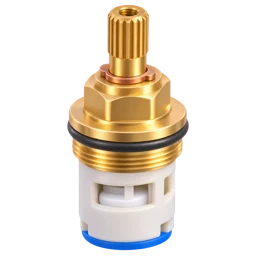
Tap cartridges · 14 min read
Tap Only Runs Hot: What to Check Before Buying

By The Sparrow team · Updated 30 November 2026
Sizes checked against the Sparrow parts catalogue · How we write guides
You move the lever towards cold and nothing changes. Or the tap has run hot on the cold side ever since it was last repaired. Either way, the tap is telling you something specific, and most of the likely causes can be checked without opening any pipework. This guide works through them in the order that finds the fault fastest, then shows what to measure if you need a new cartridge.
What makes a tap run only hot water?
Most cases come down to four faults: the cartridge is fitted the wrong way round, the hot and cold supplies are crossed, a thermostatic element has failed, or a combi boiler is being asked to do something it cannot do. The tap type narrows it down quickly.
| Tap type | How it runs hot only | First thing to check |
|---|---|---|
| Single-lever mixer | Cartridge rotated 180 degrees, crossed hoses, blocked cold inlet | Does the lever work backwards? |
| Two separate taps | The cold side has no water, so only the hot tap runs | Is the cold isolating valve open? |
| Thermostatic mixer or bar shower | Failed thermostatic element or a stuck non-return valve | Does the temperature control change anything? |
| Mixer fed by a combi boiler | Hot and cold blend and back-feed through the boiler | Does another outlet affect it? |
| Quarter-turn pair | Cold valve scaled or its supply closed | Is there flow at the cold tap at all? |
A pair of separate taps has no shared cartridge to mix the water, so "only hot" at a basin with two taps is not a cartridge problem. The hot tap is doing its job and the cold side is not delivering. Treat that as a cold supply fault, not a hot water fault.
How a single-lever mixer decides temperature
Inside the tap body is a cartridge with two inlet ports in its base, one for hot and one for cold, and an outlet that feeds the spout. Ceramic discs inside the cartridge slide across each other as you move the lever. Up and down controls how far the ports open, which sets the flow. Left and right rotates the moving disc, which changes how much of each port is exposed, and that sets the temperature.
The convention in the UK is hot on the left as you face the tap. The cartridge base usually has a mark for each side, a red ring on the hot port and a blue ring on the cold one, or letters moulded into the plastic. The locating lugs on the base are meant to line those ports up with the pipework. When they do not, the lever's temperature direction reverses and the tap can run hot when you ask for cold.
This is why a cartridge that fits perfectly can still be wrong. The body diameter, height and pin pattern can all match while the cartridge sits half a turn out.
Is the cartridge in the wrong way round?
This is the first check after any recent repair, and it is easy to confirm. Think about how the tap behaved before. If the lever used to give cold at the front position and now gives hot, the cartridge has almost certainly been refitted 180 degrees out.
Take the handle off and look at the base of the cartridge. You are looking for three things:
- Hot and cold marks. Red and blue rings, an H and C, or two ports of different shape. The red or marked port must line up with the hot supply.
- The lug pattern. Two lugs opposite each other allow the cartridge to sit in two positions. A pattern with three lugs, or two unevenly spaced lugs, usually allows only one.
- The lever's travel. With the cartridge out, you can usually see which way the moving disc opens each port. Compare it with the old one before you fit the new one.
If the cartridge is symmetrical and the tap runs hot on the cold side, rotate it half a turn and refit it. Do not force it if it will not seat: the lugs are not aligned, and forcing them will crack the cartridge or damage the tap body. A cartridge that will only go in one way is telling you that the problem is elsewhere, most likely the supplies.
How to tell if the hot and cold supplies are crossed
Crossed supplies mean the hot pipe feeds the cold inlet and the cold pipe feeds the hot inlet. The tap then works backwards, and no amount of cartridge swapping will fix it. Under a basin or kitchen sink the two supplies usually arrive as flexible hoses with isolating valves on the ends. Colour is a guide, not proof: a red handle on a valve does not guarantee the pipe behind it is hot.
- Run the hot tap for a few seconds, turn it off, then carefully feel which flexible hose is warm.
- Trace that hose to the tap. It should go to the inlet marked H or to the left-hand port as you face the tap from the front.
- If the warm hose goes to the cold side, the supplies are crossed at the valves or further back.
- Check the other taps in the property. If the cold tap at the basin runs warm too, the crossing is probably at a shared mixer or a failed non-return valve rather than at this one tap.
Swapping two flexible hoses at the isolating valves is a small plumbing job, but it becomes a bigger one if the valves are stiff, the pipes are behind a sealed panel, or the hot supply is not where you expect. If any of those apply, stop and ask a plumber. Do not cut into a pipe to test a theory.
Not sure which one you have?Snap it next to a £1 coin and Sparrow names the exact replacement for tap cartridges, with the measurements to check. Your first scan is free.
Get the appThermostatic cartridges and non-return valves
A thermostatic mixer does not use a simple on/off cartridge. It has a wax element that expands as the water heats and moves a shuttle to hold the outlet at the set temperature. Most have a temperature knob with a numbered scale and a stop button at the safe maximum. Hot goes in on the left, cold on the right, the same as a manual mixer.
When the element fails, it usually fails in one direction. The shuttle sticks, scale builds on the cold side, or the wax loses its calibration. The result is a shower or tap that runs hot whatever you set, or cold whatever you set. A thermostatic cartridge is not a wear part you can match by diameter. It is made for the valve, so you need the maker and model, usually stamped on the body or the backplate.
Thermostatic mixers also have non-return valves on the two inlets. These stop hot water being pushed back into the cold supply when pressures differ. A failed non-return valve lets the two supplies mix, which can make a cold tap run warm and can leave the outlet hot. If the temperature control moves freely but nothing changes, suspect the element. If the control feels normal and the fault comes and goes with other outlets, suspect a non-return valve.
Why a combi boiler can make a tap run hot only
A combi boiler heats water as it flows, with no stored tank. It fires when it detects enough flow through the hot outlet. That design makes it sensitive to anything that lets hot and cold water meet. If a mixer or shower valve passes water across when it is closed, cold mains pressure can push back up the hot pipe. The boiler sees flow, fires for a moment, then stops, and the water at the tap can run hot, cold or lukewarm in cycles.
Typical signs are a shower that goes hot and cold when another tap is used, a boiler that fires briefly and then goes quiet, or a cold tap that runs warm after a shower. The boiler is reacting to a plumbing fault, not causing it. A combi also has a minimum flow rate, so a tap with a blocked aerator may fail to trigger it at all, but that gives you no hot water rather than hot only.
Do not open the boiler casing or adjust the gas side. If the boiler shows a fault code, loses pressure, or locks out, call a Gas Safe registered engineer. The checks in this guide stop at the tap and the isolating valves.
Could scale or a blocked inlet do this?
Limescale rarely makes a tap run hot only on its own, but it can tip a marginal mixer further towards hot. Scale on the cold inlet strainer, inside the cartridge, or in the cold flexible hose reduces the cold flow. The hot side keeps coming at full pressure, so the mix stays hot even when the lever is in the middle.
The signs are a weaker flow than before, a tap that is slow to run cold, and chalky deposits around the spout or under the handle. Hard water areas see this more often. Cleaning the aerator and the inlet strainers is a reasonable first step. Do not scrape or polish the ceramic discs, and do not soak a cartridge in a strong descaler, because both can make the seal worse.
If the cold flow is weak at that tap only, check the isolating valve is fully open and the flexible hose is not kinked. If the flow is fine and the water is still hot, the cartridge is the next suspect, not the scale.
Symptom table: what you see and what it means
| What you notice | Most likely cause | Check |
|---|---|---|
| Hot water on both lever positions | Cartridge 180 degrees out or crossed supplies | Cartridge marks, then hose routing |
| Lever works backwards after a repair | Cartridge refitted the wrong way | Rotate the cartridge half a turn |
| Cold tap runs warm | Hot water crossing into the cold supply | Non-return valve at a mixer or shower |
| Temperature knob has no effect | Failed thermostatic element | Maker and model for a replacement cartridge |
| Hot and cold alternate at the shower | Combi cycling or a failing mixer | Whether another outlet is running |
| No flow at the cold tap | Closed isolating valve or blocked supply | The valve under the sink |
| Hot water only at one tap, others fine | That tap's cartridge or supply | The cartridge and its two hoses |
One row is worth separating from the rest. If only one tap is affected and every other outlet in the house behaves, the fault is at that tap or its two supplies. If several outlets are affected, stop looking at the cartridge and look for a shared mixer, a non-return valve or a supply problem.
Is it one tap or every hot outlet?
The scope of the fault saves a lot of time. Run the hot tap at the kitchen, the basin and the bath, and note which ones behave differently. Then do the same on the cold side.
| Where the fault appears | Likely area | Next step |
|---|---|---|
| One mixer tap only | That cartridge or its two hoses | Check orientation, then supplies |
| Every hot tap, no cold affected | Boiler, cylinder or communal supply | Call a heating engineer or plumber |
| Cold taps run warm as well | Cross-flow through a mixer or valve | Look for the shared mixer and its non-return valves |
| Shower only, especially when other taps run | Thermostatic valve or combi flow | Test the temperature control, then the non-return valves |
| One side of a two-tap basin | The cold supply to that tap | Check the isolating valve and hose |
If every hot outlet is affected, the tap is not the problem. That points to the boiler, the hot water cylinder or a communal supply, and it is a job for a qualified plumber or heating engineer. If the cold outlets are warm as well, the two supplies are mixing somewhere, and the search moves to shower valves and mixer taps that are left pressurised on both sides.
What to measure before buying a replacement
A mixer cartridge is matched on more than its width. Measure the old one with a ruler or calipers and write the figures down before you search.
- Measure the widest part of the body in millimetres. Common sizes are 25, 35 and 40 mm.
- Count the pins or lugs on the base. Note their number and spacing, and whether they are symmetrical.
- Look at the top of the stem. It is either splined with fine teeth or flat-sided, and the lever has to fit it.
- Measure the overall height from the base to the top of the stem.
- Note any numbers or letters moulded into the plastic or stamped on the brass.
- Photograph the base straight on, with a ruler or a coin beside it, before you fit the new part.
For a quarter-turn tap, the matching figures are different: 20 or 24 splines on the spindle, a 1/2 inch BSP thread on basin and kitchen taps, and 3/4 inch BSP on bath taps. The tap cartridge sizes guide covers those in detail, and the 20 or 24 spline valve guide shows how to count the teeth without losing your place.
How to replace a mixer cartridge
Replacing the cartridge is a part swap, not a plumbing repair. If the water will not isolate, stop before you start.
- Turn off the water at the isolating valves under the sink or at the main stopcock. Open the tap to release the pressure and confirm the flow has stopped.
- Prise off the decorative cap on the handle, usually with a fingernail or a thin flat tool, and undo the screw or grub screw underneath.
- Lift the handle off and remove any shroud or cover ring.
- Undo the retaining nut with a spanner while holding the tap body steady. Do not let the tap twist on its pipes.
- Lift the cartridge out and note which way round it sat. A photo taken before removal is worth more than memory.
- Wipe the inside of the tap body and check the O-rings on the new cartridge are seated and lightly lubricated with silicone grease if the maker supplies it.
- Fit the new cartridge with the hot port on the hot side, using the marks and lugs to line it up.
- Tighten the retaining nut firmly but not hard, refit the handle and cap, then open the water slowly and check for leaks around the base.
- Run hot and cold and check the lever moves the right way. If it is reversed, the cartridge is 180 degrees out.
If you have a thermostatic valve, do not follow this as a cartridge swap. Isolate the water, but buy the maker's thermostatic cartridge and follow its instructions, because the element and the non-return valves are part of the assembly. If the maker no longer supplies it, the valve usually needs replacing.
What if the cartridge is obsolete?
Older taps often outlast the cartridge that was made for them. The maker may have stopped supplying the part, or the model may never have been sold as a spare. Take the old cartridge to a plumber's merchant and compare it with a generic range. Body width, height, pin pattern and stem shape all have to match, and the hot and cold ports must sit in the same places.
A generic cartridge can work well when the fit is exact. Do not file down a lug, trim the stem or enlarge a port to make one fit. Those changes remove the features that keep the cartridge aligned, and the tap will leak or run hot again. If nothing matches, replacing the tap is usually the safer answer. A plumber can swap a tap without disturbing more pipework than necessary, and you avoid buying parts that almost fit.
Common mistakes
- Blaming the boiler before checking the cartridge and the hoses.
- Fitting a symmetrical cartridge half a turn out, then buying another one.
- Forgetting to note the old cartridge's orientation before removing it.
- Matching the body width but ignoring the base pins, stem shape and height.
- Buying a 1/2 inch valve for a bath tap, which usually takes 3/4 inch.
- Overtightening the retaining nut and cracking the cartridge or distorting the tap body.
- Replacing a thermostatic cartridge with a standard mixer cartridge.
- Swapping the hoses at the tap instead of at the isolating valves, which leaves the same crossed supply further back.
When to stop and call a plumber
Call a plumber if the water will not turn off at the isolating valve or stopcock, if a valve is seized or a nut is rounded, or if water starts appearing under the floor or in a ceiling. Do not open a boiler casing, and do not work on a pressurised unvented cylinder or a communal heating system yourself.
Also stop if the hot and cold pipes are crossed behind a sealed panel, if the tap body is cracked, or if the thermostatic valve has no replacement cartridge available. A plumber can trace the supplies and replace the valve without damaging the surrounding pipework. If you are in a flat with a shared water system, ask the building's maintenance contact before isolating anything.
If you look after several homes
Keep a note of the tap cartridge in each property, with the body width, base pin count and stem shape. The same tap model is often fitted throughout a building, so one measurement can cover several kitchens and bathrooms. Photograph the cartridge base before removal and keep the photo with the property record. When you find a cartridge that fits, buy a spare and label it with the property and the date.
This turns a repeat visit into a single trip and stops a plumber being called to a tap that only needed a part. The landlord replacement parts record shows a simple way to keep those notes.
How Sparrow helps
Sparrow is an iPhone app made by ThinkingAI Limited that identifies worn household parts from a photo taken next to a pound coin. For a tap cartridge, it names the type, estimates the body width against the coin and shows the matching spec, the checks to make before buying and links that search Screwfix, Toolstation and Amazon UK. It covers single-lever mixer cartridges in 25, 35 and 40 mm and quarter-turn valves with 20 or 24 splines. The first photo scan is free, and Sparrow matches parts only: it does not give plumbing advice.
Frequently asked questions
Why does my tap only run hot water?
On a single-lever mixer, the usual causes are a cartridge fitted half a turn out, hot and cold hoses crossed under the sink, a blocked cold inlet, or a failed thermostatic element. Work through them in that order, starting with the cartridge because it is the easiest to check.
Can a tap cartridge be fitted the wrong way round?
Yes. A cartridge with two symmetrical locating lugs can sit in two positions, 180 degrees apart. Fitting it the wrong way swaps the hot and cold ports, so the lever works backwards and the tap can run hot when you ask for cold.
Why is my cold tap running hot water?
Hot water is crossing into the cold supply, usually through a failed non-return valve in a shower mixer or a mixer tap that is passing water when closed. It can also happen if the hoses under a sink are crossed. Check whether the cold runs warm only after a shower or another tap has been used.
Does a combi boiler cause a tap to run only hot?
Not directly. A combi heats water on demand, and a mixer that lets hot and cold blend can let cold water push back up the hot pipe, making the boiler cycle. The boiler is reacting to a plumbing fault, so check the tap and the non-return valves first.
How do I know if my thermostatic cartridge has failed?
Turn the temperature control slowly from cold to hot. If the outlet stays hot whatever you set, or the control feels loose with no change, the element has probably failed. Scale on the cold side and a failed non-return valve can give similar symptoms.
Can I fix crossed hot and cold pipes myself?
Only the last connection at the isolating valves is a sensible DIY job. If the crossing is behind a panel, under a floor, or at a manifold, call a plumber. Never cut into a pipe to test which side is hot.
Not sure which one you have?Snap it next to a £1 coin and Sparrow names the exact replacement for tap cartridges, with the measurements to check. Your first scan is free.
Get the appParts guides, Sparrow
We build Sparrow, the iPhone app that identifies worn household parts from a photo taken next to a £1 coin. Our guides cover the six parts Sparrow matches: tap cartridges, euro cylinder locks, uPVC window handles, door handles, shower door seals and window hinges. Every size in a guide is checked against the same parts catalogue the app uses.

