Shower door seals · 14 min read
Shower Door Seal for 6-8mm Glass: Types and Fit

By The Sparrow team · Updated 30 November 2026
Sizes checked against the Sparrow parts catalogue · How we write guides
A shower door that drips onto the floor is usually letting water past one small strip of rubber. The strip looks simple, but the shop shelf has several profiles and each one is sized for a range of glass thicknesses. Most UK enclosures use glass in the 6 mm to 8 mm range, which is why 6-8 mm seals are the ones you will see most often. Getting the profile and the gap right takes ten minutes with a ruler, and it saves buying twice.
What does a 6-8 mm shower door seal mean?
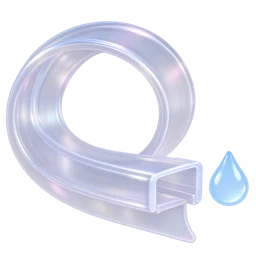
The number refers to the thickness of the glass the seal is designed to grip, not the width of the seal and not the size of the gap. A 6-8 mm seal has a U-shaped channel at the back that pushes onto the edge of the glass. The walls of that channel are spaced to hold glass from 6 mm to 8 mm thick with a firm push fit.
That range covers two common glass sizes in one part. A 6 mm door and an 8 mm door can use the same seal because the channel has enough flex to take up the difference. It is not a loose fit on 6 mm glass, and it is not a force fit on 8 mm glass. The material is usually a soft PVC, sometimes with a harder backing strip to keep the profile straight.
The seal comes in three parts: the channel that grips the glass, the flexible part that closes the gap, and the backing that joins them. When people talk about a bubble, fin or drip seal, they are describing the flexible part. The channel is the same idea on all of them.
Some seals have the glass range moulded into the backing or printed on it. If yours does, read it before you throw the old strip away. If there is no marking, measure the glass and treat the seal as a 6-8 mm part when the reading falls between those figures.
Why does the glass thickness decide the seal?
A seal that is wrong for the glass will fail in a predictable way. The channel either grips too hard or not at all, and the flexible part ends up at the wrong angle to the gap. The table shows what happens with each mismatch.
| Seal range | Fitted to 6-8 mm glass | What you notice |
|---|---|---|
| 4-6 mm | At the limit on 6 mm and impossible on 8 mm | Hard to push on, backing may lift, channel can split at the corner |
| 6-8 mm | Correct fit | Firm push, backing flat against the glass, seal stays put |
| 8-10 mm | Too loose | Slides along the edge, falls off when the door moves, water passes behind |
The failure is not always obvious at first. A loose seal may look fine when the door is open, then shift as soon as the door is closed and the seal meets the wall. A tight seal may go on, then peel away at the ends overnight. If you have to force the seal or it will not stay where you put it, the range is wrong.
How do you measure 6-8 mm shower glass?
Measure the edge of the glass, not the face. Looking through the glass distorts the thickness, and a ruler held against the face reads the gap between reflections rather than the glass itself.
- Open the door and find a clear section of the edge where the seal fits.
- Clean off limescale and old silicone with a limescale remover, then dry the edge.
- Use calipers if you have them. Otherwise hold a steel ruler square against the edge and read the thickness.
- Measure near the top, the middle and the bottom of the door.
- If the readings differ, use the largest one, because the channel has to pass over the thickest point.
Most doors read close to their nominal size, so a 6 mm door measures about 6 mm and an 8 mm door about 8 mm. A reading slightly under the nominal figure is normal, because glass is made to a tolerance and the edge may be polished or chamfered. That is exactly why seals are sold in ranges rather than single sizes.
How do you measure the gap the seal has to close?
The gap is the distance from the glass edge to the surface the seal touches: a wall, a tray upstand, a fixed panel or the other door. Measure it with the door closed, because the door moves as it swings and the gap at the open position is not the gap you need to seal.
Take three readings: near the top, in the middle and near the bottom. Most enclosures are not perfectly square, and a gap that is 4 mm at the top can be 7 mm at the bottom. Start with the widest reading, because a seal that cannot reach the widest point will leak there. Then check the narrowest point: a bubble that is much too big will make the door stiff, and a fin that is too long will fold back on itself.
| What you find | Likely seal | Why |
|---|---|---|
| Small, even gap against a flat surface | Fin seal | The blade can press lightly along the whole edge |
| Gap uneven, or wider than a fin can reach | Bubble seal | The round tube compresses to fill a varying gap |
| Gap along the bottom of the door | Drip seal | The angled lip turns water back into the tray |
| Gap between two doors or a door and a panel | Magnetic pair | The two strips meet and hold the door shut |
Here is how the numbers work in practice. Suppose the gap reads 3 mm at the top, 5 mm in the middle and 7 mm at the bottom. A fin made for a 4 mm gap will touch at the top and miss at the bottom, so water runs past the lower half. A bubble that fills 7 mm will be squeezed hard at the top, which makes the door stiff and can roll the seal out of its backing. The better answer may be a fin plus a small adjustment to the door, or a bubble sized between the two readings and checked with the door closed.
Not sure which one you have?Snap it next to a £1 coin and Sparrow names the exact replacement for shower door seals, with the measurements to check. Your first scan is free.
Get the appBubble, fin or drip: which profile should you buy?
The three profiles do different jobs, and one is not a better version of another. Match the profile to where the water is getting out.
| Profile | How it looks | Best place | What to measure |
|---|---|---|---|
| Bubble | Round hollow tube on a backing | Wall edge, tray upstand, uneven gap | Widest gap and glass thickness |
| Fin (wiper) | Flat flexible blade on a backing | Door edge against a flat panel or wall | Gap and the length of the blade |
| Drip (sweep) | Backing with an angled lip | Bottom edge of the door | Door width and lip direction |
| Magnetic | Two matching strips with a magnet face | Where two doors or a door and panel meet | Angle and glass thickness |
If the old seal is still on the door, look at its cut end. The shape of the flexible part is easy to see there, and the channel width tells you the glass range. Photograph the end with a coin beside it if you want a record for the next time.
When is a bubble seal the right choice?
A bubble seal works by compression. The hollow tube squashes against the wall or tray and fills the gap, even when the gap changes along the door. It is the forgiving option for older enclosures where nothing is quite square.
Choose a bubble diameter a little larger than the widest gap. If the tube is smaller than the gap, it will not touch and water will pass. If it is much larger, the door will be hard to close and the seal will wear through at the contact point. A bubble that is just compressed when the door is shut is about right.
Bubble seals are common along the hinge side and where glass meets a tiled wall. They can also run along a tray upstand. They are less suitable where the door has to slide across the seal, because the friction can roll the tube out of its backing.
When you clean the bathroom, wipe the bubble rather than scrubbing it. Bathroom cleaners and limescale removers left on soft PVC can harden the surface, and a hard bubble stops compressing. Rinse it and leave the door open to dry when you can.
When does a fin seal work better?
A fin seal, also called a wiper seal, is a flat blade that bends against a surface. It uses very little space, so it suits a narrow gap and a door that needs to close easily. The blade should point toward the gap and bend slightly as the door closes.
The fin must be long enough to reach. If the gap is wider than the blade, the fin will pass through the gap without touching anything. That is the most common reason a new fin seal does not stop a leak. Measure the widest gap first, then check the fin length in the listing.
A fin that is too long folds back on itself. When that happens, water can run along the fold and past the seal. If the fin curls instead of bending in a clean arc, trim it square or choose a shorter blade. Never cut a fin at an angle to make it fit.
Fins are often fitted in pairs on a door that meets a fixed panel, with one blade on each side of the glass. If your door has a fin on both faces, replace both, and keep the blades pointing the same way as the originals. A single fin fitted on the wrong face will wipe water toward the outside of the enclosure.
How does a bottom drip seal work on a 6-8 mm door?
The drip seal runs along the bottom edge of the door. It has a backing that pushes onto the glass and a lip that angles down and inward. Water running down the inside face hits the lip and is turned back toward the tray instead of running under the door.
Fit the lip facing into the shower. If it faces outward, it scoops water onto the bathroom floor. On a door with a metal bottom rail, the seal may push into a channel in the rail rather than directly onto the glass. Check how the old one was held before you pull it off.
Cut a drip seal about 2 mm short at each end so it does not catch on the frame or the other door. A seal that is exactly the width of the glass will rub, curl and eventually tear at the corners.
To test the lip direction without soaking the floor, close the door and slide a piece of dry tissue under the outside edge. Run a little water down the inside face of the glass for a few seconds. If the tissue stays dry, the lip is doing its job. If it comes away damp, check the lip before you blame the tray.
Do you need a magnetic seal instead?
If the water escapes where two doors meet, or where a door meets a fixed panel, the edge is probably fitted with a magnetic pair. Those strips look similar to a fin seal but have a flat magnetic face that meets a matching strip on the other pane. They are sold by angle: 90 degrees for a corner join, 135 degrees for an angled enclosure, and 180 degrees for doors that meet in a straight line.
A 6-8 mm magnetic pair is a different part from the bubble, fin and drip seals covered here, even though the glass range is the same. Replace both halves at once, because a new strip will not hold reliably against a worn one. The shower door seal types and sizes guide explains how the angles are measured.
Where does each seal sit on a typical enclosure?
A hinged shower enclosure usually has four edges to think about. Walking round them in order stops you buying two of the wrong thing and none of the right one.
| Edge | Usual seal | What to check |
|---|---|---|
| Bottom of the door | Drip seal | Lip faces into the shower, ends 2 mm short |
| Opening edge, meeting another door or panel | Magnetic pair | Angle and glass range, both halves replaced |
| Hinge edge | Bubble or fin | Gap narrows as the door closes, so leave room for compression |
| Wall or fixed panel | Bubble, fin or silicone | Whether the old joint was a push-on seal or a silicone bead |
The hinge edge is the one people overlook. The gap there changes as the door swings, so a seal that is too fat will make the door stiff and a seal that is too thin will leak when the door is shut. Check the gap in the closed position, not halfway open.
The wall edge may not use a push-on seal at all. Many enclosures have a silicone bead where the glass meets the tiles, and adding a rubber seal over it can trap water behind the frame. If the old arrangement was silicone, replace the silicone rather than inventing a new seal position.
How do you cut a 6-8 mm seal to length?
Cut the seal a few millimetres long, fit it, then trim. It is much easier to take a little off than to add it back.
- Measure the glass edge the seal will cover and add 5 mm.
- Mark the cut with a pencil on the backing, not on the flexible part.
- Lay the seal in a mitre box and cut with a fine-tooth hacksaw, or use a sharp knife on a soft PVC profile.
- Cut square, with light pressure, so the channel does not crush.
- Run a finger along the cut edge to check for burrs, then test the fit before the final trim.
If the seal feels stiff, warm it in a bowl of warm water for a few minutes before cutting. Warm PVC is easier to push onto the glass and less likely to split. Do not use boiling water, which can distort the profile.
Without a mitre box, hold the seal flat on a cutting board and use the factory-cut end of the strip as your guide. A sharp knife works better on soft PVC than a saw, provided you cut in one steady stroke. A saw is the better choice for a hard backing strip, which can tear when cut with a blade.
How do you fit the seal without leaks?
Fitting is mostly preparation. Old silicone, limescale and soap residue all stop the channel seating fully, and a seal that sits proud of the glass leaves a path for water.
- Pull off the old seal and scrape away any silicone stuck to the glass with a plastic scraper.
- Clean the glass edge with limescale remover, rinse and dry it completely.
- Check the new seal is the right way round: fin toward the gap, drip lip into the shower.
- Start at one end and push the channel onto the glass with your thumb, working along in short sections.
- Do not stretch the seal. Stretching makes it pull back at the ends and leaves a gap.
- If it drags, wet the glass edge with a little washing-up liquid in water, then push it on.
- Close the door and check the seal touches along its full length.
- Trim the ends, then run a jug of water along the door to test.
A rubber mallet tapped on a block of wood can help seat a stiff backing, but do not hit the glass directly. Work along the seal rather than forcing one spot.
Why does a new seal still leak?
If water still gets out after fitting, the cause is usually one of a few simple faults. Check them in order before buying another seal.
| What happens | Likely cause | Fix |
|---|---|---|
| Water under the door | Drip lip facing outward, or seal cut too short | Refit with the lip inward, replace if torn |
| Water at the hinge side | Gap wider than the fin can reach | Fit a bubble seal or a longer fin |
| Seal slides along the glass | Wrong glass range, usually 8-10 mm on 6 mm glass | Buy the 6-8 mm part |
| Door hard to close | Bubble too large for the gap | Fit a smaller bubble or a fin |
| Leak at a corner joint | Seals butted with a gap between them | Cut neatly and butt them, or use a maker-approved silicone dab |
| Mould on the seal | Water trapped behind a loose seal | Remove, clean, dry and refit or replace |
Water appearing at the corner of the tray rather than the door is often failed silicone, not a seal. The guide to a shower door leaking at the bottom shows how to tell the difference.
What are the common mistakes?
- Buying by length alone and ignoring the glass range.
- Measuring the gap with the door open, when the door is not in its closed position.
- Cutting the seal to the exact glass width before testing the fit.
- Stretching the seal along the glass so it shrinks back at the ends.
- Fitting a drip seal with the lip facing out of the shower.
- Leaving old silicone or limescale under the new seal.
- Running silicone along the whole seal instead of only where the maker allows.
When should you stop and call a professional?
Stop if the glass is chipped or cracked near the edge, because a seal will not make it safe. Stop if the door hinges are loose and the door no longer hangs square, since a new seal will not close a gap that changes as the door drops. Stop if the leak comes from under the tray, the waste or the wall silicone, which is a plumbing or re-sealing job rather than a seal.
A heavy frameless door that has started to move is awkward to handle. If the door swings on its own or the glass touches the frame, have the enclosure checked by the installer or a bathroom fitter before you use it.
How can Sparrow help you match the seal?
Sparrow is an iPhone app made by ThinkingAI Limited that identifies worn household parts from a photo taken next to a pound coin. Photograph the cut end of the old seal on the glass edge with the coin beside it, and the app estimates the profile and glass range against the coin, shows the matching 6-8 mm seal spec, and links that search UK retailers. If the old seal is missing, the size finder asks a few questions instead. For a closer look at photographing small parts, see how to identify a replacement part from a photo.
Frequently asked questions
What size shower door seal do I need for 6mm glass?
Either a 4-6 mm or a 6-8 mm seal can fit 6 mm glass, but 6-8 mm is the safer buy because it also covers 8 mm doors. A 4-6 mm seal will not fit 8 mm glass.
How do I measure 6mm shower glass?
Measure the edge of the glass with calipers or a ruler, not through the face. Take a reading near the top, middle and bottom, because the edge may be chipped or coated in limescale.
Should I choose a bubble or fin seal?
Choose a bubble seal when the gap is uneven or wider than a fin can reach. Choose a fin seal when the gap is small and the fin can press lightly against a flat surface.
Can I cut a 6-8mm seal to length?
Yes. Most seals come in lengths of about 1900 to 2000 mm and are cut to fit with a fine-tooth hacksaw or a sharp knife. Cut slightly long, test the fit, then trim.
Why does my new shower seal still leak?
The usual causes are a seal cut too short, a seal stretched during fitting, the wrong glass range, or a drip lip facing the wrong way. Check the gap with the door closed before buying another.
Will a 6-8mm seal fit 10mm glass?
No. The channel is too narrow for 10 mm glass, so the seal will not push home and the backing will stand away from the glass. Use a seal rated for 8-10 mm glass instead.
Not sure which one you have?Snap it next to a £1 coin and Sparrow names the exact replacement for shower door seals, with the measurements to check. Your first scan is free.
Get the appParts guides, Sparrow
We build Sparrow, the iPhone app that identifies worn household parts from a photo taken next to a £1 coin. Our guides cover the six parts Sparrow matches: tap cartridges, euro cylinder locks, uPVC window handles, door handles, shower door seals and window hinges. Every size in a guide is checked against the same parts catalogue the app uses.

