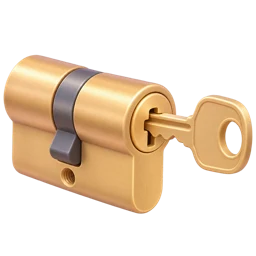
Euro cylinder locks · 14 min read
45/50 Euro Cylinder Thumbturn: Sizing and Fitting

By The Sparrow team · Updated 30 November 2026
Sizes checked against the Sparrow parts catalogue · How we write guides
This is the long one. A 45/50 turns up on doors that are thicker than the uPVC front door the rest of the street has, and on doors where the inside handle backplate stands well off the face. The extra length is useful until the knob starts catching or the outside end stands proud. This guide covers the measurement, the inside clearance, the near-miss sizes that will not fit, and the cases where the shorter 45/45 is the smarter purchase.
What does 45/50 mean?
A 45/50 thumbturn has a key on the outside and a turn knob on the inside. The first number is the distance from the fixing screw centre to the outside end. The second is the distance from the same centre to the inside end.
At 45 mm and 50 mm, the cylinder is 95 mm long overall. The inside is 5 mm longer than the outside, so the screw sits a little outside the midpoint. That small offset is set by the door, not by the lock, and it is why the pair has to be measured rather than guessed.
| Dimension | 45/50 thumbturn | Why it matters |
|---|---|---|
| Outside length | 45 mm | Sets the key end position at the outside handle |
| Inside length | 50 mm | Gives the knob and backplate room |
| Overall length | 95 mm | Shared with no other common pair in this range |
| Screw position | 45 mm from outside | Must match the hole in the door edge |
| Turn side | Inside | The cylinder is built this way round |
Do not confuse the 95 mm overall with the 90 mm of a 40/50 or 45/45. Five millimetres is enough to stop the screw lining up or leave the outside end proud.
Which doors need a 45/50 thumbturn?
The size belongs on doors with a thick slab, deep inside furniture, or both. Composite doors are the most common, especially the heavier styles with a moulded inner skin and a substantial internal handle backplate.
Timber doors with a euro lock case can also take it if the case and furniture add up to 45 mm outside and 50 mm inside. A standard uPVC door rarely does, because the slab and handle depths are smaller.
| Door | Likely to need 45/50? | What pushes the size up |
|---|---|---|
| Thick composite door | Yes | Deep slab and internal backplate |
| Composite door with a bar handle | Sometimes | Handle mounting depth on the inside |
| Timber door with a euro lock | Possible | Lock case position and door thickness |
| Standard uPVC door | Rarely | Usually takes 35/45 or 40/50 |
| Flat entrance door | Possible | Check the fire certificate before changing hardware |
A door being thick does not guarantee a 45/50. The screw position is what counts, and it depends on the lock case and the furniture as well as the slab. Measure before you order, even on a door you have owned for years.
One more clue: if the old cylinder has a long inside end, the door was built for a deep backplate or the handles were changed for deeper ones at some point. That history explains why a door of the same model down the road can take a shorter size.
How to measure for a 45/50
Measure in millimetres from the centre of the fixing screw. If the old cylinder turns, you can measure it in the door. If it is worn or damaged, take it out and measure it on a flat surface.
- Find the fixing screw. It runs through the door edge, level with the keyhole. Remove the cap or trim if there is one.
- Measure to the outside end. Start at the centre of the screw hole and measure to the outside face. You are looking for about 45 mm.
- Measure to the inside end. From the same centre, measure to the inside face where the thumbturn sits. You are looking for about 50 mm.
- Write the pair down. 45/50 means 45 mm outside and 50 mm inside. Do not write the total first.
- Confirm the turn side. The knob should be on the inside end. If it is not, the cylinder is the wrong handing.
- Check the knob clearance. Close the door and turn the knob through its full travel before you spend any money.
Not sure which one you have?Snap it next to a £1 coin and Sparrow names the exact replacement for euro cylinder locks, with the measurements to check. Your first scan is free.
Get the appHow much handle clearance does the knob need?
The longer the inside end, the further the knob stands into the room. That is helpful when the backplate is deep, and a nuisance when the handle is close. Clearance is the check people skip, and it is the one that causes most returns.
With the door closed, the knob needs a full circle of clear space. Look at the inside lever, the backplate, the frame rebate and anything fixed nearby. A door chain, a coat hook or a blind pull can all be in the way.
| What is near the knob | What to check | If it is tight |
|---|---|---|
| Inside lever handle | Gap at every point of the turn | Shorter inside length or a different handle |
| Backplate | Knob stands proud enough to grip | Longer inside length, if the door needs it |
| Door frame | Clearance with the door shut | Check the hinge alignment first |
| Door chain or limiter | Knob completes its turn | Move the fitting or choose key/key |
| Adjacent wall or cupboard | Hand and knob fit in the gap | Consider a key/key cylinder instead |
A knob that rubs is not just annoying. It puts sideways force on the cylinder and can make the key stiff from the outside. If the knob cannot turn freely, the fit is wrong.
Check the clearance again after a few days. Doors settle, hinges wear and a gap that looked fine on the first day can close up. If the knob starts to catch, deal with it before it damages the cylinder.
When the 45/45 is the better buy
The 45/50 and 45/45 share the same outside length and the same screw position. That makes them interchangeable on the same door as far as the fixing screw is concerned. The only difference is 5 mm on the inside.
If the 50 mm end stands too far into the room, puts the knob too close to the handle, or leaves the knob proud of a shallow backplate, the 45/45 can be the better fit. The key side stays exactly where it was.
| Situation | 45/50 | 45/45 |
|---|---|---|
| Deep inside backplate | Good, knob reaches out | May sit recessed |
| Shallow inside backplate | Knob stands proud | Neater fit |
| Handle close to the cylinder | Knob may rub | More clearance |
| Knob hard to grip | Good | May be too short |
| Same door, same screw hole | Fits | Fits |
Do not apply the same logic to the outside. Changing the outside length changes the screw position, so a 45/50 cannot become a 40/50 just because the outside stands proud. If the outside is wrong, the door needs the size it was built for.
Which sizes look close but will not fit?
Several cylinders in this range sit within 5 mm of each other. None of them are interchangeable unless the outside length matches, because the fixing screw has to meet the tapped hole in the body.
| Size | Overall | Outside | Inside | Same screw position as 45/50? |
|---|---|---|---|---|
| 45/50 | 95 mm | 45 mm | 50 mm | Yes, this is the reference |
| 45/45 | 90 mm | 45 mm | 45 mm | Yes, inside 5 mm shorter |
| 40/50 | 90 mm | 40 mm | 50 mm | No, outside 5 mm shorter |
| 50/50 | 100 mm | 50 mm | 50 mm | No, outside 5 mm longer |
The 40/50 is the one that catches people, because the inside length is identical and the overall is only 5 mm different. The outside length is the part that decides whether the screw lines up.
If you are replacing a cylinder and the old one was 40/50, do not assume the door can take a 45/50 because the door is thick. The screw hole in the door is the fixed point, and it was set for a 40 mm outside length.
Checking the door edge and lock case
Before you order, look at the door edge around the fixing screw. The screw should pass through a clean hole and into the cylinder without forcing. If the hole is elongated, oval or full of filler, the cylinder may not sit securely even when the size is right.
Check the lock case behind the cylinder too. A case that has slipped, or a door that has dropped, can make a new cylinder feel tight. The cylinder is only one part of the locking system, and the 45/50 is long enough that a small misalignment is easier to feel.
If the door edge is damaged, have it repaired before fitting a new cylinder. A lock that is held by a loose screw in a damaged hole will work its way free.
Can new handles change the size you need?
Yes. The cylinder is measured to the face of the handle or backplate, so changing the handles can change the length the cylinder has to reach. A deeper backplate pushes the face further from the screw, and a shallower one brings it closer.
This matters when you replace handles and a lock at the same time. Fit the new handles first, then measure to the new faces. Measuring to the old handles and ordering the old size can leave the new cylinder standing proud or sitting short.
| Change | Effect on the required length | What to do |
|---|---|---|
| Deeper outside backplate | Outside length may need to increase | Measure to the new face before ordering |
| Shallower outside backplate | Outside length may need to decrease | Check the screw position, not just the length |
| Deeper inside backplate | Inside length may need to increase | Check the knob still clears the handle |
| Shallower inside backplate | Inside length may need to decrease | Check the knob is still easy to grip |
Cylinders come in fixed pairs, so a handle change can push you to a different pair, and that pair has its screw hole in a different place along the body. That is why the old size cannot always be reused after new furniture goes on. Measure once with the new handles fitted, not twice with the old ones.
Ordering the thumbturn the right way round
The knob must be on the inside end. A thumbturn cylinder is built with the turn mechanism at one end and the keyway at the other, so it cannot be reversed like a centred key/key body.
When the cylinder arrives, hold it up before you fit it. The knob should face the room and the key should face outside. If the two are the wrong way round, the cylinder is the wrong handing and should go back.
On a 45/50 the inside end is the longer one, which makes the handing easy to check with a ruler. The 50 mm side takes the knob. If the knob is on the 45 mm side, stop and query the order.
Which rating should a long thumbturn cylinder have?
TS007 is the UK standard for replacement euro cylinders and associated door hardware. Three stars means the cylinder is rated on its own. One star means it only reaches the same level with 2-star handles.
Sold Secure SS312 Diamond is an independent test with Diamond as its highest grade. The outside end is the part exposed on the door face, so check the rating rather than assuming a longer cylinder is stronger.
| Marking | What it covers | What to check on a 45/50 |
|---|---|---|
| TS007 3-star | Cylinder rated alone | Marked on the body or box |
| TS007 1-star | Rated with 2-star handles | The handles carry the matching mark |
| SS312 Diamond | Independent top grade | Shown alongside TS007 |
| No marking | No stated rating | Accept only if you want a basic lock |
For a plain explanation of snapping and what the stars change, see anti-snap euro cylinder locks explained.
What to check before you order
- The pair. 45 mm outside and 50 mm inside, not 95 mm overall.
- The screw position. 45 mm from the outside end, matching the old body.
- The handing. Knob on the inside end, key on the outside.
- The inside clearance. The knob turns without rubbing once the door is shut.
- The outside fit. Sitting flush with the handle, or standing no more than about 3 mm proud.
- The rating. TS007 3-star or SS312 Diamond if you want a security-rated cylinder in this size.
- The finish. Match the handle, and check the knob finish matches too.
- The keys. Count them before ordering, especially if the cylinder is part of a keyed-alike set.
- The door. Check the edge, the lock case and the hinges for damage or movement.
Fitting a 45/50 thumbturn
Work with the door open and keep the old cylinder beside you for comparison. The sequence is the same as any euro cylinder, with extra care around the longer body.
- Compare the two cylinders. The lengths, screw hole and knob end should all match.
- Put the key in and align the cam, the lever that throws the lock. A slight turn lines the cam up with the body.
- Slide the cylinder in. The 50 mm end goes to the inside. Keep the key in until it is through the door.
- Line up the fixing screw. Sight through the edge hole and line up the thread.
- Fit the screw. Hand tight first, then snug. Stop before the body distorts.
- With the door still open, turn the knob. It should move through its full travel without catching.
- Test the key from outside. The key should turn smoothly and throw the cam.
- Shut the door and repeat the checks. Check the knob clears the handle and frame, then check the door locks and unlocks.
If the door has been rehung or the hinges have dropped, fit the cylinder with the door open and check the alignment carefully. A long cylinder can feel tight if the door is out of square, even when the size is correct.
After fitting, keep the old cylinder until you have used the door for a week. If a fault appears, comparing the old and new bodies side by side tells you whether the size, the handing or the door is to blame.
Troubleshooting a 45/50 thumbturn
| Symptom | Probable cause | What to check |
|---|---|---|
| Knob catches the handle | Inside length too long, or handle too close | Clearance with the door closed, then consider 45/45 |
| Knob sits recessed and is hard to grip | Inside length too short | Whether a 45/50 is actually needed |
| Key is stiff | Screw over-tightened or cylinder binding | Slacken the screw slightly and retest |
| Key will not turn while the knob moves | Knob left between positions | Turn the knob fully to its stop |
| Outside end stands proud | Outside length too long for the door | The screw position and the door size |
| Door will not lock | Handle, gearbox or door alignment | The mechanism, not just the cylinder |
If the knob works but the door will not lock, the cylinder is probably not the fault. Check the handle and the multipoint gearbox before you buy another lock. The gearbox drives the hooks and bolts along the door edge.
Common mistakes with a 45/50
- Buying a 40/50 because the inside length is the same.
- Assuming the thickest door in the house needs the longest cylinder.
- Ordering a thumbturn without checking the handing.
- Forgetting to test knob clearance with the door closed.
- Rounding a 45/45 up to 45/50 without checking the inside fit.
- Copying a cylinder that already stood proud outside.
- Choosing on price before checking the security rating.
One more: ordering the same size for a front and back door because they look alike. The handles and slab can differ, and the back door may need a shorter cylinder on the inside.
When to stop and call a locksmith
Stop if the door is locked shut, the cylinder has snapped, or the key has broken inside the lock. Those are jobs for a locksmith, and forcing the door can damage the multipoint mechanism.
Call a professional if the cylinder spins, if the lock case grinds or if the door is a fire door. Fire door hardware is decided by the door certificate and a qualified installer, not by the cylinder packaging.
If the door opens and the thumbturn is simply worn, a 45/50 replacement in the right handing is a manageable DIY swap.
If the door has to be lifted or pushed to lock, stop before changing the cylinder. That is a sign of a dropped door or a worn hinge, and a new lock will not fix it. Adjusting the hinges or replacing worn ones is the better first step.
Recording the size and checking it again
Write down the size, the handing and the date. A photo of the old cylinder next to a ruler, taken before it goes in the bin, is the quickest record and saves measuring the door again.
If the door has more than one lock, or you look after several properties, keep the details together. The replacement parts record is a simple format for that.
Sparrow is an iPhone app made by ThinkingAI Limited that identifies worn household parts from a photo taken next to a one pound coin. Photograph the door edge with the coin flat against it so the cylinder and screw are visible, and the app estimates the outside and inside lengths and shows the matching spec. It is a second opinion on the size, not a substitute for checking the knob clearance yourself.
For the other cylinder lengths and how they relate, see the euro cylinder sizes chart. If the old lock is still in the door, the measuring guide shows how to take the reading without removing it.
Frequently asked questions
What does 45/50 mean on a thumbturn?
45 mm from the centre of the fixing screw to the outside end and 50 mm to the inside end, so 95 mm overall. The thumbturn knob sits on the 50 mm side, inside the house.
Which doors use a 45/50 thumbturn?
Thick composite doors, timber doors with deep internal furniture and some doors with a deep inside backplate. It is a size for doors that need more length than a standard uPVC door.
Is 45/50 the same as 45/45?
No, but they share the same 45 mm outside length and screw position. A 45/45 is 5 mm shorter on the inside, so it can be the better choice if the 50 mm knob stands too far into the room.
Can I swap a 45/50 for a 40/50?
No. Both have a 50 mm inside length, but the outside length and screw position differ by 5 mm. The fixing screw will not line up.
Can the thumbturn go on the outside?
No. The knob is made for the inside face. Order the cylinder with the turn on the inside or it will not fit the door correctly.
What if the knob hits the handle?
Check the gap with the door closed. A shorter inside length, such as 45/45, may help, or the handle may need moving or replacing. Do not force the knob past the handle.
Not sure which one you have?Snap it next to a £1 coin and Sparrow names the exact replacement for euro cylinder locks, with the measurements to check. Your first scan is free.
Get the appParts guides, Sparrow
We build Sparrow, the iPhone app that identifies worn household parts from a photo taken next to a £1 coin. Our guides cover the six parts Sparrow matches: tap cartridges, euro cylinder locks, uPVC window handles, door handles, shower door seals and window hinges. Every size in a guide is checked against the same parts catalogue the app uses.

